
| Date | 18th, Sep 2021 |
|---|
Home > Press > Scientists demonstrate pathway to forerunner of nanotubes that could lead to widespread industrial fabrication
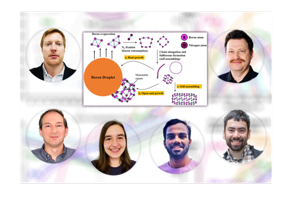 Author and co-authors with figure from paper. Clockwise from top left: Lead author Yuri Barsukov with co-authors Igor Kaganovich, Alexander Khrabry, Omesh Dwivedi, Sierra Jubin, Stephane Ethier.
CREDIT
Batalova Valentina, Elle Starkman/Office of Communications, Elle Starkman, Han Wei, Hannah Smith, Elle Starkman. Collage by Elle Starkman.
Author and co-authors with figure from paper. Clockwise from top left: Lead author Yuri Barsukov with co-authors Igor Kaganovich, Alexander Khrabry, Omesh Dwivedi, Sierra Jubin, Stephane Ethier.
CREDIT
Batalova Valentina, Elle Starkman/Office of Communications, Elle Starkman, Han Wei, Hannah Smith, Elle Starkman. Collage by Elle Starkman.
Abstract: Scientists have identified a chemical pathway to an innovative insulating nanomaterial that could lead to large-scale industrial production for a variety of uses � including in spacesuits and military vehicles. The nanomaterial -- thousands of times thinner than a human hair, stronger than steel and noncombustible -- could block radiation to astronauts and help shore up military vehicle armor, for example.
Princeton, NJ | Posted on September 17th, 2021
Collaborative researchers at the U.S. Department of Energy�s (DOE) Princeton Plasma Physics Laboratory (PPPL) have proposed a step-by-step chemical pathway to the precursors of this nanomaterial, known as boron nitride nanotubes (BNNT), which could lead to their large-scale production.
�Pioneering work�
The breakthrough brings together plasma physics and quantum chemistry and is part of the expansion of research at PPPL. �This is pioneering work that takes the Laboratory in new directions,� said PPPL physicist Igor Kaganovich, principal investigator of the BNNT project and co-author of the paper that details the results in the journal Nanotechnology.
Collaborators identified the key chemical pathway steps as the formation of molecular nitrogen and small clusters of boron, which can chemically react together as the temperature created by a plasma jet cools, said lead author Yuri Barsukov of the Peter the Great St. Petersburg Polytechnic University. He developed the chemical reaction pathways by performing quantum chemistry simulations with the assistance of Omesh Dwivedi, a PPPL intern from Drexel University, and Sierra Jubin, a graduate student in the Princeton Program in Plasma Physics.
The interdisciplinary team included Alexander Khrabry, a former PPPL researcher now at Lawrence Livermore National Laboratory who developed a thermodynamic code used in this research, and PPPL physicist Stephane Ethier who helped the students compile the software and set up the simulations.
The results solved the mystery of how molecular nitrogen, which has the second strongest chemical bond among diatomic, or double-atom molecules, can nonetheless break apart through reactions with boron to form various boron-nitride molecules, Kaganovich said. �We spent considerable amount of time thinking about how to get boron - nitride compounds from a mixture of boron and nitrogen,� he said. �What we found was that small clusters of boron, as opposed to much larger boron droplets, readily interact with nitrogen molecules. That�s why we needed a quantum chemist to go through the detailed quantum chemistry calculations with us.�
BNNTs have properties similar to carbon nanotubes, which are produced by the ton and found in everything from sporting goods and sportswear to dental implants and electrodes. But the greater difficulty of producing BNNTs has limited their applications and availability.
Chemical pathway
Demonstration of a chemical pathway to the formation of BNNT precursors could facilitate BNNT production. The process of BNNT synthesis begins when scientists use a 10,000-degree plasma jet to turn boron and nitrogen gas into plasma consisting of free electrons and atomic nuclei, or ions, embedded in a background gas. This shows how the process unfolds:
� The jet evaporates the boron while the molecular nitrogen largely stays intact;
� The boron condenses into droplets as the plasma cools;
� The droplets form small clusters as the temperature falls to a few thousand degrees;
� The critical next step is the reaction of nitrogen with small clusters of boron molecules to form boron-nitrogen chains;
� The chains grow longer by colliding with one another and fold into precursors of boron nitride nanotubes.
�During the high-temperature synthesis the density of small boron clusters is low,� Barsukov said. �This is the main impediment to large-scale production.�
The findings have opened a new chapter in BNNT nanomaterial synthesis. �After two years of work we have found the pathway,� Kaganovich said. �As boron condenses it forms big clusters that nitrogen doesn�t react with. But the process starts with small clusters that nitrogen reacts with and there is still a percentage of small clusters as the droplets grow larger,� he said.
�The beauty of this work,� he added, �is that since we had experts in plasma and fluid mechanics and quantum chemistry we could go through all these processes together in an interdisciplinary group. Now we need to compare possible BNNT output from our model with experiments. That will be the next stage of modeling.�
Support for this research comes from the DOE Office of Science.
####
About PPPLPPPL, on Princeton University's Forrestal Campus in Plainsboro, N.J., is devoted to creating new knowledge about the physics of plasmas � ultra-hot, charged gases � and to developing practical solutions for the creation of fusion energy. The Laboratory is managed by the University for the U.S. Department of Energy�s Office of Science, which is the single largest supporter of basic research in the physical sciences in the United States and is working to address some of the most pressing challenges of our time.
For more information, please click here
Contacts:John GreenwaldDOE/Princeton Plasma Physics Laboratory
Office: 609-243-2672
Copyright © PPPL
If you have a comment, please Contact us.
Issuers of news releases, not 7th Wave, Inc. or Nanotechnology Now, are solely responsible for the accuracy of the content.
Bookmark:


Laboratories
 University of Illinois Chicago joins Brookhaven Lab's Quantum Center June 10th, 2022
News and information
University of Illinois Chicago joins Brookhaven Lab's Quantum Center June 10th, 2022
Organic water splitters get a boost June 10th, 2022
Govt.-Legislation/Regulation/Funding/Policy
University of Illinois Chicago joins Brookhaven Lab's Quantum Center June 10th, 2022
Bumps could smooth quantum investigations: Rice University models show unique properties of 2D materials stressed by contoured substrates June 10th, 2022
Nanostructured fibers can impersonate human muscles June 3rd, 2022
Possible Futures
Electron-phonon coupling assisted universal red luminescence of o-phenylenediamine-based CDs June 10th, 2022
Marching to the Cadence of Electronics: Innovation A new paper in Nature validates technology developed by John Bowers and collaborators June 10th, 2022
Small materials may be key to reducing cardiovascular disease deaths, researchers say June 10th, 2022
Decoding a key part of the cell, atom by atom June 10th, 2022
Nanotubes/Buckyballs/Fullerenes/Nanorods
Nanotubes: a promising solution for advanced rubber cables with 60% less conductive filler June 1st, 2022
Protective equipment with graphene nanotubes meets the strictest ESD safety standards March 25th, 2022
CEA and Startup C12 Join Forces to Develop Next-Generation Quantum Computers with Multi-Qubit Chips at Wafer Scale March 25th, 2022
Discoveries
Electron-phonon coupling assisted universal red luminescence of o-phenylenediamine-based CDs June 10th, 2022
Marching to the Cadence of Electronics: Innovation A new paper in Nature validates technology developed by John Bowers and collaborators June 10th, 2022
Small materials may be key to reducing cardiovascular disease deaths, researchers say June 10th, 2022
Decoding a key part of the cell, atom by atom June 10th, 2022
Materials/Metamaterials
Nanotubes: a promising solution for advanced rubber cables with 60% less conductive filler June 1st, 2022
New route to build materials out of tiny particles May 27th, 2022
A one-stop shop for quantum sensing materials May 27th, 2022
Announcements
Organic water splitters get a boost June 10th, 2022
Interviews/Book Reviews/Essays/Reports/Podcasts/Journals/White papers/Posters
Decoding a key part of the cell, atom by atom June 10th, 2022
Organic water splitters get a boost June 10th, 2022
Military
Bumps could smooth quantum investigations: Rice University models show unique properties of 2D materials stressed by contoured substrates June 10th, 2022
Nanostructured fibers can impersonate human muscles June 3rd, 2022
Lightening up the nanoscale long-wavelength optoelectronics May 13th, 2022
Aerospace/Space
University of Strathclyde and National University of Singapore to co-ordinate satellite quantum communications May 13th, 2022
Lightening up the nanoscale long-wavelength optoelectronics May 13th, 2022
Studying atomic structure of aluminum alloys for manufacturing modern aircraft March 25th, 2022
