
| Date | 25th, Sep 2021 |
|---|
Home > Press > Nanocellulose decorated with proteins is suitable for 3D cell culturing
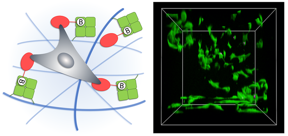 Schematic presentation showing avidin-conjugated nanocellulose fibers functionalized with biotinylated adhesive protein. 3D cell culture of fibroblast cells. Live-dead staining indicates high cell viability.
CREDIT
Reprinted with permission from Leppiniemi et al. Biomacromolecules. Copyright 2021 American Chemical Society.
Schematic presentation showing avidin-conjugated nanocellulose fibers functionalized with biotinylated adhesive protein. 3D cell culture of fibroblast cells. Live-dead staining indicates high cell viability.
CREDIT
Reprinted with permission from Leppiniemi et al. Biomacromolecules. Copyright 2021 American Chemical Society.
Abstract: Wood-derived cellulose nanofibers form a hydrogel in water, referred to as nanocellulose, which is a highly promising material for various biological applications. However, nanocellulose is rather simple in terms of chemical composition compared to the natural environment of cells in living tissue. To enable the tailoring of nanocellulose-based hydrogels, researchers from Tampere University in Finland, in collaboration with researchers from UPM Biomedicals, developed avidin-conjugated nanocellulose. Such material enables the attachment of biotinylated molecules on avidin-conjugated nanocellulose fibers.
Kauppi, Finland | Posted on September 24th, 2021
�We utilized a protein named avidin � which is originally isolated from chicken eggs � that binds the biotin vitamin with extremely high affinity. Biotin can be chemically attached to various biomolecules without compromising its activity�, says Postdoctoral Researcher Jenni Leppiniemi, who is the principal investigator in the project working in a group led by Professor Vesa Hyt�nen.
�The benefit of avidin-conjugated nanocellulose is that it can be tailored and functionalized as necessary by choosing different biotinylated molecules for different applications,� Leppiniemi explains. When the avidin-conjugated nanocellulose fibers were functionalized with biotinylated proteins originating from extracellular matrix, a 3D hydrogel was obtained, which offers plausible attachment sites for cells. The cells were found to proliferate quicker in the functionalized hydrogel compared to bare nanocellulose, and the cell viability remained high during the experiment.
These findings indicate that the developed material was highly suitable for the 3D culturing of cells. The cells also showed signs of being associated with efficient integrin signaling indicating that they have the capacity to attach tightly to functionalized nanocellulose.
Avidin-conjugated nanocellulose offers promising possibilities for applications requiring tailored hydrogels, such as cell differentiation and tissue engineering. Product Development Scientist Piia Mikkonen from UPM Biomedicals suggests that the developed material could be a potential alternative to animal-derived hydrogel materials, which are complicated in their composition and poorly defined chemically.
###
The results of the project were published in the Biomacromolecules journal.
Jenni Leppiniemi, Zeeshan Mutahir, Alexander Dulebo, Piia Mikkonen, Markus Nuopponen, Paula Turkki, and Vesa Hyt�nen: Avidin-Conjugated Nanofibrillar Cellulose Hydrogel Functionalized with Biotinylated Fibronectin and Vitronectin Promotes 3D Culture of Fibroblasts
####
For more information, please click here
Contacts:Pirjo AchteTampere University
Office: 358-504-336-290
Copyright © Tampere University
If you have a comment, please Contact us.
Issuers of news releases, not 7th Wave, Inc. or Nanotechnology Now, are solely responsible for the accuracy of the content.
Bookmark:


News and information
 �Fruitcake� structure observed in organic polymers June 3rd, 2022
Progressive Medicinal and Herbal Nanoscience for Targeted Drug Delivery Systems June 3rd, 2022
Artificial Intelligence Centered Cancer Nanomedicine: Diagnostics, Therapeutics and Bioethics June 3rd, 2022
Hydrogels
The deformation of the hydrogel is used to measure the negative pressure of water April 22nd, 2022
A chameleon-inspired smart skin changes color in the sun September 11th, 2019
Researchers grow cells in 'paper organs' May 1st, 2019
Possible Futures
Nanoscale bowtie antenna under optical and electrical excitations June 3rd, 2022
Emerging vaccine nanotechnology June 3rd, 2022
�Fruitcake� structure observed in organic polymers June 3rd, 2022
Progressive Medicinal and Herbal Nanoscience for Targeted Drug Delivery Systems June 3rd, 2022
Discoveries
Nanoscale bowtie antenna under optical and electrical excitations June 3rd, 2022
Emerging vaccine nanotechnology June 3rd, 2022
�Fruitcake� structure observed in organic polymers June 3rd, 2022
Materials/Metamaterials
Nanotubes: a promising solution for advanced rubber cables with 60% less conductive filler June 1st, 2022
New route to build materials out of tiny particles May 27th, 2022
A one-stop shop for quantum sensing materials May 27th, 2022
Announcements
�Fruitcake� structure observed in organic polymers June 3rd, 2022
Progressive Medicinal and Herbal Nanoscience for Targeted Drug Delivery Systems June 3rd, 2022
Artificial Intelligence Centered Cancer Nanomedicine: Diagnostics, Therapeutics and Bioethics June 3rd, 2022
Interviews/Book Reviews/Essays/Reports/Podcasts/Journals/White papers/Posters
�Fruitcake� structure observed in organic polymers June 3rd, 2022
Progressive Medicinal and Herbal Nanoscience for Targeted Drug Delivery Systems June 3rd, 2022
Artificial Intelligence Centered Cancer Nanomedicine: Diagnostics, Therapeutics and Bioethics June 3rd, 2022
