
The special properties of cell membrane-coated biomimetic nanoparticles (NPs) have attracted extensive studies in the field of nanomedicine. These properties include long blood circulation, immune escaping, specific molecular recognition and efficient cancer targeting, indicating a great potential in targeted cancer therapy.
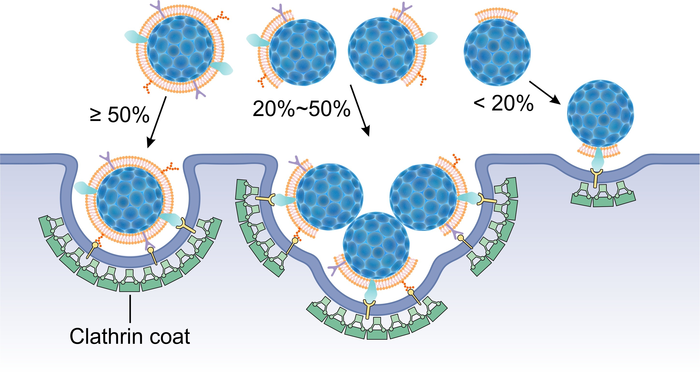 Schematic illustration of a possible endocytic entry mechanism for partially coated NPs. Image Credit: Lizhi Liu.
However, the integrity of the cell membrane coating on NPs, known as key metrics connected to the quality of such biomimetic systems and the consequent biomedical function, has remained largely undiscovered. Scientists in their current study have come up with a fluorescence quenching assay to probe the integrity of the cell membrane coating.
The study published in the Nature Communications journal illustrates that the significant majority of the cell membrane-coated NPs were just partially coated when the conventional coating methods were employed.
The data is essential as the coating degree affects the NPs’ biological fate. The study was performed at the University of Eastern Finland, Department of Applied Physics, in Professor Vesa-Pekka Lehto’s research group.
The present methods for characterizing the cell membrane coating are only qualitative and fail to statistically evaluate the degree and variability of the coating. When we applied the developed quantification method to evaluate the success of the commonly used protocols to produce fully coated NPs, we found that the fraction never exceeded 20%.
Lizhi Liu, Study First Author, University of Eastern Finland
“Our discovery is a big surprise to whole scientific community in nanomedicine because it has been generally accepted that the cell membrane coating is perfect. Despite of the partial coating, biomimetic NPs could still be internalized by the target cells via different pathways,” stated Dr. Wujun Xu, one of the corresponding authors of the paper.
For this process to be explained, the authors suggested a new endocytic entry mechanism for such partially coated NPs by computational simulations. Particularly, the NPs with a high coating degree (≥50%) penetrated the cells separately, whereas the NPs with a low coating degree (
