
Tests showed that the approach enhanced photon upconversion eleven thousand-fold.
Highly luminescent lanthanide-doped nanocrystals are desirable for use in biomedical applications and optical imaging. However, a large portion of lanthanide dopants reside on the surface or subsurface layers of the nanocrystal, forming a dark, nonluminescent layer.
As the size of the nanocrystal decreases, its photoluminescence becomes weakened by surface quenching. Although previous studies concur that excitation energy loss in the crystal is due primarily to surface quenching, the mechanism underlying this phenomenon is poorly understood.
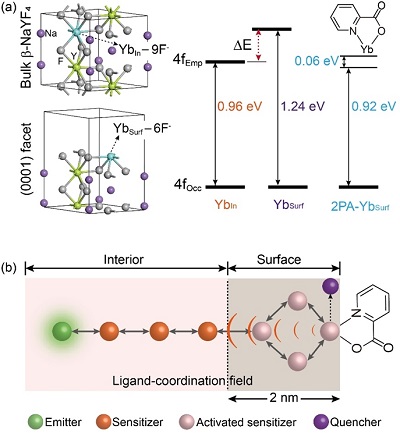
The NUS team, led by professor Xiaogang Liu and professor Hui Xu from Heilongjiang University in China, enhanced multiphoton upconversion in sub-10-nm crystals. The team used a molecule-mediated approach to surface reconstruction and reconstructed orbital hybridization and crystal field splitting in surface lanthanides via ligand coordination. The ligand coordination activated the sensitizer-containing dark layer of the crystal and facilitated the energy migration between the surface and the inner lanthanide sensitizers, amplifying excitation energy and improving upconversion efficiency.
Mechanistic studies indicated that reconstructing orbital hybridization and crystal-field splitting via surface ligand coordination minimized the energy difference between the 4f orbitals of the surface and inner lanthanide sensitizers. The 4f-orbital energy resonance enabled energy migration within the ytterbium sublattice, which impeded energy diffusion to surface defects and ultimately enhancing energy transfer to the emitters.
The researchers further found that ligand coordination could exert energy-level reconstruction with a ligand-sensitizer separation distance of over 2 nm.
When NaGdF4:Yb/Tm nanoparticles, 5 nm in diameter, were coordinated with bidentate picolinic acid molecules, the nanoparticles demonstrated an upconversion amplification in the ultraviolet (UV) region of up to eleven thousand-fold.
“Our approach has demonstrated a simple and effective strategy for upconversion luminescence enhancement. Molecule coordination neither changes the size and morphology of nanocrystals nor requires complex instrumentation,” Liu said. “These bright, ultrasmall upconversion nanoparticles hold potential in achieving superresolution imaging, intraneuronal axon transport tracking, and imaging-guided precision diagnosis at the single-particle level.”
The research was published in Nature Photonics (www.doi.org/10.1038/s41566-021-00862-3).
