
The slide incorporates layers of finely printed metals on a glass surface to manipulate the way light interacts with cells. The result is a drastically enhanced contrast, which the researchers have compared to the jump from black-and-white television to color television.
“For the first time I saw cancer cells just popping up at me,” Parker said. “All we did was take a section of breast cancer tissue, put it on a glass slide, and look at it under a conventional light microscope. And we could easily distinguish cancer cells from the surrounding normal tissue. The slide also distinguishes cancer from other noncancerous abnormalities in the breast, which has great promise for early cancer diagnosis.”
Searching for just a few cancer cells hiding in the midst of hundreds of healthy cells is a difficult task, like trying to find a needle in a haystack, Abbey said. “So what our technology aims to do is to make this process much easier and quicker for the pathologist by identifying abnormal cancer cells from a field of thousands.”
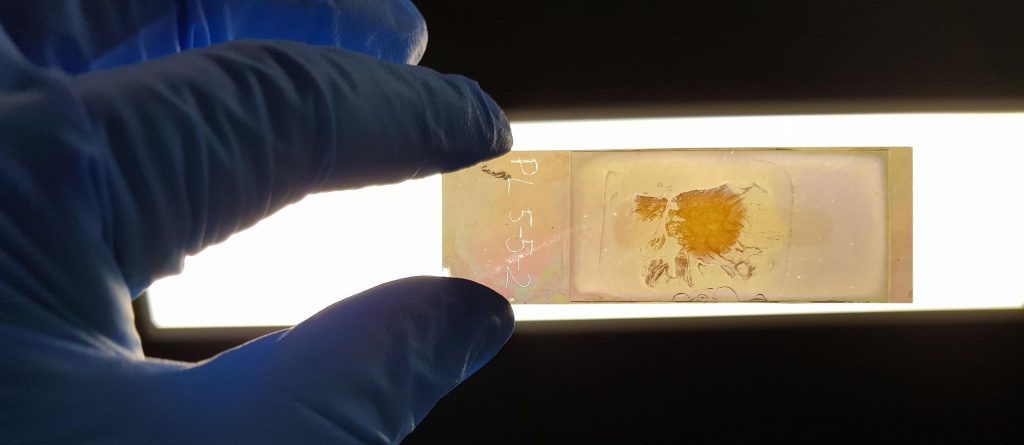
“But until recently, we lacked a key piece of equipment, meaning that we had to post our slides to Europe for additional processing,” Abbey said.
The equipment in question, a lithography system capable of printing high-resolution nanostructures, has since been acquired by ANFF and La Trobe University.
“Now, having that equipment here as a first in Australia, it means that we’re able to carry out all of our fabrication locally, and instead of producing tens of slides we’re now able to manufacture them in the thousands,” said Nicolas Voelcker, director for the Victorian Node of the ANFF.
“Our vision is to extend our technology to assist the diagnosis of a range of other cancers by analyzing all sorts of tissue sections, as well as use in plant biology and agriculture. And now we can do it all in Melbourne,” Abbey said.
“Based on our preliminary findings with the NanoMslide, we think this platform could be really useful in early breast cancer diagnosis, but also in other cancers where we’re really just trying to pick up a few cancer cells in a complex tissue or a blood sample,” Parker said.
The research was published in Nature (www.doi.org/10.1038/s41586-021-03835-2).
