
The team’s approach uses simple thin-film deposition, one of the most mature nanofabrication techniques, and is aided by key advances in materials and machine learning.
Applications for the work include sensing, free space communications, and detection.
Standard thermal emitters, such as incandescent light bulbs, generate broadband thermal radiation that restricts their use to simple applications. In contrast, lasers and LEDs offer the narrow frequency emission necessary for many applications, but are often inefficient and/or expensive. This has directed research toward wavelength-selective thermal emitters to provide the narrow bandwidth of a laser or LED, but with the simple design of a thermal emitter. However, to date most thermal emitters with user-defined output spectra have required patterned nanostructures fabricated through expensive low-throughput methods.
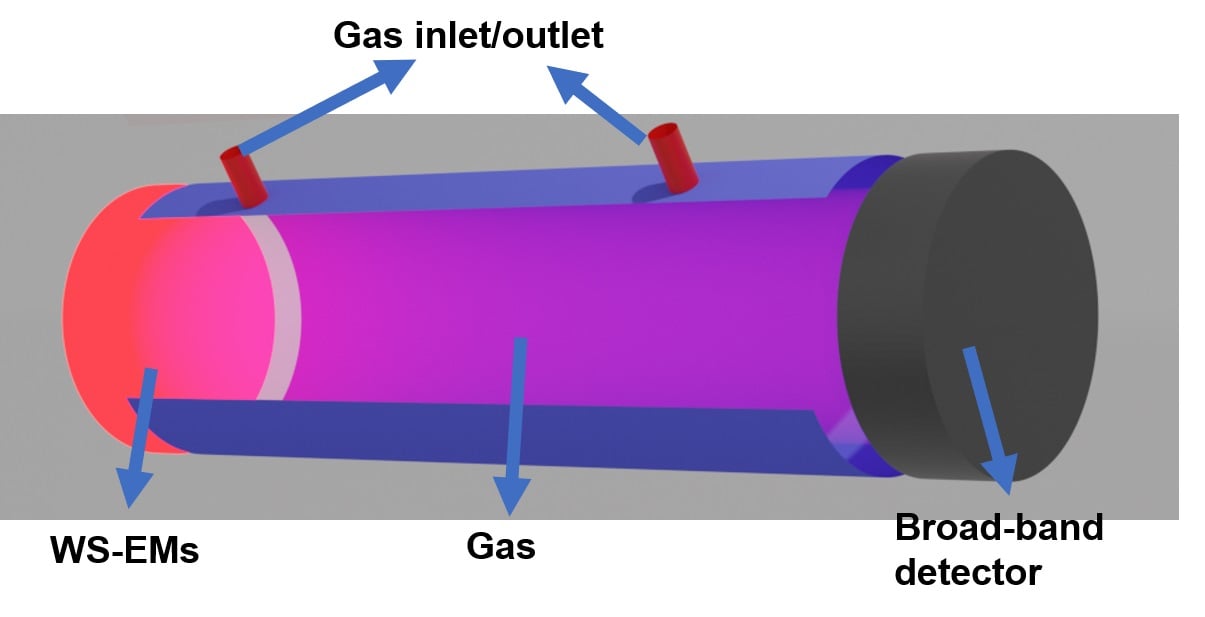
The combination of these multiple layers of materials gives rise to a so-called Tamm-polariton, where the emission wavelength of the device is dictated by the interactions between the layers. Until now such designs were limited to a single designated wavelength output. But creating multiple resonances at multiple frequencies with user-controlled wavelength linewidth and intensity is imperative for matching the absorption spectra of most molecules.
However, material design has been challenging and computationally intense. Because advanced applications require functionality at multiple resonances, the new process had to drastically shorten design time. A typical device, for example, would contain tens to hundreds of designable parameters, creating high customization demands requiring unrealistic computation times. In a scenario that independently optimizes nine parameters, sampling 10 points per parameter, the simulations would take 15 days assuming 100 simulations per second. With more parameters, the time increases exponentially — 11 and 12 parameters would require three and 31 years, respectively.
To address this challenge, Mingze He, lead author of the paper, proposed an inverse design algorithm that computes an optimized structure within minutes on a consumer-grade computer. Further, the code could provide the ability to match the desired emission wavelength, linewidth, and amplitude of multiple resonances simultaneously over an arbitrary spectral bandwidth.
Another hurdle was identifying a semiconductor material capable of allowing a large dynamic range of electron densities. For this, the team used doped semiconductor material, developed by Maria’s research team at Penn State, which allows intentional design of optical properties.
“This allows the fabrication of advanced mid-infrared light sources at wafer-scale with very low cost and minimal fabrication steps,” He said.
This experimental section was conducted with Penn State collaborators while the devices were characterized by He and J. Ryan Nolen, a recent graduate of the Caldwell group. Together, the teams demonstrated the capability of inversely designed infrared light sources.
“The combination of the cadmium oxide material tunability with the fast optimization of aperiodic distributed Bragg reflectors offers the potential to design infrared light sources with user-defined output spectra. While these have immediate potential in chemical sensing, these also exhibit significant promise in a variety of other applications ranging for environmental and remoted sensing, spectroscopy, and infrared signaling and communications,” Caldwell said.
The research was published in Nature Materials (www.doi.org/10.1038/s41563-021-01094-0).
