
The team generated the new “clean” layer by oxidizing a single atomic layer of another 2D material, tungsten selenide. When team members layered TOS on top of the graphene, they found that it left the graphene riddled with electricity-conducting holes. The holes could be fine-tuned to better control the materials’ electricity-conducting properties by adding a few atomic layers of tungsten selenide between the TOS and graphene.
The researchers found that graphene’s electrical mobility, or how easily charges move through it, was higher with their new doping method than previous attempts. Adding tungsten selenide spacers further increased the mobility, to the point where the effect of the TOS became negligible. This left mobility to be determined by the intrinsic properties of graphene itself.
This combination of high doping and high mobility gives graphene greater electrical conductivity than that of highly conductive metals, including copper and gold.
As the ability of the doped graphene to conduct electricity improved, the transparency of the graphene also increased, due to Pauli blocking — a phenomenon where charges manipulated by doping block the material from absorbing light.
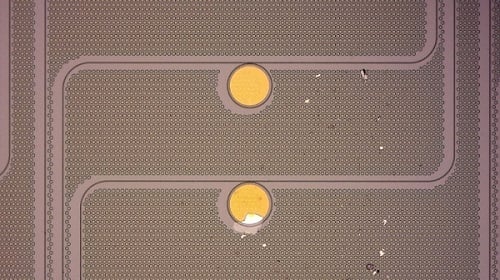
Achieving a high rate of transparency and conductivity is crucial to the ability to move information through light-based photonic devices; if too much light is absorbed, information becomes lost. The team found a much smaller loss for TOS-doped graphene than for other conductors, which suggested that the new method could hold potential for next-generation ultra-efficient photonic devices.
One promising direction for the research involves altering graphene’s electronic and optical properties by changing the pattern of the TOS, and imprinting electrical circuits directly on the graphene itself. The research team is also working to integrate the doped material into novel photonic devices, with potential applications in transparent electronics, telecommunications systems, and quantum computers.
The research was published in Nature Electronics (www.doi.org/10.1038/s41928-021-00657-y).
