
Fluorescent nanodiamonds are microscopic particles with small amounts of other chemical elements trapped inside as impurities. For microscopy applications, they are distinctive in the way that they do not bleach, said research leader Mantas Žurauskas, an imaging research scientist for the GlaxoSmithKline Center for Optical Molecular Imaging at the Beckman Institute.
According to Žurauskas, each time a fluorescent nanodiamond is observed, it appears the same. “This is very rare in fluorescence microscopy,” Žurauskas said.
However, it is a challenge in biomedical microscopy imaging to create reliable calibrations samples, or “phantoms.”
“There are changes each time you look at a fluorescent structure. As phantoms, I used fluorescent beads very often; these are like little beads filled with fluorescent dye,” Žurauskas said. “Each time you look at them, they are a bit dimmer. It is really this fluorescence decay that is a big enemy in fluorescence microscopy.”
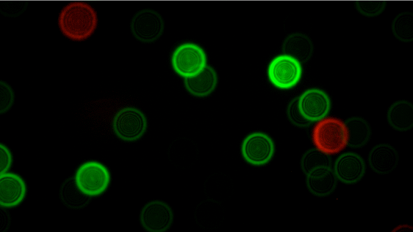
“It is kind of a first-aid kit for a microscope,” Žurauskas said of the phantom-enabled calibration. “Ideally, we want to take the same object each time and see the same image.”
The stability and longevity of nanodiamonds allows their continuous reuse as a calibration tool, which eliminates the labor-intensive preparation that is typically required for fluorescence microscopy, the researchers said.
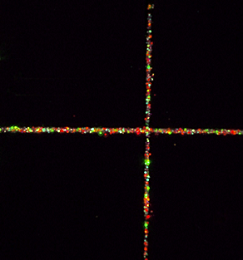
The researchers took advantage of the physical properties of nanodiamonds to engineer the imaging phantoms. “The nanodiamonds are distributed randomly, and they are very sparse, so that you can look at individual particles, or on the opposite end of the spectrum you can look at dense distributions of these particles,” Žurauskas said. “A second plane contains a viewfinder grid, which is effectively a laser-machined grid with nanodiamonds embedded in it. This helps to find the same area each time.”
Industry partner GlaxoSmithKline is assessing the phantom for quality control applications in its own biomedical research labs.
The research was published in Photonics Research (www.doi.org/10.1364/PRJ.434236).
