
| Date | 20th, Nov 2021 |
|---|
Home > Press > Visualizing temperature transport: An unexpected technique for nanoscale characterization
 CREDIT
Tokyo Tech
CREDIT
Tokyo Tech
Abstract: As devices continue to shrink, new challenges in their measurement and design present themselves. For devices based on molecular junctions, in which single molecules are bound to metals or semiconductors, we have a variety of techniques to study and characterize their electric transport properties. In contrast, probing the thermal transport properties of such junctions at the nanoscale has proven more challenging, and many temperature-related quantum phenomena in them remain poorly understood.
Tokyo, Japan | Posted on November 19th, 2021
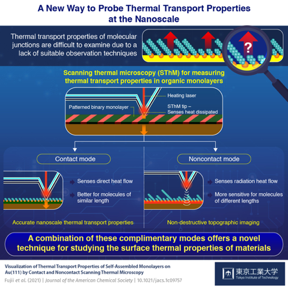
In a few studies, scientists managed to measure the thermal transport properties in molecular junctions at the nanoscale using a technique called scanning thermal microscopy (SThM). This method involves putting a very sharp metallic tip in contact with the target material and moving this tip throughout the material�s surface. The tip, which is heated from behind using a laser, contains a thermocouple. This small device measures temperature differences and so, by balancing the heating of the tip caused by the laser with the tip�s cooling caused by heat flowing into the target sample, it becomes possible to measure a material�s thermal transport characteristics point by point.
In a recent study published in Journal of the American Chemical Society, scientists from Tokyo Tech reported a serendipitous yet important finding while using SThM. The team was employing a SThM technique to measure the thermal transport properties of self-assembled monolayers (SAMs). These samples contained alternating stripes of each of the three possible pairs between n-Hexadecanethiol, n-Butanethiol, and Benzenethiol. Besides employing the standard contact-based SThM approach, the researchers tried using a non-contact regime as well, in which the tip of the scanning thermal microscope was kept above the sample without touching it. Unexpectedly, they realized this non-contact regime had some serious potential.
In the contact SThM regime, heat flows directly from the tip to the sample. By contrast, in the non-contact SThM regime, the only heat transfer between the tip and the sample occurs via heat radiation. As the team found out through experiments, while the contact regime is best for visualizing the thermal transport characteristics, the non-contact regime is much more sensitive to the actual length of the molecules �sticking out� from the substrate. Thus, the combination of the non-contact and contact regimes provides an all-new way of creating topographic and thermal transport images of a sample simultaneously.
Moreover, the non-contact approach has advantages over other well-established microscopy techniques, as Associate Professor Shintaro Fujii, lead author of the paper, explains: �The non-contact SThM approach is completely non-destructive, unlike other techniques like atomic force microscopy, which does require contact between the scanning tip and the sample and thus has a mechanical impact that can damage soft organic materials.�
Overall, the insight provided by this study will pave the way to novel technological advances and a deeper comprehension of materials at the nanoscale. �Our work not only is the first to provide thermal images of organic SAMs, but also provides a new technique for investigating thermal transport properties, which will be essential for thermal management in various types of nanodevices,� concludes Fujii.
Let us hope this work helps scientists elucidate the many mysteries of thermal phenomena.
####
For more information, please click here
Contacts:Kazuhide HasegawaTokyo Institute of Technology
Copyright © Tokyo Institute of Technology
If you have a comment, please Contact us.
Issuers of news releases, not 7th Wave, Inc. or Nanotechnology Now, are solely responsible for the accuracy of the content.
Bookmark:


News and information
 �Fruitcake� structure observed in organic polymers June 3rd, 2022
Progressive Medicinal and Herbal Nanoscience for Targeted Drug Delivery Systems June 3rd, 2022
Artificial Intelligence Centered Cancer Nanomedicine: Diagnostics, Therapeutics and Bioethics June 3rd, 2022
Imaging
Snapshot measurement of single nanostructure�s circular dichroism March 25th, 2022
Better understanding superconductors with Higgs spectroscopy Prof. Stefan Kaiser from TU Dresden awarded ERC Consolidator Grant March 18th, 2022
Visualizing the invisible: New fluorescent DNA label reveals nanoscopic cancer features March 4th, 2022
Possible Futures
Nanoscale bowtie antenna under optical and electrical excitations June 3rd, 2022
Emerging vaccine nanotechnology June 3rd, 2022
�Fruitcake� structure observed in organic polymers June 3rd, 2022
Progressive Medicinal and Herbal Nanoscience for Targeted Drug Delivery Systems June 3rd, 2022
Chip Technology
�Fruitcake� structure observed in organic polymers June 3rd, 2022
On-Chip Photodetection: Two-dimensional material heterojunctions hetero-integration May 13th, 2022
Small microring array enables large complex-valued matrix multiplication May 13th, 2022
Nanoelectronics
Eyebrow-raising: Researchers reveal why nanowires stick to each other February 11th, 2022
Leibniz Prize winner Professor Dr. Oliver G. Schmidt moves to Chemnitz University of Technology: President Professor Dr. Gerd Strohmeier refers to an 'absolute top transfer' September 10th, 2021
Non-linear effects in coupled optical microcavities August 5th, 2021
Discoveries
Nanoscale bowtie antenna under optical and electrical excitations June 3rd, 2022
Emerging vaccine nanotechnology June 3rd, 2022
�Fruitcake� structure observed in organic polymers June 3rd, 2022
Announcements
�Fruitcake� structure observed in organic polymers June 3rd, 2022
Progressive Medicinal and Herbal Nanoscience for Targeted Drug Delivery Systems June 3rd, 2022
Artificial Intelligence Centered Cancer Nanomedicine: Diagnostics, Therapeutics and Bioethics June 3rd, 2022
Interviews/Book Reviews/Essays/Reports/Podcasts/Journals/White papers/Posters
�Fruitcake� structure observed in organic polymers June 3rd, 2022
Progressive Medicinal and Herbal Nanoscience for Targeted Drug Delivery Systems June 3rd, 2022
Artificial Intelligence Centered Cancer Nanomedicine: Diagnostics, Therapeutics and Bioethics June 3rd, 2022
Photonics/Optics/Lasers
Lightening up the nanoscale long-wavelength optoelectronics May 13th, 2022
On-Chip Photodetection: Two-dimensional material heterojunctions hetero-integration May 13th, 2022
Small microring array enables large complex-valued matrix multiplication May 13th, 2022
