
The technology — single-shot photoluminescence lifetime imaging thermometry (SPLIT) — is based on the luminescence of nanoparticles doped with rare earth ions.
“These nanoparticles are considered as nanothermometers because their luminescent properties change with the temperature of the environment. They are also biocompatible,” said Fiorenzo Vetrone, a professor at INRS.
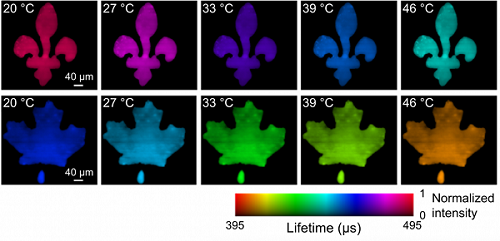
“Our camera is different from a common one, where each click gives one image: Our camera works by capturing all the images of a dynamic event into one snapshot,” said Xianglei Liu, a Ph.D. student at INRS and lead author of the research article.
Temperature can then by sensed by checking how fast the emitted light fades out. Since the technique performs in real time, SPLIT can follow the phenomenon as it happens. For the first time, it enables the luminescence thermometry using the nanoparticle’s lifetime with a moving sample.
Researcher Jinyang Liang and Vetrone believe that SPLIT technology can increase the ability to detect and therefore treat skin cancers. Currently, the capacity to detect melanoma, and, more specifically, micro-melanoma, is still limited. Existing diagnostic approaches are restricted by their invasiveness, resolution, and accuracy, which lead to biopsies. Optical thermometry could therefore be used to detect cancer cells, whose rapid metabolism leads to a higher temperature than that of normal tissue, making them more visible with SPLIT. Clinics can use a thermal camera to detect melanoma. However, the resolution is low.
“SPLIT marks an important step in the technical development. With high resolution, the technology could be used to precisely locate the cancerous mole,” Liang said.
Beyond detection, the technology could monitor the light dose during certain types of treatments. For example, photothermal therapy attacks cancer cells through the heat generated by exposure to near-infrared light.
“We want to eradicate the cancer, but not the surrounding tissue, so if the temperature is too high, the treatment could be decreased or stopped for a while. If it’s too low, we can increase the light to get the right dose,” Vetrone said.
The research was published in Nature Communications (www.doi.org/10.1038/s41467-021-26701-1).
