
Date11th, Aug 2021

Summary:

High-angle annular dark-field scanning transmission electron microscopy can be used to determine complex conformational structures of both crystalline and amorphous polynuclear non-planar coordination molecules, as shown by scientists from Tokyo Institute of Technology (Tokyo Tech). Using iridium as a tracer metal, they were successful in determining the different conformations of a highly branched coordination compound molecule. This has opened up possibilities for imaging and designing of complex inorganic and organic molecules. Coordination compounds have molecular structures which consist of either one or multiple metal atoms at the center, surrounded by non-metal atoms. Their fascinating physical and chemical properties, which have significant applications in material science, depend largely on their molecular structure. Thus, a definitive analysis of their molecular structure is necessary not only for understanding their properties, but also for designing specific coordination compounds with targeted functions. Though several analytical methods are available for structural determination of coordination compounds, they each have their own limitations. For example, X-ray crystallography can only determine the structure of crystalline compounds, while nuclear magnetic resonance cannot provide accurate results when paramagnetic atoms are involved. A more recent microscopy technique, high-angle annular dark-field scanning transmission electron microscopy (HAADF-STEM), that has revolutionized the field of molecular imaging with real-time visualization of single coordination molecules, is also limited to observation of simple and planar molecules. Hence, the structural determination of various conformations (all possible spatial orientations of atoms) of both crystalline and amorphous polynuclear coordination molecules remains unexplored. To bridge this gap, a team of researchers from Tokyo Institute of Technology, led by Professor Kimihisa Yamamoto and Associate Professor Takane Imaoka, have developed a novel imaging method using a metal-atom tracer in HAADF-STEM to determine the conformational structures of complex and highly branched polynuclear coordination compounds. Their findings are published in Science Advances. Explaining the new method, Prof. Imaoka states, "Using iridium as a metal tracer, because its high atomic number (Z=77) will provide better visualization with HAADF-STEM, we synthesized iridium fixated dendritic phenylazomethine (DPA) compounds. Then, we determined the optimum operating conditions for HAADF-STEM, under which the different conformations of these highly branched DPA compounds could be determined with the highest accuracy." To determine the optimum operating conditions for HAADF-STEM, the researchers observed samples of iridium-DPA compound, dispersed on the surface of graphene nanopowder, under a variety of operating conditions. They found that reducing the beam current to 7 pA and exposure time per pixel to 8 microseconds and using low magnification helped reduce the damage to the iridium-DPA compound and allowed the successful observation of its structure. The iridium atoms appear as bright spots in the HAADF-STEM images, indicating their position in the structure of the molecule. Once the HAADF-STEM image of the iridium-DPA molecule was obtained using the optimum conditions, the researchers compared it to simulated images of all possible conformations of the molecule to find the closest match. The structures captured in the experimental HAADF-STEM images fit extremely well with the simulated conformational structures. Thus, the most accurate conformational orientation of a molecule can be easily determined by comparing HAADF-STEM and simulated images. The potential applications of this heavy metal guided HAADF-STEM technology are not only limited to structural analysis coordination compounds. Highlighting future work, Prof. Imaoka remarks, "Our study is a pioneering effort in imaging conformational structures of complex macromolecules. As this technology is effective for both crystalline and amorphous compounds, we believe this technology can also be applied for determination of structures of multinuclear peptides through complexation with tracer metal atoms, and work on this area is already under progress." Reference Authors : Kenji Takada1, Mari Morita1, Takane Imaoka1,2, Junko Kakinuma1, Ken Albrecht1,2, Kimihisa Yamamoto1,2 Title of original paper : Metal atom–guided conformational analysis of single polynuclear coordination molecules Journal : Science Advances DOI : 10.1126/sciadv.abd9887 Affiliations : 1 JST ERATO, Yamamoto Atom Hybrid Project, Tokyo Institute of Technology 2 Institute of Innovative Research, Tokyo Institute of Technology * Corresponding authors' emails: yamamoto.k.at@m.titech.ac.jp; timaoka@res.titech.ac.jp; albrecht@cm.kyushu-u.ac.jp Press release "Novel Molecular Imaging Technique Casts Complex Coordination Molecules in a New Light!" Silver Linings: Adding Silver to the Nanoclusters Can Do Wonders for their Luminescence | Tokyo Tech News Smaller than Ever—Exploring the Unusual Properties of Quantum-sized Materials | Tokyo Tech News Going Small for Big Solutions: Sub-Nanoparticle Catalysts Made from Coinage Elements as Effective Catalysts | Tokyo Tech News Synthesizing a Superatom: Opening Doors to their Use as Substitutes for Elemental Atoms | Tokyo Tech News The power of going small: Copper oxide subnanoparticle catalysts prove most superior | Tokyo Tech News Nanoscience breakthrough: Probing particles smaller than a billionth of a meter | Tokyo Tech News Discovery of periodic tables for molecules | Tokyo Tech News Can't get thinner than this: synthesis of atomically flat boron sheets | Tokyo Tech News Press seminar held on new functional multimetallic clusters created through the precise combination of metal elements | Tokyo Tech News Metallic nano-particles light up another path towards eco-friendly catalysts | Tokyo Tech News Breakthrough in blending metals: Precise control of multimetallic one-nanometer cluster formation achieved | Tokyo Tech News How a tetrahedral substance can be more symmetrical than a spherical atom | Tokyo Tech News A Preparative-Scale Reaction Using Platinum Clusters with a Single-Digit Atomicity Realized | Tokyo Tech News One-Nanometer Trimetallic Alloy Particles Created | Tokyo Tech News New aspect of atom mimicry for nanotechnology applications | Tokyo Tech News Controllable light-emitting materials to advance light sensing and nano-medicine | Tokyo Tech News A step forward for fuel cell technology | Tokyo Tech News Yamamoto-Imaoka Group JST ERATO Yamamoto Atom Hybrid Project Researcher Profile | Tokyo Tech STAR Search - Takane Imaoka Researcher Profile | Tokyo Tech STAR Search - Kimihisa Yamamoto Laboratory for Chemistry and Life Science, Institute of Innovative Research Institute of Innovative Research Department of Chemical Science and Engineering, School of Materials and Chemical Technology Latest Research News Further Information Associate Professor Takane Imaoka Institute of Innovative Research, Tokyo Institute of Technology Email timaoka@res.titech.ac.jp Contact Public Relations Division, Tokyo Institute of Technology Email media@jim.titech.ac.jp Tel +81-3-5734-2975 Subscribe to Tokyo Tech Bulletin

Full text:

Published: August 11, 2021

High-angle annular dark-field scanning transmission electron microscopy can be used to determine complex conformational structures of both crystalline and amorphous polynuclear non-planar coordination molecules, as shown by scientists from Tokyo Institute of Technology (Tokyo Tech). Using iridium as a tracer metal, they were successful in determining the different conformations of a highly branched coordination compound molecule. This has opened up possibilities for imaging and designing of complex inorganic and organic molecules.
Expanding the Scope of High-Angle Annular Dark-Field Scanning Transmission Electron Microscopy

Coordination compounds have molecular structures which consist of either one or multiple metal atoms at the center, surrounded by non-metal atoms. Their fascinating physical and chemical properties, which have significant applications in material science, depend largely on their molecular structure. Thus, a definitive analysis of their molecular structure is necessary not only for understanding their properties, but also for designing specific coordination compounds with targeted functions.

Though several analytical methods are available for structural determination of coordination compounds, they each have their own limitations. For example, X-ray crystallography can only determine the structure of crystalline compounds, while nuclear magnetic resonance cannot provide accurate results when paramagnetic atoms are involved. A more recent microscopy technique, high-angle annular dark-field scanning transmission electron microscopy (HAADF-STEM), that has revolutionized the field of molecular imaging with real-time visualization of single coordination molecules, is also limited to observation of simple and planar molecules. Hence, the structural determination of various conformations (all possible spatial orientations of atoms) of both crystalline and amorphous polynuclear coordination molecules remains unexplored.

To bridge this gap, a team of researchers from Tokyo Institute of Technology, led by Professor Kimihisa Yamamoto and Associate Professor Takane Imaoka, have developed a novel imaging method using a metal-atom tracer in HAADF-STEM to determine the conformational structures of complex and highly branched polynuclear coordination compounds. Their findings are published in Science Advances. Explaining the new method, Prof. Imaoka states, "Using iridium as a metal tracer, because its high atomic number (Z=77) will provide better visualization with HAADF-STEM, we synthesized iridium fixated dendritic phenylazomethine (DPA) compounds. Then, we determined the optimum operating conditions for HAADF-STEM, under which the different conformations of these highly branched DPA compounds could be determined with the highest accuracy."

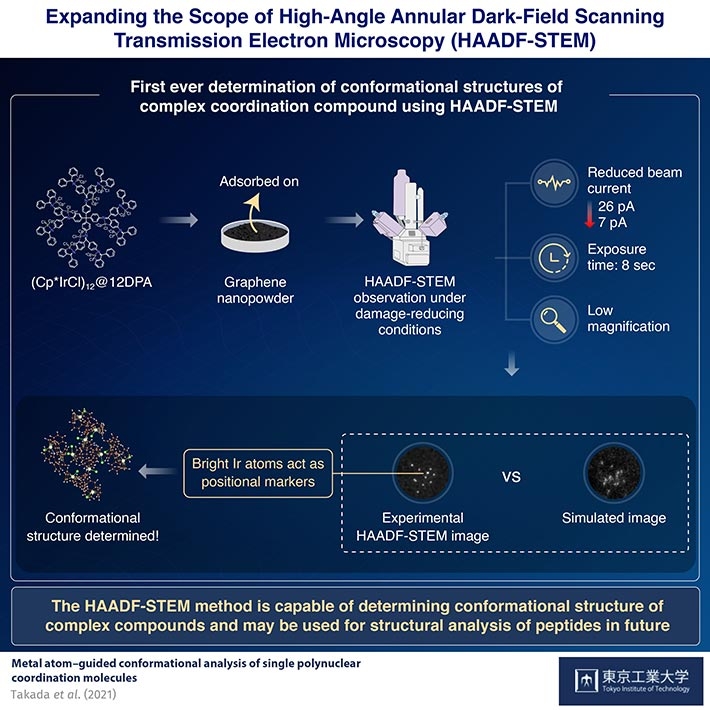
To determine the optimum operating conditions for HAADF-STEM, the researchers observed samples of iridium-DPA compound, dispersed on the surface of graphene nanopowder, under a variety of operating conditions. They found that reducing the beam current to 7 pA and exposure time per pixel to 8 microseconds and using low magnification helped reduce the damage to the iridium-DPA compound and allowed the successful observation of its structure. The iridium atoms appear as bright spots in the HAADF-STEM images, indicating their position in the structure of the molecule.

Once the HAADF-STEM image of the iridium-DPA molecule was obtained using the optimum conditions, the researchers compared it to simulated images of all possible conformations of the molecule to find the closest match. The structures captured in the experimental HAADF-STEM images fit extremely well with the simulated conformational structures. Thus, the most accurate conformational orientation of a molecule can be easily determined by comparing HAADF-STEM and simulated images.

The potential applications of this heavy metal guided HAADF-STEM technology are not only limited to structural analysis coordination compounds. Highlighting future work, Prof. Imaoka remarks, "Our study is a pioneering effort in imaging conformational structures of complex macromolecules. As this technology is effective for both crystalline and amorphous compounds, we believe this technology can also be applied for determination of structures of multinuclear peptides through complexation with tracer metal atoms, and work on this area is already under progress."

Reference

Authors :

Kenji Takada1, Mari Morita1, Takane Imaoka1,2, Junko Kakinuma1, Ken Albrecht1,2, Kimihisa Yamamoto1,2

Title of original paper :

Metal atom–guided conformational analysis of single polynuclear coordination molecules

Journal :

Science Advances

DOI :

Affiliations :

1 JST ERATO, Yamamoto Atom Hybrid Project, Tokyo Institute of Technology

2 Institute of Innovative Research, Tokyo Institute of Technology

* Corresponding authors' emails: yamamoto.k.at@m.titech.ac.jp; timaoka@res.titech.ac.jp; albrecht@cm.kyushu-u.ac.jp

Press release "Novel Molecular Imaging Technique Casts Complex Coordination Molecules in a New Light!" Silver Linings: Adding Silver to the Nanoclusters Can Do Wonders for their Luminescence | Tokyo Tech News Smaller than Ever—Exploring the Unusual Properties of Quantum-sized Materials | Tokyo Tech News Going Small for Big Solutions: Sub-Nanoparticle Catalysts Made from Coinage Elements as Effective Catalysts | Tokyo Tech News Synthesizing a Superatom: Opening Doors to their Use as Substitutes for Elemental Atoms | Tokyo Tech News The power of going small: Copper oxide subnanoparticle catalysts prove most superior | Tokyo Tech News Nanoscience breakthrough: Probing particles smaller than a billionth of a meter | Tokyo Tech News Discovery of periodic tables for molecules | Tokyo Tech News Can't get thinner than this: synthesis of atomically flat boron sheets | Tokyo Tech News Press seminar held on new functional multimetallic clusters created through the precise combination of metal elements | Tokyo Tech News Metallic nano-particles light up another path towards eco-friendly catalysts | Tokyo Tech News Breakthrough in blending metals: Precise control of multimetallic one-nanometer cluster formation achieved | Tokyo Tech News How a tetrahedral substance can be more symmetrical than a spherical atom | Tokyo Tech News A Preparative-Scale Reaction Using Platinum Clusters with a Single-Digit Atomicity Realized | Tokyo Tech News One-Nanometer Trimetallic Alloy Particles Created | Tokyo Tech News New aspect of atom mimicry for nanotechnology applications | Tokyo Tech News Controllable light-emitting materials to advance light sensing and nano-medicine | Tokyo Tech News A step forward for fuel cell technology | Tokyo Tech News Yamamoto-Imaoka Group JST ERATO Yamamoto Atom Hybrid Project Researcher Profile | Tokyo Tech STAR Search - Takane Imaoka Researcher Profile | Tokyo Tech STAR Search - Kimihisa Yamamoto Laboratory for Chemistry and Life Science, Institute of Innovative Research Institute of Innovative Research Department of Chemical Science and Engineering, School of Materials and Chemical Technology Latest Research News