
| Date | 17th, Dec 2021 |
|---|
Home > Press > Series of preclinical studies supports the Army�s pan-coronavirus vaccine development strategy
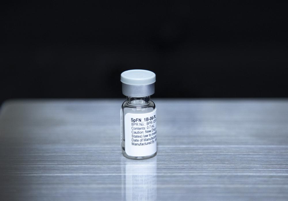 A vial of spike ferritin nanoparticle (SpFN), WRAIR�s COVID-19 vaccine. Built on a ferritin platform, the vaccine offers a flexible approach to targeting multiple variants of the virus that causes COVID-19 and potentially other coronaviruses as well.
CREDIT
U.S. Army photo by Mike Walters/ RELEASED
A vial of spike ferritin nanoparticle (SpFN), WRAIR�s COVID-19 vaccine. Built on a ferritin platform, the vaccine offers a flexible approach to targeting multiple variants of the virus that causes COVID-19 and potentially other coronaviruses as well.
CREDIT
U.S. Army photo by Mike Walters/ RELEASED
Abstract: A series of recently published preclinical study results show that the Spike Ferritin Nanoparticle (SpFN) COVID-19 vaccine developed by researchers at the Walter Reed Army Institute of Research (WRAIR) not only elicits a potent immune response but may also provide broad protection against SARS-CoV-2 variants of concern as well as other coronaviruses.
Silver Spring, MD | Posted on December 17th, 2021
Scientists in WRAIR�s Emerging Infectious Diseases Branch (EIDB) developed the SpFN nanoparticle vaccine, based on a ferritin platform, as part of a forward-thinking �pan-SARS� strategy that aims to address the current pandemic and acts as a first line of defense against variants of concern and similar viruses that could emerge in the future.
�The accelerating emergence of human coronaviruses throughout the past two decades and the rise of SARS-CoV-2 variants, including most recently Omicron, underscore the continued need for next-generation preemptive vaccines that confer broad protection against coronavirus diseases,� said Dr. Kayvon Modjarrad, Director of the Emerging Infectious Diseases Branch at WRAIR, co-inventor of the vaccine and the U.S. Army lead for SpFN. �Our strategy has been to develop a �pan-coronavirus� vaccine technology that could potentially offer safe, effective and durable protection against multiple coronavirus strains and species.�
Pre-clinical studies published today in Science Translational Medicine indicate that the SpFN vaccine protects non-human primates from disease caused by the original strain of SARS-CoV-2 and induces highly-potent and broadly-neutralizing antibody responses against major SARS-CoV-2 variants of concern including the SARS-CoV-1 virus that emerged in 2002.
SpFN entered Phase 1 human trials in April 2021. Early analyses, expected to conclude this month, will provide insights into whether SpFN�s potency and breadth, as demonstrated in preclinical trials, will carry over into humans. The data will also allow researchers to compare SpFN�s immune profile to that of other COVID-19 vaccines already authorized for emergency use.
�This vaccine stands out in the COVID-19 vaccine landscape,� Modjarrad said. �The repetitive and ordered display of the coronavirus spike protein on a multi-faced nanoparticle may stimulate immunity in such a way as to translate into significantly broader protection.�
WRAIR developed a secondary candidate vaccine, a SARS-CoV-2 Spike Receptor-Binding Domain Ferritin Nanoparticle (RFN) vaccine, which targets a smaller part of the coronavirus Spike protein than the SpFN vaccine. Results from a study, published recently in the Proceedings of the National Academy of Sciences, show that this vaccine potentially offers similar protection against an array of SARS-CoV-2 variants and SARS-CoV-1.
�The RFN vaccine candidate is more compact and has some natural advantages as we try to increase the immune response against multiple coronaviruses using a single vaccine platform, so it is still under consideration as part of our pan-coronavirus vaccine development pipeline,� said WRAIR structural biologist and vaccine co-inventor, Dr. Gordon Joyce.
�The threat from COVID-19 continues as it evolves, and eventually there will be other emerging disease threats,� said Dr. Nelson Michael, Director of the Center for Infectious Diseases Research at WRAIR. �Our investment in developing a next generation vaccine is an important step towards getting ahead of COVID-19 and future disease threats.�
###
About the Army-developed SpFN vaccine
The SpFN vaccine is a protein subunit nanoparticle vaccine platform, meaning it presents a fragment of a virus to the immune system to elicit a protective response. SpFN comprises multiple coronavirus Spike proteins linked to the surface of a multifaceted ferritin nanoparticle. Researchers hypothesize that presenting multiple copies of Spike in an ordered fashion may be the key to inducing a potent and broad immune response. The platform also has advantages as a potentially global vaccine because it remains stable at a wide range of temperatures. This would be especially useful in settings where ultra-cold freezers are scarce.
The SpFN vaccine is formulated with an adjuvant called ALFQ, one of the Army Liposome Formulation family of adjuvants developed by Army researchers at WRAIR. An adjuvant is a component of a vaccine that helps activate the immune system and improve immune responses. Preclinical and early clinical studies have demonstrated ALFQ to be safe and strongly potent as a vaccine adjuvant.
####
About The U.S. Military HIV Research Program (MHRP)The Walter Reed Army Institute of Research (WRAIR) (https://www.wrair.army.mil), part of the U.S. Army Medical Research and Development Command, provides unique research capabilities and innovative medical solutions to a range of Force Health Protection and Readiness challenges currently facing U.S. Service Members, along with threats anticipated during future operations. WRAIR has created a model of vaccine and therapeutic development that is unique, nimble, and responsive to dynamically evolving infectious disease threats of military importance. Leveraging WRAIR�s expertise, facilities, and international network, the Institute has helped developed many of the vaccines and drugs in use today by military and civilian medicine, around the globe. In 2018, the Emerging Infectious Diseases Branch was created with an explicit mission to survey, anticipate and counter the growing threat of emerging infectious diseases of key importance to U.S. forces in the homeland and abroad.
For more information, please click here
Contacts:Lisa ReillyThe U.S. Military HIV Research Program (MHRP)
Office: 301-500-3634
Copyright © The U.S. Military HIV Research Program (MHRP)
If you have a comment, please Contact us.
Issuers of news releases, not 7th Wave, Inc. or Nanotechnology Now, are solely responsible for the accuracy of the content.
Bookmark:


News and information
 �Fruitcake� structure observed in organic polymers June 3rd, 2022
Progressive Medicinal and Herbal Nanoscience for Targeted Drug Delivery Systems June 3rd, 2022
Artificial Intelligence Centered Cancer Nanomedicine: Diagnostics, Therapeutics and Bioethics June 3rd, 2022
Govt.-Legislation/Regulation/Funding/Policy
Nanostructured fibers can impersonate human muscles June 3rd, 2022
Bacteria-killing drills get an upgrade Visible light triggers: Rice�s molecular machines to treat infections June 1st, 2022
A one-stop shop for quantum sensing materials May 27th, 2022
Nanomedicine
Emerging vaccine nanotechnology June 3rd, 2022
Progressive Medicinal and Herbal Nanoscience for Targeted Drug Delivery Systems June 3rd, 2022
Artificial Intelligence Centered Cancer Nanomedicine: Diagnostics, Therapeutics and Bioethics June 3rd, 2022
Nanostructured fibers can impersonate human muscles June 3rd, 2022
Discoveries
Nanoscale bowtie antenna under optical and electrical excitations June 3rd, 2022
Emerging vaccine nanotechnology June 3rd, 2022
�Fruitcake� structure observed in organic polymers June 3rd, 2022
Announcements
�Fruitcake� structure observed in organic polymers June 3rd, 2022
Progressive Medicinal and Herbal Nanoscience for Targeted Drug Delivery Systems June 3rd, 2022
Artificial Intelligence Centered Cancer Nanomedicine: Diagnostics, Therapeutics and Bioethics June 3rd, 2022
Interviews/Book Reviews/Essays/Reports/Podcasts/Journals/White papers/Posters
�Fruitcake� structure observed in organic polymers June 3rd, 2022
Progressive Medicinal and Herbal Nanoscience for Targeted Drug Delivery Systems June 3rd, 2022
Artificial Intelligence Centered Cancer Nanomedicine: Diagnostics, Therapeutics and Bioethics June 3rd, 2022
Military
Nanostructured fibers can impersonate human muscles June 3rd, 2022
Lightening up the nanoscale long-wavelength optoelectronics May 13th, 2022
New hardware integrates mechanical devices into quantum tech April 22nd, 2022
Nanobiotechnology
Emerging vaccine nanotechnology June 3rd, 2022
Bacteria-killing drills get an upgrade Visible light triggers: Rice�s molecular machines to treat infections June 1st, 2022
Diabetes drug improves antibacterial treatment speed and effectiveness, researchers report May 27th, 2022
Oregon State University research pushes closer to new therapy for pancreatic cancer May 6th, 2022
