
| Date | 17th, Dec 2021 |
|---|
Home > Press > QuTech takes important step in quantum computing with error correction: �Until now researchers have encoded and stabilized. We now show that we can compute as well.�
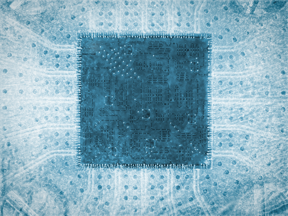 Artistic image of a seven-transmon superconducting quantum processor similar to the one used in this work
CREDIT
DiCarlo Lab and Marieke de Lorijn
Artistic image of a seven-transmon superconducting quantum processor similar to the one used in this work
CREDIT
DiCarlo Lab and Marieke de Lorijn
Abstract: Researchers at QuTech�a collaboration between the TU Delft and TNO�have reached a milestone in quantum error correction. They have integrated high-fidelity operations on encoded quantum data with a scalable scheme for repeated data stabilization. The researchers report their findings in the December issue of Nature Physics.
Delft, Netherlands | Posted on December 17th, 2021
More qubits
Physical quantum bits, or qubits, are vulnerable to errors. These errors arise from various sources, including quantum decoherence, crosstalk, and imperfect calibration. Fortunately, the theory of quantum error correction stipulates the possibility to compute while synchronously protecting quantum data from such errors.
�Two capabilities will distinguish an error corrected quantum computer from present-day noisy intermediate-scale quantum (NISQ) processors�, says Prof Leonardo DiCarlo of QuTech. �First, it will process quantum information encoded in logical qubits rather than in physical qubits (each logical qubit consisting of many physical qubits). Second, it will use quantum parity checks interleaved with computation steps to identify and correct errors occurring in the physical qubits, safeguarding the encoded information as it is being processed.� According to theory, the logical error rate can be exponentially suppressed provided that the incidence of physical errors is below a threshold and the circuits for logical operations and stabilization are fault tolerant.
All the operations
The basic idea thus is that if you increase the redundancy and use more and more qubits to encode data, the net error goes down. The researchers at TU Delft, together with colleagues at TNO, have now realized a major step toward this goal, realizing a logical qubit consisting of seven physical qubits (superconducting transmons). �We show that we can do all the operations required for computation with the encoded information. This integration of high-fidelity logical operations with a scalable scheme for repeated stabilization is a key step in quantum error correction�, says Prof Barbara Terhal, also of QuTech.
First-author and PhD candidate Jorge Marques further explains: �Until now researchers have encoded and stabilized. We now show that we can compute as well. This is what a fault-tolerant computer must ultimately do: process and protect data from errors all at the same time. We do three types of logical-qubit operations: initializing the logical qubit in any state, transforming it with gates, and measuring it. We show that all operations can be done directly on encoded information. For each type, we observe higher performance for fault-tolerant variants over non-fault-tolerant variants.� Fault-tolerant operations are key to reducing the build-up of physical-qubit errors into logical-qubit errors.
Long term
DiCarlo emphasizes the multidisciplinary nature of the work: �This is a combined effort of experimental physics, theoretical physics from Barbara Terhal�s group, and also electronics developed with TNO and external collaborators. The project is mainly funded by IARPA and Intel Corporation.�
�Our grand goal is to show that as we increase encoding redundancy, the net error rate actually decreases exponentially�, DiCarlo concludes. �Our current focus is on 17 physical qubits and next up will be 49. All layers of our quantum computer�s architecture were designed to allow this scaling.�
####
For more information, please click here
Contacts:Aldo BrinkmanDelft University of Technology
Office: +316 343 212 95Cell: +31652593003Expert Contact
Leo DiCarloQuTech
Office: +31 (0)15-2786097
Copyright © Delft University of Technology
If you have a comment, please Contact us.
Issuers of news releases, not 7th Wave, Inc. or Nanotechnology Now, are solely responsible for the accuracy of the content.
Bookmark:


News and information
 �Fruitcake� structure observed in organic polymers June 3rd, 2022
Progressive Medicinal and Herbal Nanoscience for Targeted Drug Delivery Systems June 3rd, 2022
Artificial Intelligence Centered Cancer Nanomedicine: Diagnostics, Therapeutics and Bioethics June 3rd, 2022
Possible Futures
Nanoscale bowtie antenna under optical and electrical excitations June 3rd, 2022
Emerging vaccine nanotechnology June 3rd, 2022
�Fruitcake� structure observed in organic polymers June 3rd, 2022
Progressive Medicinal and Herbal Nanoscience for Targeted Drug Delivery Systems June 3rd, 2022
Quantum Computing
A one-stop shop for quantum sensing materials May 27th, 2022
Discoveries
Nanoscale bowtie antenna under optical and electrical excitations June 3rd, 2022
Emerging vaccine nanotechnology June 3rd, 2022
�Fruitcake� structure observed in organic polymers June 3rd, 2022
Announcements
�Fruitcake� structure observed in organic polymers June 3rd, 2022
Progressive Medicinal and Herbal Nanoscience for Targeted Drug Delivery Systems June 3rd, 2022
Artificial Intelligence Centered Cancer Nanomedicine: Diagnostics, Therapeutics and Bioethics June 3rd, 2022
Interviews/Book Reviews/Essays/Reports/Podcasts/Journals/White papers/Posters
�Fruitcake� structure observed in organic polymers June 3rd, 2022
Progressive Medicinal and Herbal Nanoscience for Targeted Drug Delivery Systems June 3rd, 2022
Artificial Intelligence Centered Cancer Nanomedicine: Diagnostics, Therapeutics and Bioethics June 3rd, 2022
Alliances/Trade associations/Partnerships/Distributorships
University of Strathclyde and National University of Singapore to co-ordinate satellite quantum communications May 13th, 2022
CEA and Startup C12 Join Forces to Develop Next-Generation Quantum Computers with Multi-Qubit Chips at Wafer Scale March 25th, 2022
Wise-integration and EDOM Technology Announce Channel Partnership for GaN IC Power Semiconductor Deployment February 11th, 2022
Research partnerships
Nanostructured fibers can impersonate human muscles June 3rd, 2022
Bacteria-killing drills get an upgrade Visible light triggers: Rice�s molecular machines to treat infections June 1st, 2022
Novel sensors enable precise measurement of dopamine May 27th, 2022
