
The group works with aerogels composed of crystalline semiconductor nanoparticles. In its work, it surmised that if photocatalysis is to be more efficient and useful to industry, the catalyst must be able to absorb light from a broad range of wavelengths.
The material of choice for photocatalysis, the semiconductor titanium dioxide (TiO2), only absorbs lights in the ultraviolet (UV) wavelength, which comprises only about 5% of the spectrum. While searching for a way to optimize TiO2 for photocatalysis, researcher Junggou Kwon discovered that doping the aerogel with nitrogen caused individual oxygen atoms in the aerogel to be replaced with nitrogen atoms, making it possible for the aerogel to absorb more visible portions of the spectrum.
Kwon produced an aerogel using TiO2 nanoparticles and small amounts of the noble metal palladium. She then placed the aerogel in a reactor and infused it with ammonia (NH3) gas. The NH3 gas caused individual nitrogen atoms to embed themselves in the crystal structure of the TiO2 nanoparticles.
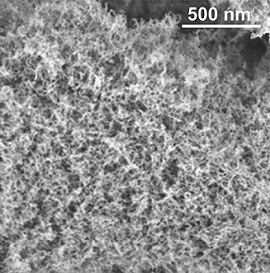
Plasma-enhanced chemical vapor deposition at low temperature using NH3 gas enabled the nitrogen to be efficiently integrated into the preformed TiO2 aerogels, improving their optical properties while preserving their favorable characteristics — their large surface area, extensive porosity, and nanoscale properties.
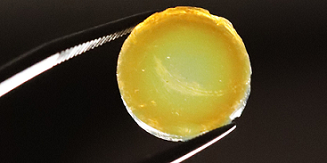
Aerogels with palladium produced up to 70× more H2 than aerogels without the addition. The nitrogen-doped TiO2 nanoparticle-based aerogels, when loaded with palladium nanoparticles, showed a significant enhancement in visible-light-driven photocatalytic H2 production, demonstrating excellent stability continuously for a period of five days, at which point the experiment was concluded. “The process would probably have been stable for longer,” Niederberger said. “Especially with regard to industrial applications, it’s important for it to be stable for as long as possible.”
As a new class of photocatalysts with an exceptional 3D structure, aerogels offer the potential for additional gas-phase reactions beyond H2 production. Compared to electrolysis, which uses electric current to drive chemical reactions, photocatalysis requires only light.
The aerogel developed by Niederberger’s group was done primarily as a feasibility study; further investigation is needed to determine whether the group’s technique could be used to produce H2 on a large scale.
For example, the researchers still need to resolve how to accelerate the flow of gas through the extremely small pores of the aerogel.
“To operate such a system on an industrial scale, we first have to increase the gas flow and also improve the irradiation of the aerogels,” Niederberger said.
The research was published in ACS Applied Materials & Interfaces (www.doi.org/10.1021/acsami.1c12579).
