
| Date | 25th, Dec 2021 |
|---|
Home > Press > Researchers uncover the mechanism of electric field detection in microscale graphene sensors
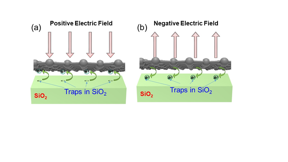 Schematic diagram showing the mechanism of electric field sensing in the graphene sensors for (a) positive and (b) negative electric fields. In the case of the positive electric field, the electrons are attracted towards the graphene channel from the SiO2 layer. In contrast, electrons are transferred from the graphene channel to the traps in the SiO2 layer for the negative electric field.
CREDIT
Manoharan Muruganathan from JAIST.
Schematic diagram showing the mechanism of electric field sensing in the graphene sensors for (a) positive and (b) negative electric fields. In the case of the positive electric field, the electrons are attracted towards the graphene channel from the SiO2 layer. In contrast, electrons are transferred from the graphene channel to the traps in the SiO2 layer for the negative electric field.
CREDIT
Manoharan Muruganathan from JAIST.
Abstract: The ability to sense the magnitude and polarity of the electric field is of great scientific interest. It has various real-life applications, such as early prediction of lightning and detection of supersonic aircraft. Presently, field mills are the widely used electric field sensors. While they can detect electric fields of either polarity and field of magnitude as low as 1 V/m, the large size (>1m) hinders their wide use for real-life applications. Also, the motor inside the field mill, which enables the detection of the electric field, is prone to failure. Some efforts have been made to miniaturize the electric field sensor by introducing MEMS-based sensors. While they are small and do not involve any moving parts, the complex fabrication process makes these sensors less cost-effective.
Ishikawa, Japan | Posted on December 24th, 2021
This encouraged researchers at Japan Advanced Institute of Science and Technology (JAIST) and Otowa Electric Co., Ltd., a leading lightning protection equipment manufacturer, to look for a better alternative. Their investigation led to graphene, a two-dimensional material of one atom thickness. "It is well known that the carrier density in graphene is highly sensitive to external perturbations. Such change in carrier density is reflected in the drain current. Although there was some attempt and proposal to use graphene as an electric field sensor, none of the previous works established the underlying mechanism of electric field sensing in graphene. We realized that it is vital to establish the mechanism first to make any improvement in the sensor, which became our primary goal." says Senior Lecturer Manoharan Muruganathan.
Through a series of well-thought experiments, the team finally established the mechanism of electric field sensing in graphene. It is found that the transfer of charges between graphene and the traps at the SiO2/graphene interface under the application of an electric field is a crucial phenomenon in the sensing mechanism. Such a transfer of charges and the resultant change in carrier density are reflected as the drain current change. The direction of charge transfer depends on the polarity of the electric field. The electrons are transferred from traps to graphene under a positive electric field, whereas they are transferred from graphene to traps under a negative electric field. Thus, the change in drain current under an electric field is opposite for positive and negative electric fields, making it easier to detect the field's polarity. In addition, the number of charge carriers transferred between graphene and the traps depends on the magnitude of the electric field. The higher the electric field, the larger the electrons moved between graphene and the traps. Such difference in the amount of charge transferred is also reflected in the drain current. Thus the drain current variation under the application of an electric field can be equated to the magnitude of the electric field.
####
For more information, please click here
Contacts:Manoharan MuruganathanJapan Advanced Institute of Science and Technology
Office: +81-761-51-1573
Copyright © Japan Advanced Institute of Science and Technology (JAIST)
If you have a comment, please Contact us.
Issuers of news releases, not 7th Wave, Inc. or Nanotechnology Now, are solely responsible for the accuracy of the content.
Bookmark:


News and information
 �Fruitcake� structure observed in organic polymers June 3rd, 2022
Progressive Medicinal and Herbal Nanoscience for Targeted Drug Delivery Systems June 3rd, 2022
Artificial Intelligence Centered Cancer Nanomedicine: Diagnostics, Therapeutics and Bioethics June 3rd, 2022
Graphene/ Graphite
Nanotubes: a promising solution for advanced rubber cables with 60% less conductive filler June 1st, 2022
Dynamic metasurfaces and metadevices empowered by graphene May 6th, 2022
Graphene crystals grow better under copper cover April 1st, 2022
2 Dimensional Materials
UCI scientists turn a hydrogen molecule into a quantum sensor: New technique enables precise measurement of electrostatic properties of materials April 22nd, 2022
Graphene crystals grow better under copper cover April 1st, 2022
Possible Futures
Nanoscale bowtie antenna under optical and electrical excitations June 3rd, 2022
Emerging vaccine nanotechnology June 3rd, 2022
�Fruitcake� structure observed in organic polymers June 3rd, 2022
Progressive Medicinal and Herbal Nanoscience for Targeted Drug Delivery Systems June 3rd, 2022
Sensors
A one-stop shop for quantum sensing materials May 27th, 2022
New nanomechanical oscillators with record-low loss May 13th, 2022
Discoveries
Nanoscale bowtie antenna under optical and electrical excitations June 3rd, 2022
Emerging vaccine nanotechnology June 3rd, 2022
�Fruitcake� structure observed in organic polymers June 3rd, 2022
Announcements
�Fruitcake� structure observed in organic polymers June 3rd, 2022
Progressive Medicinal and Herbal Nanoscience for Targeted Drug Delivery Systems June 3rd, 2022
Artificial Intelligence Centered Cancer Nanomedicine: Diagnostics, Therapeutics and Bioethics June 3rd, 2022
Interviews/Book Reviews/Essays/Reports/Podcasts/Journals/White papers/Posters
�Fruitcake� structure observed in organic polymers June 3rd, 2022
Progressive Medicinal and Herbal Nanoscience for Targeted Drug Delivery Systems June 3rd, 2022
Artificial Intelligence Centered Cancer Nanomedicine: Diagnostics, Therapeutics and Bioethics June 3rd, 2022
