
To achieve a large-scale universal fault-tolerant optical quantum computer, the light source would require highly squeezed quantum noise and photon number parity that is maintained even in high-photon-number components. For instance, a squeezing level of more than 65% is required to generate time-domain multiple quantum entanglement, or two-dimensional clustered states, that can be used for large-scale quantum computation.
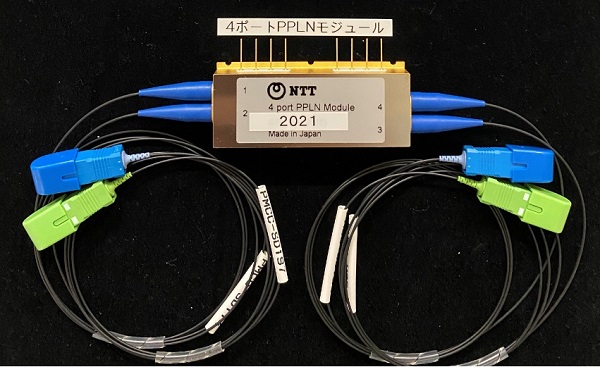
The researchers took an approach in which an initial module generates squeezed light and a second module converts the optical quantum information into classical light information. The optical parametric amplifier developed as the light source is used in the opposite direction to achieve optical amplification that maintains photon number parity. Unlike the conventional balanced homodyne detection technique, this measurement method can amplify and convert the quantum signal into a classical optical signal without changing it into electrons.
While connecting the optical fiber components, the researchers successfully measured squeezed light in which quantum noise is squeezed to more than 75% with a bandwidth of more than 6 THz, meaning that the quantum states required for optical quantum computing can be generated and measured, even in a fully closed system in optical fibers. Therefore, the researchers believe the light source will enable a stable and maintenance-free optical quantum computer on a realistic scale.
The research was published in Applied Physics Letters (www.doi.org/10.1063/5.0063118).
