
| Date | 15th, Jan 2022 |
|---|
Home > Press > NSF funds Rice effort to measure, preserve quantum entanglement: Physicist Guido Pagano wins CAREER Award to develop tools for quantum computing
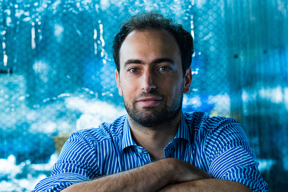 Guido Pagano is an assistant professor of physics and astronomy at Rice University
CREDIT
Jeff Fitlow/Rice University
Guido Pagano is an assistant professor of physics and astronomy at Rice University
CREDIT
Jeff Fitlow/Rice University
Abstract: Rice University physicist Guido Pagano has won a prestigious CAREER award from the National Science Foundation (NSF) to study quantum entanglement and develop new error-correcting tools for quantum computation.
Houston, TX | Posted on January 14th, 2022
CAREER awards are the NSF�s most esteemed grants for early-career faculty. The agency gives about 500 of the five-year grants each year for young scientists it believes �have the potential to serve as academic role models in research and education.�
�The idea is to develop tools to not only create entanglement via unitary evolution, as you would do in a quantum computation, but also partially measure the system during this evolution and see if the entanglement survives this perturbation,� said Pagano, assistant professor of physics and astronomy. �I want to understand what happens when I keep iterating those two operations: partial measurement and quantum evolution.�
Measuring a quantum entangled system causes perturbations, and one goal of the work is to find out how much disruption the entangled system can withstand under particular conditions. To find those answers, Pagano�s team will create new tools quantum computer makers could also use for correcting errors caused by quantum decoherence, a major hurdle in the fledgling field.
Pagano�s lab specializes in the study of quantum entanglement, the phenomenon that makes quantum computing possible. Pagano and his students cool ytterbium ions within a fraction of a degree of absolute zero and string them together like pearls on necklaces. The ions are held in 1D strands by electromagnetic traps that both isolate individual ions and allow them to share quantum states.
The setup is similar to those used by some quantum computing companies, but Pagano�s team uses the system to ask fundamental questions about how entanglement propagates and is affected by disturbances like the partial measurements required for error-corrected quantum computation.
�Our platform is a pristine spin system,� Pagano said. �Each ion has two possible states. They can be up or down. And I can optically manipulate their spins to create quantum states and study what happens when those entangled spin states are evolved in ways that are similar to the unitary operations used in quantum computation.�
�What this grant proposes is also related to quantum error correction,� Pagano said. �The idea is to find ways to protect the entangled ions while you�re doing the very, very disruptive operations related to measurement on other, auxiliary ions.�
For example, Pagano and his students might create a string of 10 entangled ions, evolve the entangled quantum state of all 10, then conduct a measurement on three ions while protecting the others. Pagano likened the process to �shelving� the quantum information of the seven ions that aren�t being measured, conducting a measurement on the remaining three, and then continuing with the next step in the evolution of the quantum system.
�The information stored on the shelf is protected,� he said. �Then, whenever you've finished the measurement, you can bring the quantum information back from the shelf to the actual system and keep going.�
By repeating this process, Pagano�s group can both study how measurement perturbs the ions� shared quantum state and gather information that can be used to correct errors arising from quantum decoherence.
####
About Rice UniversityLocated on a 300-acre forested campus in Houston, Rice University is consistently ranked among the nation�s top 20 universities by U.S. News & World Report. Rice has highly respected schools of Architecture, Business, Continuing Studies, Engineering, Humanities, Music, Natural Sciences and Social Sciences and is home to the Baker Institute for Public Policy. With 4,052 undergraduates and 3,484 graduate students, Rice�s undergraduate student-to-faculty ratio is just under 6-to-1. Its residential college system builds close-knit communities and lifelong friendships, just one reason why Rice is ranked No. 1 for lots of race/class interaction and No. 1 for quality of life by the Princeton Review. Rice is also rated as a best value among private universities by Kiplinger�s Personal Finance.
Follow Rice News and Media Relations via Twitter @RiceUNews.
For more information, please click here
Contacts:Jade BoydRice University
Office: 713-348-6778
Copyright © Rice University
If you have a comment, please Contact us.
Issuers of news releases, not 7th Wave, Inc. or Nanotechnology Now, are solely responsible for the accuracy of the content.
Bookmark:


News and information
 �Fruitcake� structure observed in organic polymers June 3rd, 2022
Progressive Medicinal and Herbal Nanoscience for Targeted Drug Delivery Systems June 3rd, 2022
Artificial Intelligence Centered Cancer Nanomedicine: Diagnostics, Therapeutics and Bioethics June 3rd, 2022
Nanostructured fibers can impersonate human muscles June 3rd, 2022
Quantum Physics
Observation of fractional exclusion statistics in quantum critical matter May 27th, 2022
Physics
Observation of fractional exclusion statistics in quantum critical matter May 27th, 2022
Possible Futures
Nanoscale bowtie antenna under optical and electrical excitations June 3rd, 2022
Emerging vaccine nanotechnology June 3rd, 2022
�Fruitcake� structure observed in organic polymers June 3rd, 2022
Progressive Medicinal and Herbal Nanoscience for Targeted Drug Delivery Systems June 3rd, 2022
Quantum Computing
A one-stop shop for quantum sensing materials May 27th, 2022
Announcements
�Fruitcake� structure observed in organic polymers June 3rd, 2022
Progressive Medicinal and Herbal Nanoscience for Targeted Drug Delivery Systems June 3rd, 2022
Artificial Intelligence Centered Cancer Nanomedicine: Diagnostics, Therapeutics and Bioethics June 3rd, 2022
Grants/Sponsored Research/Awards/Scholarships/Gifts/Contests/Honors/Records
Nanostructured fibers can impersonate human muscles June 3rd, 2022
Bacteria-killing drills get an upgrade Visible light triggers: Rice�s molecular machines to treat infections June 1st, 2022
A new step in the search for room-temperature superconductors May 27th, 2022
Lightening up the nanoscale long-wavelength optoelectronics May 13th, 2022
