
| Date | 28th, Jan 2022 |
|---|
Home > Press > Scientists enhance energy storage capacity of graphene supercapacitors via solar heating
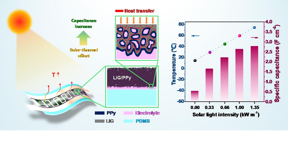 Schematic diagram of fabricating process for the solar-thermal MSC and their energy storage performance under different light intensities
CREDIT
LI Nian
Schematic diagram of fabricating process for the solar-thermal MSC and their energy storage performance under different light intensities
CREDIT
LI Nian
Abstract: Prof. WANG Zhenyang's research group from the Hefei Institutes of Physical Science (HFIPS) of the Chinese Academy of Sciences (CAS) has enhanced the energy storage capacity of graphene supercapacitors via solar heating. Related research results were published in the Journal of Materials Chemistry A.
Hefei, China | Posted on January 28th, 2022
In low temperature environments, the hindered diffusion of electrolyte ions seriously restricts the electrochemical performance of supercapacitors. Electrode materials with solar-thermal properties are expected to provide a new strategy to solve this problem. However, it remains a challenge to develop electrode materials with both excellent solar-thermal properties and high energy storage capacity.
In this research, the researchers prepared graphene films with three-dimensional porous structures using laser-induction technology. They composited the polypyrrole uniformly composited into the graphene network by pulse electrodeposition. Graphene/polypyrrole composite electrodes were obtained and a new type of solar-thermally enhanced supercapacitor was thus constructed.
This supercapacitor has many advantages. When the temperature dropped to -30 centigrade, the electrochemical performance of the supercapacitor, which is normally severely degraded, could be enhanced rapidly to room temperature under solar irradiation at light intensities of 1.0 kW m-2. Meanwhile, at room temperature (15�C), the surface temperature of the devices increased by 45�C under solar irradiation at light intensities of 1.0 kW m-2.
"After the temperature of electrodes was raised, the optimized pore structure and the increased electrolyte ion diffusion rate increased the energy storage capacity by 4.8 times. In addition, since the solid electrolyte was well protected, the capacitance retention rate of the supercapacitor was still as high as 85.8% after 10,000 times of charging and discharging," said Dr. LI Nian, a member of the team.
This work provided new solutions for solving the low temperature problem of supercapacitors and developing high energy density devices and was supported by the National Key R&D Project of China, the National Natural Science Foundation of China, the Anhui Provincial Science and Technology Major Project, and the Anhui Provincial Key R&D Program.
####
For more information, please click here
Contacts:Weiwei ZhaoHefei Institutes of Physical Science, Chinese Academy of Sciences
Office: 86-551-655-91206
Copyright © Hefei Institutes of Physical Science, Chinese Academy of Sciences
If you have a comment, please Contact us.
Issuers of news releases, not 7th Wave, Inc. or Nanotechnology Now, are solely responsible for the accuracy of the content.
Bookmark:


News and information
 �Fruitcake� structure observed in organic polymers June 3rd, 2022
Progressive Medicinal and Herbal Nanoscience for Targeted Drug Delivery Systems June 3rd, 2022
Artificial Intelligence Centered Cancer Nanomedicine: Diagnostics, Therapeutics and Bioethics June 3rd, 2022
Graphene/ Graphite
Nanotubes: a promising solution for advanced rubber cables with 60% less conductive filler June 1st, 2022
Dynamic metasurfaces and metadevices empowered by graphene May 6th, 2022
Graphene crystals grow better under copper cover April 1st, 2022
Govt.-Legislation/Regulation/Funding/Policy
Nanostructured fibers can impersonate human muscles June 3rd, 2022
Bacteria-killing drills get an upgrade Visible light triggers: Rice�s molecular machines to treat infections June 1st, 2022
A one-stop shop for quantum sensing materials May 27th, 2022
Possible Futures
Nanoscale bowtie antenna under optical and electrical excitations June 3rd, 2022
Emerging vaccine nanotechnology June 3rd, 2022
�Fruitcake� structure observed in organic polymers June 3rd, 2022
Progressive Medicinal and Herbal Nanoscience for Targeted Drug Delivery Systems June 3rd, 2022
Discoveries
Nanoscale bowtie antenna under optical and electrical excitations June 3rd, 2022
Emerging vaccine nanotechnology June 3rd, 2022
�Fruitcake� structure observed in organic polymers June 3rd, 2022
Announcements
�Fruitcake� structure observed in organic polymers June 3rd, 2022
Progressive Medicinal and Herbal Nanoscience for Targeted Drug Delivery Systems June 3rd, 2022
Artificial Intelligence Centered Cancer Nanomedicine: Diagnostics, Therapeutics and Bioethics June 3rd, 2022
Battery Technology/Capacitors/Generators/Piezoelectrics/Thermoelectrics/Energy storage
Engineering piezoelectricity and strain sensitivity in CdS to promote piezocatalytic hydrogen evolution May 13th, 2022
Achieving higher performance with potassium ion battery April 15th, 2022
Solar/Photovoltaic
USTC found a pathway to high-quality ZnSe quantum wires April 8th, 2022
Graphene crystals grow better under copper cover April 1st, 2022
Peering into precise ultrafast dynamics in matter March 25th, 2022
�Workhorse� of photovoltaics combined with perovskite in tandem for the first time February 25th, 2022
