
| Date | 28th, Jan 2022 |
|---|
Home > Press > Studied for clean energy, carbon nanotubes find new potential in anticancer drug delivery: Short carbon nanotubes in liposome membranes help fuse the liposomes and cancer cells to directly deliver a cancer-killing drug
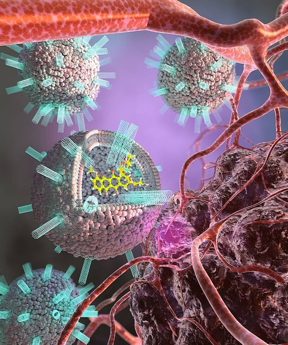 Liposomes studded with carbon nanotubes and carrying a chemotherapy drug dock to the surface of a cancer cell. This causes the liposome to fuse to the cancer cell and deliver the drug, killing the cell.
CREDIT
Image courtesy of Lawrence Livermore National Laboratory. Image created by EllaMaru Studios.
Liposomes studded with carbon nanotubes and carrying a chemotherapy drug dock to the surface of a cancer cell. This causes the liposome to fuse to the cancer cell and deliver the drug, killing the cell.
CREDIT
Image courtesy of Lawrence Livermore National Laboratory. Image created by EllaMaru Studios.
Abstract: The ScienceFundamental science often finds applications beyond its original focus. Previously, scientists found applications for small diameter carbon nanotube porins in energy technology. Nanotube porins are tubes with walls just molecules thick that act as pores through the walls of a thin membrane of liposomes, a type of tiny synthetic particle. Scientists have now assembled these nanotubes in a new way to deliver a cancer drug. The key is that the nanotubes pull the liposomes and the cancer cells together, allowing the membranes of the liposome and cancer to mix. This fusion process allows the drug to freely pass from the liposome to the cell. This results in very effective delivery of the anticancer drug doxorubicin, killing up to 90 percent of diseased cells.
Washington, DC | Posted on January 28th, 2022
The ImpactThis new pathway to deliver a drug directly into a cell interior addresses a long-standing challenge for medicine. It provides a new platform for understanding how to precisely deliver a wide range of drugs to individual cells. This understanding will potentially enhance the arsenal of innovative drug carriers for treatment of difficult to cure diseases. Another potential application includes more efficient methods for administering vaccines.
SummaryCarbon nanotube pores that create and maintain water �wires� could allow for rapid transport of protons in next-generation, artificial, proton-conducting membranes. These membranes could lead to applications such as more efficient fuel cells for powering cars and homes. Scientists have now used reconfigured versions of these same carbon nanotubes to directly introduce the anticancer drug doxorubicin from spherical sacs of phospholipid molecules (liposomes) through the cell plasma membrane into its interior. Chemotherapy is an effective treatment for many cancer patients but delivering these drugs into unhealthy cells is still quite difficult. Doctors have used liposomes to deliver therapeutic drugs to diseased cells for some time. However, this process usually follows an inefficient delivery pathway, and the drugs are often destroyed before they get to the cells. This pathway is bypassed when small diameter, carbon nanotube porins are incorporated into liposomes full of the anticancer drug. These porins allow fusion of liposome and cell membranes, permitting direct delivery of the drug. Computational simulations revealed that tiny dimers of carbon nanotubes embedded in the exterior of the liposome membrane first tether the liposome and cell membranes together very closely. Mixing of the membranes induced by such proximity causes the cells and liposomes to blend. This leads to direct delivery of the drug, killing most of the cancer cells.
FundingThis research was primarily supported by the Department of Energy Office of Science, Office of Basic Energy Sciences and the Laboratory Directed Research and Development program at Lawrence Livermore National Laboratory. Analysis of kinetics was supported by the National Science Foundation and computational work was supported by the Max Planck Society.
####
For more information, please click here
Contacts:Michael ChurchDOE/US Department of Energy
Office: 2028416299
Copyright © DOE/US Department of Energy
If you have a comment, please Contact us.
Issuers of news releases, not 7th Wave, Inc. or Nanotechnology Now, are solely responsible for the accuracy of the content.
Bookmark:


Cancer
 Emerging vaccine nanotechnology June 3rd, 2022
News and information
�Fruitcake� structure observed in organic polymers June 3rd, 2022
Progressive Medicinal and Herbal Nanoscience for Targeted Drug Delivery Systems June 3rd, 2022
Artificial Intelligence Centered Cancer Nanomedicine: Diagnostics, Therapeutics and Bioethics June 3rd, 2022
Nanostructured fibers can impersonate human muscles June 3rd, 2022
Laboratories
Govt.-Legislation/Regulation/Funding/Policy
Nanostructured fibers can impersonate human muscles June 3rd, 2022
Bacteria-killing drills get an upgrade Visible light triggers: Rice�s molecular machines to treat infections June 1st, 2022
A one-stop shop for quantum sensing materials May 27th, 2022
Possible Futures
Nanoscale bowtie antenna under optical and electrical excitations June 3rd, 2022
Emerging vaccine nanotechnology June 3rd, 2022
�Fruitcake� structure observed in organic polymers June 3rd, 2022
Progressive Medicinal and Herbal Nanoscience for Targeted Drug Delivery Systems June 3rd, 2022
Nanotubes/Buckyballs/Fullerenes/Nanorods
Nanotubes: a promising solution for advanced rubber cables with 60% less conductive filler June 1st, 2022
Protective equipment with graphene nanotubes meets the strictest ESD safety standards March 25th, 2022
CEA and Startup C12 Join Forces to Develop Next-Generation Quantum Computers with Multi-Qubit Chips at Wafer Scale March 25th, 2022
A single molecule makes a big splash in the understanding of the two types of water January 7th, 2022
Nanomedicine
Emerging vaccine nanotechnology June 3rd, 2022
Progressive Medicinal and Herbal Nanoscience for Targeted Drug Delivery Systems June 3rd, 2022
Artificial Intelligence Centered Cancer Nanomedicine: Diagnostics, Therapeutics and Bioethics June 3rd, 2022
Nanostructured fibers can impersonate human muscles June 3rd, 2022
Discoveries
Nanoscale bowtie antenna under optical and electrical excitations June 3rd, 2022
Emerging vaccine nanotechnology June 3rd, 2022
�Fruitcake� structure observed in organic polymers June 3rd, 2022
Announcements
�Fruitcake� structure observed in organic polymers June 3rd, 2022
Progressive Medicinal and Herbal Nanoscience for Targeted Drug Delivery Systems June 3rd, 2022
Artificial Intelligence Centered Cancer Nanomedicine: Diagnostics, Therapeutics and Bioethics June 3rd, 2022
Interviews/Book Reviews/Essays/Reports/Podcasts/Journals/White papers/Posters
�Fruitcake� structure observed in organic polymers June 3rd, 2022
Progressive Medicinal and Herbal Nanoscience for Targeted Drug Delivery Systems June 3rd, 2022
Artificial Intelligence Centered Cancer Nanomedicine: Diagnostics, Therapeutics and Bioethics June 3rd, 2022
Nanobiotechnology
Emerging vaccine nanotechnology June 3rd, 2022
Bacteria-killing drills get an upgrade Visible light triggers: Rice�s molecular machines to treat infections June 1st, 2022
Diabetes drug improves antibacterial treatment speed and effectiveness, researchers report May 27th, 2022
Oregon State University research pushes closer to new therapy for pancreatic cancer May 6th, 2022
