
Physicists at Moscow Institute of Physics and Technology (MIPT) and Skolkovo Institute of Science and Technology (Skoltech) have discovered a method to alter and intentionally tune the electronic properties of carbon nanotubes to fulfill the needs of novel electronic devices.
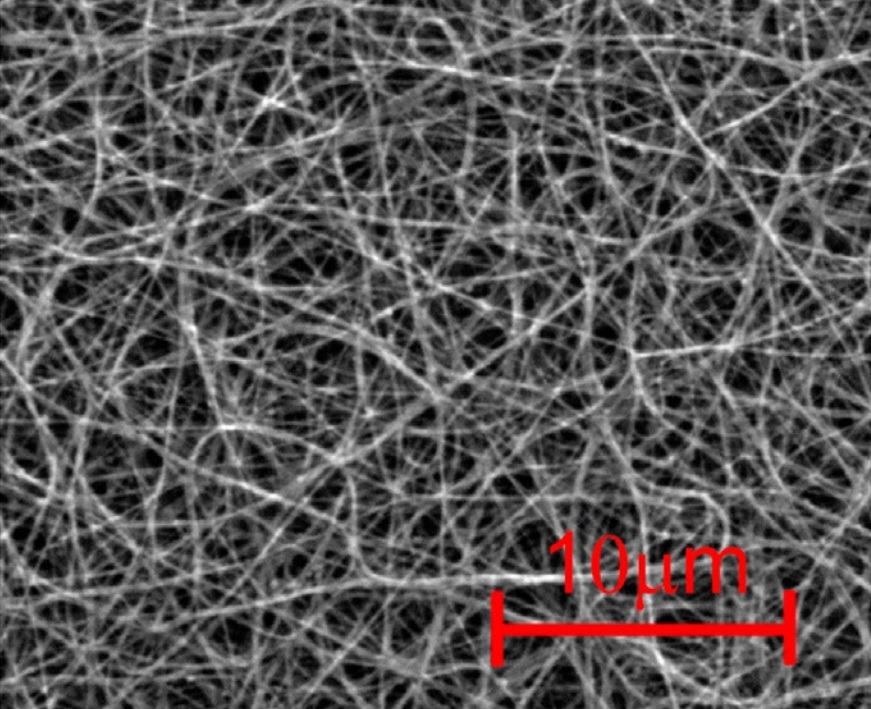 Carbon nanotube film under a scanning electron microscope. Image Credit: Skolkovo Institute of Science and Technology.
The study has been published in the Carbon journal.
Carbon nanomaterials are an extensive class of compounds that consists of fullerenes, graphene, nanofibers, nanotubes and more. Even though the physical properties of several of these materials already appear in textbooks, researchers continue to make new structures and find methods to utilize them in real-life applications.
Macro structures developed as randomly oriented films created of carbon nanotubes appear to look like very thin cobwebs having an area that reaches several dozen square centimeters and thickness of just a few nanometers.
Carbon nanotube films exhibit an incredible combination of physical and chemical properties, like flexibility, stretchability, mechanical stability, outstanding adhesion to several substrates, chemical inertness, unusual optical and electrical properties.
Dissimilar to metallic films, such highly conducting films seem to be light and flexible and, thus, can be utilized in several electrical devices, like modulators, electromagnetic shields, bolometers, antennas and so on.
The awareness of the basic physical principles is vital for the effective use of the films’ electrodynamic and electrical properties in real life. The terahertz and far infrared spectral bands with wavelengths of 2 mm to 500 nm are of particular interest, where the films display typical metallic conductor properties.
Researchers from MIPT and Skoltech analyzed films conductivity in the terahertz and infrared bands with the help of films synthesized by the gas phase deposition technique. Few of the films were created of nanotubes with lengths varying from 0.3 to 13 µm, while others were treated with oxygen plasma for around 100 to 400 seconds and altered their electrodynamic properties in the process.
In a previous study, the authors demonstrated that the conductivity of high-quality pristine films could be precisely explained utilizing the conductivity model valid for metals. In such films, free electrons consist of sufficient energy to overcome possible barriers at the intersections of separate nanotubes and could move very easily over the full film, leading to high conductivity.
But reducing tubes length (down to 0.3 μm) or exposing films to plasma (for longer than 100 seconds) results in a drop in conductivity at low terahertz frequencies (
