
| Date | 12th, Feb 2022 |
|---|
Home > Press > Eyebrow-raising: Researchers reveal why nanowires stick to each other
 Researchers reveal why nanowires stick to each other
CREDIT
Nano Research
Researchers reveal why nanowires stick to each other
CREDIT
Nano Research
Abstract: Nanowires, used in sensors, transistors, optoelectronic devices and other systems that require subatomic preciseness, like to stick together. Untangling electrical wires can be a difficult task � imagine trying to separate out wires 1/1000 the width of a human hair. The self-attraction of nanowires has been a major problem for quality and efficient bulk fabrication, with the potential to catastrophically short-circuit nanowire-based devices, but researchers in China have now revealed why the components cling to one each other.
Beijing, China | Posted on February 11th, 2022
They published their work on Dec. 27, 2021, in Nano Research.
�Electrostatic force, capillary force or van der Waals force has all been considered as driver of self-attraction in nanowires, but the cause remained debatable due to experimental challenges,� said first author Junfeng Cui, Dr. Junfeng Cui, Key Laboratory for Precision and Non-Traditional Machining Technology of Ministry of Education, Dalian University of Technology.
Nanowires attract each other in the air, but they are too tiny to be thoroughly examined without microscopic inspection. Nanowires are typically imaged with an electron microscope, which uses a beam of electrons to visualize especially small subjects � a variable that is difficult to correct in a material as sensitive to electrons as nanowires.
It�s a catch-22: the researchers need the microscope to see how the wires behave, but the microscope changes their behavior. So, the researchers took a step back to the basics and employed an optical microscope. While not able to reveal nearly as much detail as an electron microscope, an optical microscope uses visible light that does not interfere with the nanowires.
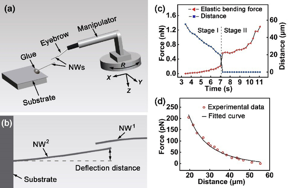
Next, they used a moveable manipulator holding a human eyebrow hair to apply glue to a nanowire and affix it to a substrate. The leftover glue was used to attach another nanowire to the eyebrow hair. Both nanowires were brought into focus in the optical microscope.
�We were able to measure the distance between two individual nanowires and related attractive force in real time,� Cui said, explaining they determined the attractive force by studying how the nanowire deflected from its stationary position. �The two nanowires attached to each other instantaneously when they were close enough, which can be attributed to the electrostatic force.�
Like plastic wrap sticking to a person�s hand, the differently charged electrons in the two nanowires increased as their distance decreased, snapping to each other at close range. And, like plastic wrap, it takes some force to separate them again � van der Waals force, to be precise. A weak interaction between atoms near each other, the van der Waals force can be easily broken by exerting stronger mechanical force to separate the materials.
�Providing a safe distance is the key to avoid nanowires bunching up together and possibly short circuiting leading to disastrous accidents, especially the fields of aerospace and nuclear energy � but, on the other hand, nanowire self-attraction has great potential in such applications as nanotweezers or nanoelectromechanical switches,� Cui said. �Understanding the self-attraction of nanowires is key to fabricating high-quality nanowires and developing high-performance nanowire-based devices. Our versatile method to identify and measure nanowire self-attraction revealed that the attraction behavior of nanowires can be controlled, as we hoped.�
Cui is also affiliated with the Key Laboratory of Marine Materials and Related Technologies, Ningbo Institute of Materials Technology and Engineering, Chinese Academy of Sciences (CAS).
Other contributors include Zhenyu Zhang, Key Laboratory for Precision and Non-Traditional Machining Technology of Ministry of Education, Dalian University of Technology; Le Lv, Guoxin Chen and Nan Jiang, Key Laboratory of Marine Materials and Related Technologies, Ningbo Institute of Materials Technology and Engineering, CAS; and Kazuhito Nishimura, Advanced Nano-Processing Engineering Lab, Mechanical Engineering, Kogakuin University.
The Youth Innovation Promotion Association CAS, the Science and Technology Major Project of Ningbo, the National Key R&D Program of China, the National Natural Science Foundation of China, Changjiang Scholars Program of Chinese Ministry of Education, the Xinghai Science Funds for Distinguished Young Scholars at Dalian University of Technology and the Collaborative Innovation Center of Major Machine Manufacturing in Liaoning supported this work.
####
About Tsinghua University PressEstablished in 1980, belonging to Tsinghua University, Tsinghua University Press (TUP) is a leading comprehensive higher education and professional publisher in China. Committed to building a top-level global cultural brand, after 41 years of development, TUP has established an outstanding managerial system and enterprise structure, and delivered multimedia and multi-dimensional publications covering books, audio, video, electronic products, journals and digital publications. In addition, TUP actively carries out its strategic transformation from educational publishing to content development and service for teaching & learning and was named First-class National Publisher for achieving remarkable results.
About Nano Research
Nano Research is a peer-reviewed, international and interdisciplinary research journal, sponsored by Tsinghua University and the Chinese Chemical Society. It offers readers an attractive mix of authoritative and comprehensive reviews and original cutting-edge research papers. After more than 10 years of development, it has become one of the most influential academic journals in the nano field. Rapid review to ensure quick publication is a key feature of Nano Research. In 2020 InCites Journal Citation Reports, Nano Research has an Impact Factor of 8.897 (8.696, 5 years), the total cites reached 23150, and the number of highly cited papers reached 129, ranked among the top 2.5% of over 9000 academic journals, ranking first in China's international academic journals.
For more information, please click here
Contacts:Yao MengTsinghua University Press
Office: 86-108-347-0574
Copyright © Tsinghua University Press
If you have a comment, please Contact us.
Issuers of news releases, not 7th Wave, Inc. or Nanotechnology Now, are solely responsible for the accuracy of the content.
Bookmark:


News and information
 �Fruitcake� structure observed in organic polymers June 3rd, 2022
Progressive Medicinal and Herbal Nanoscience for Targeted Drug Delivery Systems June 3rd, 2022
Artificial Intelligence Centered Cancer Nanomedicine: Diagnostics, Therapeutics and Bioethics June 3rd, 2022
Imaging
Snapshot measurement of single nanostructure�s circular dichroism March 25th, 2022
Better understanding superconductors with Higgs spectroscopy Prof. Stefan Kaiser from TU Dresden awarded ERC Consolidator Grant March 18th, 2022
Visualizing the invisible: New fluorescent DNA label reveals nanoscopic cancer features March 4th, 2022
Possible Futures
Nanoscale bowtie antenna under optical and electrical excitations June 3rd, 2022
Emerging vaccine nanotechnology June 3rd, 2022
�Fruitcake� structure observed in organic polymers June 3rd, 2022
Progressive Medicinal and Herbal Nanoscience for Targeted Drug Delivery Systems June 3rd, 2022
Chip Technology
�Fruitcake� structure observed in organic polymers June 3rd, 2022
On-Chip Photodetection: Two-dimensional material heterojunctions hetero-integration May 13th, 2022
Small microring array enables large complex-valued matrix multiplication May 13th, 2022
Nanoelectronics
Visualizing temperature transport: An unexpected technique for nanoscale characterization November 19th, 2021
Leibniz Prize winner Professor Dr. Oliver G. Schmidt moves to Chemnitz University of Technology: President Professor Dr. Gerd Strohmeier refers to an 'absolute top transfer' September 10th, 2021
Non-linear effects in coupled optical microcavities August 5th, 2021
Discoveries
Nanoscale bowtie antenna under optical and electrical excitations June 3rd, 2022
Emerging vaccine nanotechnology June 3rd, 2022
�Fruitcake� structure observed in organic polymers June 3rd, 2022
Materials/Metamaterials
Nanotubes: a promising solution for advanced rubber cables with 60% less conductive filler June 1st, 2022
New route to build materials out of tiny particles May 27th, 2022
A one-stop shop for quantum sensing materials May 27th, 2022
Announcements
�Fruitcake� structure observed in organic polymers June 3rd, 2022
Progressive Medicinal and Herbal Nanoscience for Targeted Drug Delivery Systems June 3rd, 2022
Artificial Intelligence Centered Cancer Nanomedicine: Diagnostics, Therapeutics and Bioethics June 3rd, 2022
Interviews/Book Reviews/Essays/Reports/Podcasts/Journals/White papers/Posters
�Fruitcake� structure observed in organic polymers June 3rd, 2022
Progressive Medicinal and Herbal Nanoscience for Targeted Drug Delivery Systems June 3rd, 2022
Artificial Intelligence Centered Cancer Nanomedicine: Diagnostics, Therapeutics and Bioethics June 3rd, 2022
Tools
Snapshot measurement of single nanostructure�s circular dichroism March 25th, 2022
JEOL Introduces New Scanning Electron Microscope with �Simple SEM� Automation and Live Elemental and 3D Analysis January 14th, 2022
Super-resolved imaging of a single cold atom on a nanosecond timescale January 7th, 2022
Major instrumentation initiative for research into quantum technologies: Paderborn University receives funding from German Research Foundation December 24th, 2021
