
| Date | 12th, Feb 2022 |
|---|
Home > Press > Nanopores feel the heat: Researchers at Osaka University use a tiny thermometer to directly monitor changes in temperature when ions pass through a nanopore, which may lead to more efficient DNA sequencing technology
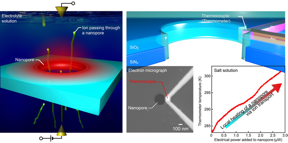 Schematic diagram showing the process of ionic heat dissipation in a nanopore (left). A nanoscale thermometer embedded on one side of the nanopore to detect local temperature changes caused by voltage-driven ionic transport (right).
CREDIT
� 2022 M. Tsutsui et al., Ionic heat dissipation in solid-state pores. Science Advances
Schematic diagram showing the process of ionic heat dissipation in a nanopore (left). A nanoscale thermometer embedded on one side of the nanopore to detect local temperature changes caused by voltage-driven ionic transport (right).
CREDIT
� 2022 M. Tsutsui et al., Ionic heat dissipation in solid-state pores. Science Advances
Abstract: Scientists from SANKEN (the Institute of Scientific and Industrial Research) at Osaka University measured the thermal effects of ionic flow through a nanopore using a thermocouple. They found that, under most conditions, both the current and heating power varied with applied voltage as predicted by Ohm�s law. This work may lead to more advanced nanoscale sensors.
Osaka, Japan | Posted on February 11th, 2022
Nanopores, which are tiny openings in a membrane so small that only a single DNA strand or virus particle can pass through, are an exciting new platform for building sensors. Often, an electrical voltage is applied between the two side of the membrane to draw the substance to be analyzed through the nanopore. At the same time, charged ions in the solution can be transported, but their effect on the temperature has not been extensively studied. A direct measurement of the thermal effects caused by these ions can help make nanopores more practical as sensors.
Now, a team of researchers at Osaka University have created a thermocouple made of gold and platinum nanowires with a point of contact just 100 nm in size that served as the thermometer. It was used to measure the temperature directly next to a nanopore cut into a 40-nm-thick film suspended on a silicon wafer.
Joule heating occurs when electrical energy is converted into heat by the resistance in a wire. This effect occurs in toasters and electric stoves, and can be thought of as inelastic scattering by the electrons when they collide with the nuclei of the wire. In the case of a nanopore, the scientists found that thermal energy was dissipated in proportion to the momentum of the ionic flow, which is in line with the predictions of Ohm�s law. When studying a 300-nm-sized nanopore, the researchers recorded the ionic current of a phosphate buffered saline as a function of applied voltage. �We demonstrated nearly ohmic behavior over a wide range of experimental conditions,� first author Makusu Tsutsui says.
With smaller nanopores, the heating effect became more pronounced, because less fluid from the cooler side could pass through to equalize the temperature. As a result, the heating could cause a non-negligible effect, with nanopores experiencing a temperature increase of a few degrees under standard operating conditions. �We expect the development of novel nanopore sensors that can not only identify viruses, but might also be able to deactivate them at the same time,� senior author Tomoji Kawai says. The researchers proposed other situations in which the heating can be beneficial�for example, to prevent the nanopore from being clogged by a polymer, or to separate the strands of DNA being sequenced.
####
About Osaka UniversityOsaka University was founded in 1931 as one of the seven imperial universities of Japan and is now one of Japan's leading comprehensive universities with a broad disciplinary spectrum. This strength is coupled with a singular drive for innovation that extends throughout the scientific process, from fundamental research to the creation of applied technology with positive economic impacts. Its commitment to innovation has been recognized in Japan and around the world, being named Japan's most innovative university in 2015 (Reuters 2015 Top 100) and one of the most innovative institutions in the world in 2017 (Innovative Universities and the Nature Index Innovation 2017). Now, Osaka University is leveraging its role as a Designated National University Corporation selected by the Ministry of Education, Culture, Sports, Science and Technology to contribute to innovation for human welfare, sustainable development of society, and social transformation.
For more information, please click here
Contacts:Saori ObayashiOsaka University
Office: 81-661-055-886
Copyright © Osaka University
If you have a comment, please Contact us.
Issuers of news releases, not 7th Wave, Inc. or Nanotechnology Now, are solely responsible for the accuracy of the content.
Bookmark:


Possible Futures
 Nanoscale bowtie antenna under optical and electrical excitations June 3rd, 2022
Emerging vaccine nanotechnology June 3rd, 2022
�Fruitcake� structure observed in organic polymers June 3rd, 2022
Progressive Medicinal and Herbal Nanoscience for Targeted Drug Delivery Systems June 3rd, 2022
Nanomedicine
Emerging vaccine nanotechnology June 3rd, 2022
Progressive Medicinal and Herbal Nanoscience for Targeted Drug Delivery Systems June 3rd, 2022
Artificial Intelligence Centered Cancer Nanomedicine: Diagnostics, Therapeutics and Bioethics June 3rd, 2022
Nanostructured fibers can impersonate human muscles June 3rd, 2022
Sensors
A one-stop shop for quantum sensing materials May 27th, 2022
New nanomechanical oscillators with record-low loss May 13th, 2022
Discoveries
Nanoscale bowtie antenna under optical and electrical excitations June 3rd, 2022
Emerging vaccine nanotechnology June 3rd, 2022
�Fruitcake� structure observed in organic polymers June 3rd, 2022
Announcements
�Fruitcake� structure observed in organic polymers June 3rd, 2022
Progressive Medicinal and Herbal Nanoscience for Targeted Drug Delivery Systems June 3rd, 2022
Artificial Intelligence Centered Cancer Nanomedicine: Diagnostics, Therapeutics and Bioethics June 3rd, 2022
Interviews/Book Reviews/Essays/Reports/Podcasts/Journals/White papers/Posters
�Fruitcake� structure observed in organic polymers June 3rd, 2022
Progressive Medicinal and Herbal Nanoscience for Targeted Drug Delivery Systems June 3rd, 2022
Artificial Intelligence Centered Cancer Nanomedicine: Diagnostics, Therapeutics and Bioethics June 3rd, 2022
