
| Date | 16th, Feb 2022 |
|---|
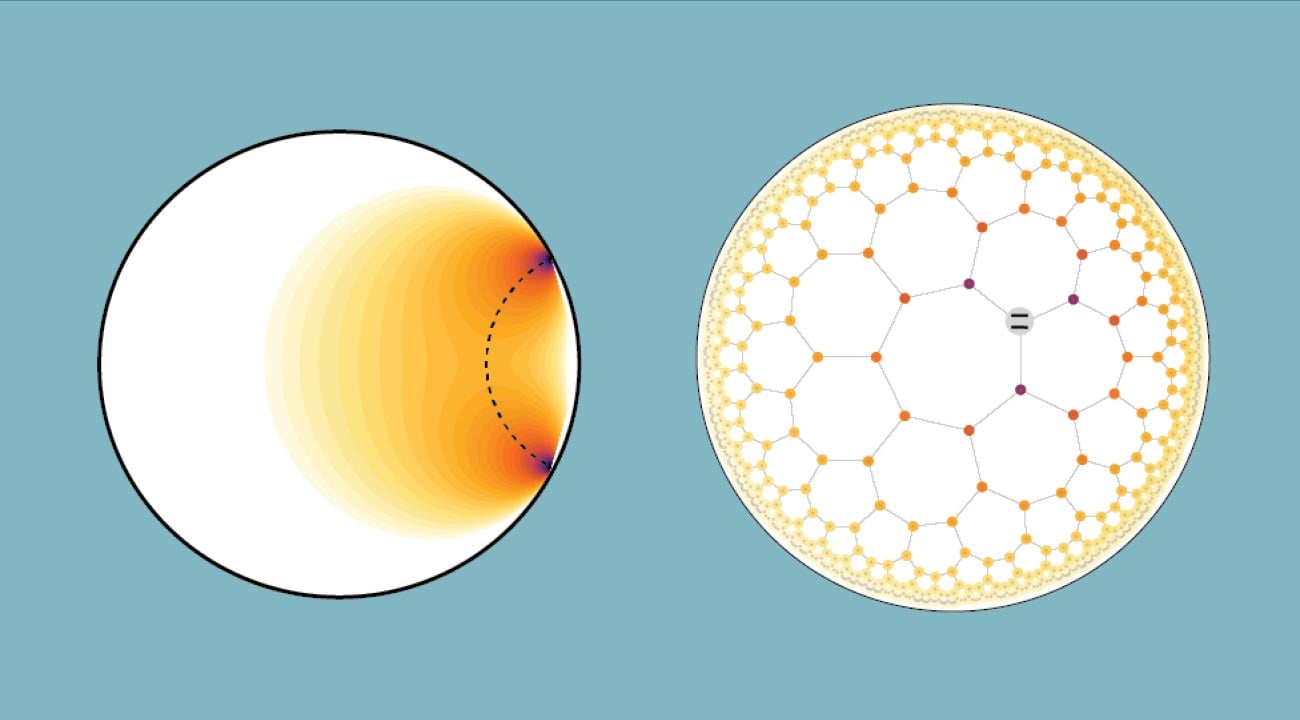
(Left image) Microwave photons that create an interaction between pairs of qubits (black dots on the edge) in a hyperbolic space are most likely to travel along the shortest path (dotted line). In both images, the darker colors show where photons are more likely to be found. (Right image) A quantum state formed by a qubit (grey dot containing parallel black lines) and an attached microwave photon that can be found at one of the intersections of the grid representing a curved space. Credit: Przemyslaw Bienias/JQI
One of the mind-bending ideas that physicists and mathematicians have come up with is that space itself—not just objects in space—can be curved. When space curves (as happens dramatically near a black hole), sizes and directions defy normal intuition. Something as straightforward as defining a straight line requires careful consideration.
Understanding curved spaces is important to expanding our knowledge of the universe, but it is fiendishly difficult to study curved spaces in a lab setting (even using simulations). A previous collaboration between researchers at JQI explored using labyrinthine circuits made of superconducting resonators to simulate the physics of certain curved spaces (see the previous story for additional background information and motivation of this line of research). In particular, the team looked at hyperbolic lattices that represent spaces—called
