
Though these nanostructures improve a sensor’s ability to detect molecules, their tiny dimensions make it hard to guide the molecules to the correct area of the sensor.
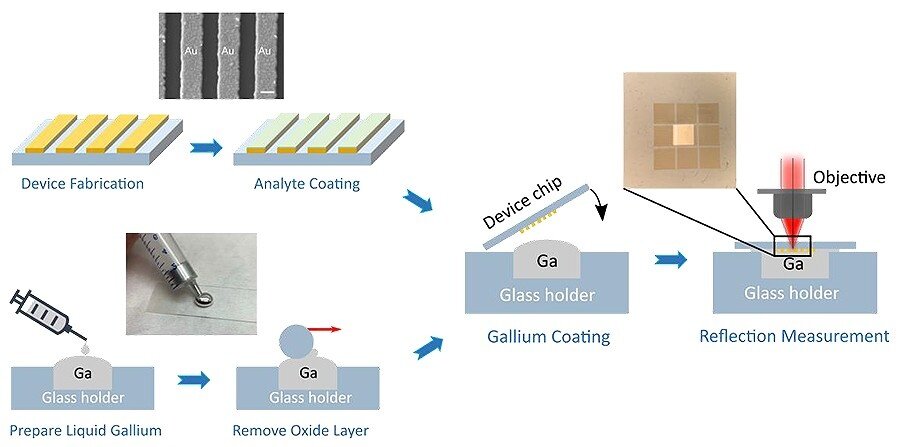
The technology developed by the Buffalo team is designed to solve that problem; the sensors work with light in the mid-infrared band of the spectrum and consist of several arrays of tiny rectangular strips of gold. The strips are dipped in 1-octadecanethiol (ODT), the chemical compound that the researchers chose to identify.
They added a drop of liquid gallium, and, lastly, they placed a thin glass cover on top to form a sandwich-like structure.
The design of the sensor, with its layers and cavities, creates what the researchers call a “nanopatch antenna.” The antenna both funnels molecules into the cavities and absorbs enough infrared light to analyze biological and chemical samples.
“Even a single layer of molecule in our sensor can lead to a 10% change in the amount of light reflected, whereas a typical sensor may only produce a 1% change,” Liu said.
After measuring the ODT, the researchers removed the liquid gallium from the sensor chip surface with a swab. This process allows the sensor to be reused, which could make it more cost-effective than similar alternatives.
“The structure of our sensor makes it suitable for point-of-care applications that can be implemented by a nurse on a patient, or even outside the hospital in a patient’s home,” Liu said.
The team intends to continue to refine the sensor with the goal of using it for bioanalytical sensing and medical diagnostics applications, such as sensing biomarkers linked to certain diseases.
The research was published in Advanced Materials (www.doi.org/10.1002/adma.202107950).
