Samples of the glass are poured in the lab
Aston University
1/2
Samples of the glass are poured in the lab
Aston University
2/2
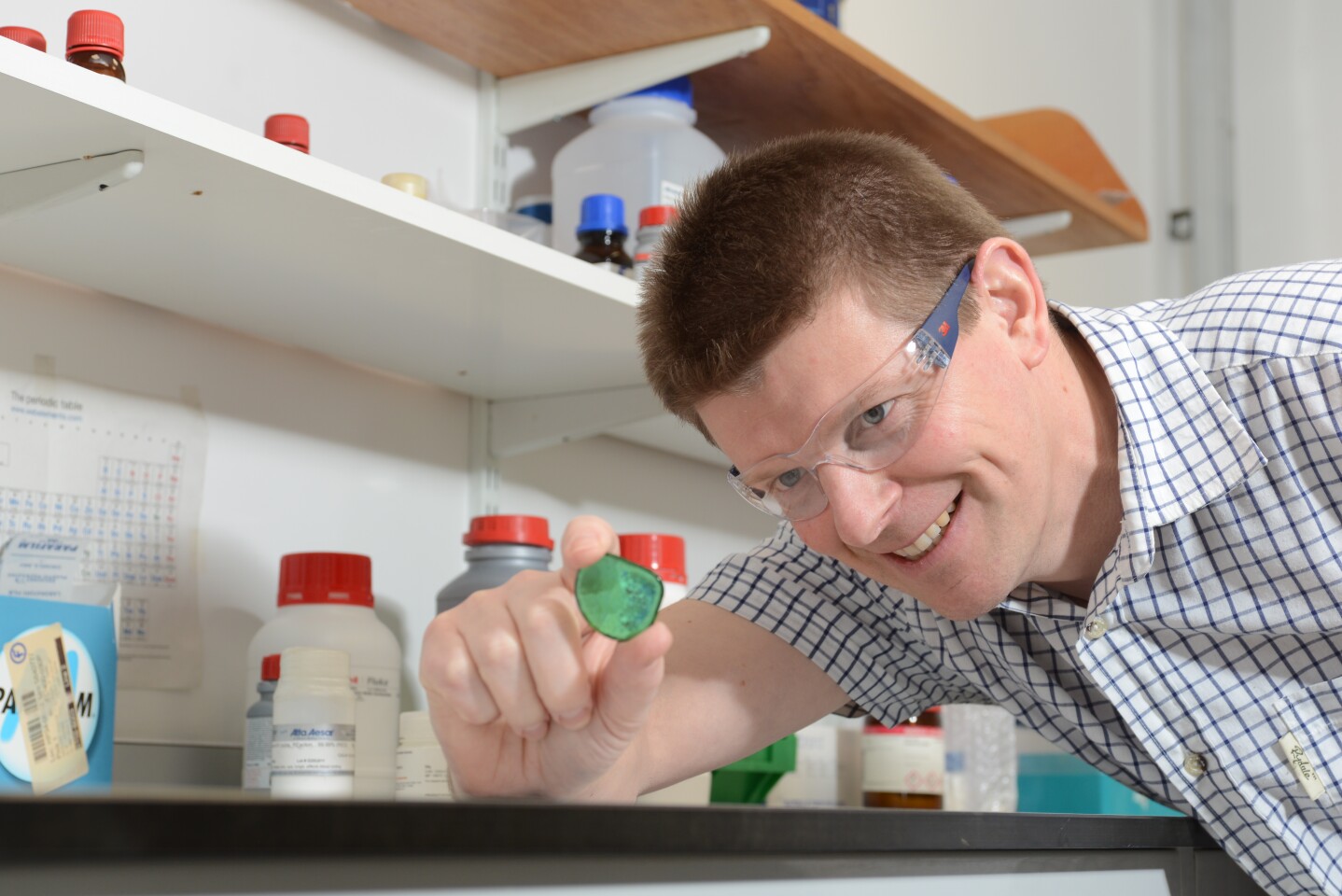
Prof. Richard Martin with one of the samples, prior to the powdering process
Aston University
For some time now, an antimicrobial material known as bioactive glass has been put forward for use in applications such as medical implants, hospital surfaces and wound dressings. Now, scientists report that they have boosted its bacteria-killing effect by over 100 times.
Typically, bioactive glass incorporates nanoparticles of a specific antibacterial metal oxide. Therefore, one might assume that if two types of oxides were used, the effect would be doubled.
However, researchers at Britain's Aston University have discovered that depending on which two metal oxides are combined, the resulting bioactive glass can actually be much more effective than glass made with either one of the oxides on its own.
Led by Prof. Richard Martin, the team created samples of bioactive glass which contained either zinc, copper or cobalt alone, along with samples that incorporated two of the metal oxides in different combinations. These samples were each ground into a powder, sterilized, then added to colonies of toxic Escherichia coli and Staphylococcus aureus bacteria, and to cultures of Candida abicans fungus.
Aston University
After 24 hours, glass that combined copper with either zinc or cobalt proved to be over 100 times more effective at killing E. coli than samples which contained only one oxide. The glass that specifically combined copper with zinc was similarly effective at eradicating S. aureus. Glass made with a combination of cobalt and zinc, on the other hand, was shown to be best at killing the fungus.
"It was exciting to run our experiments and find something that is significantly better at stopping infection in its tracks and could potentially reduce the number of antibiotic treatments that are prescribed," said Martin. "We believe combining antimicrobial metal oxides has significant potential for numerous applications."
The research is described in a paper that was recently published in the journal ACS Biomaterials Science & Engineering.
Source: Aston University