
Thin targets are necessary for higher ion energy in laser ion acceleration. However, it’s been difficult to directly accelerate ions with an extremely thin target regime because the noise components of an intense laser tend to destroy the targets before the main peak of the laser pulse. To mitigate this, plasma mirrors are deployed to remove the noise components in order to realize efficient ion acceleration with an intense laser.
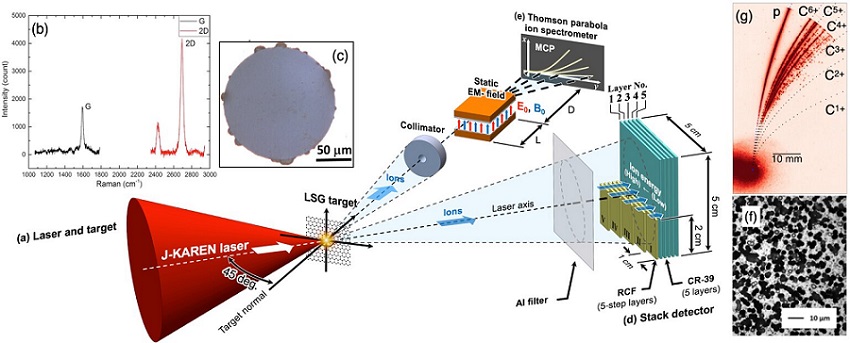
“Atomically thin graphene is transparent, highly electrically and thermally conductive, and lightweight, while also being the strongest material,” said study author Wei-Yen Woon of National Central University. “To date, graphene has seen a variety of applications, including those in transportation, medicine, electronics, and energy. We demonstrate another disruptive application of graphene in the field of laser-ion acceleration, in which the unique features of graphene play an indispensable role.”
Direct irradiation of the LSG targets generate MeV protons and carbons from subrelativistic to relativistic laser intensities from low-contrast to high-contrast conditions without a plasma mirror, demonstrating the durability of graphene.
“The outcomes of this research are applicable to the development of compact and efficient laser-driven ion accelerators for cancer therapy, laser nuclear fusion, high-energy physics, and laboratory astrophysics,” said lead author Yasuhiro Kuramitsu of Osaka University.
The direct acceleration of energetic ions without the use of a plasma mirror, he continued, demonstrates the utility of LSG. The researchers plan to use the atomically thin LSG as target mount to accelerate other materials that can’t stand on their own.
They also plan to show the energetic ion acceleration at nonrelativistic intensity, which would enable the investigation of laser ion acceleration at relatively small laser facilities.
“Furthermore, even without a plasma mirror at the extremely thin target regime, energetic ion acceleration is realized,” Kuramitsu said. “This opens up a new regime of laser-driven ion acceleration.”
The research was published in Scientific Reports (www.doi.org/10.1038/s41598-022-06055-4).
