
| Date | 13th, Mar 2022 |
|---|
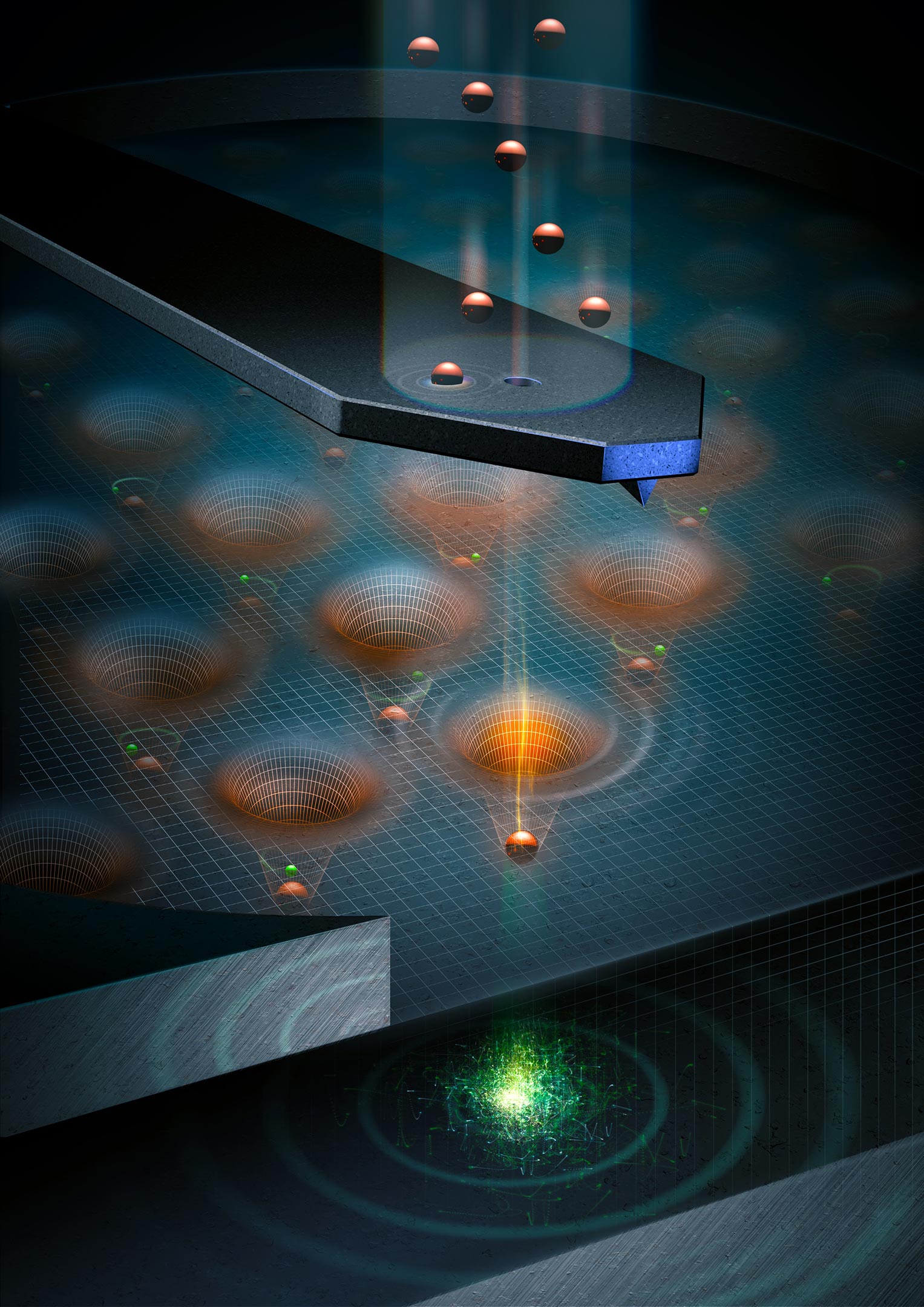
Illustration of the single atom technique. (Cropped – click image for full view.) Credit: David Jamieson, University of Melbourne
Atom by atom: new silicon computer chip technique opens up quantum computing construction possibilities.
Quantum computers could be constructed cheaply and reliably using a new technique perfected by a University of Melbourne-led team that embeds single atoms in silicon wafers, one-by-one, mirroring methods used to build conventional devices, in a process outlined in an Advanced Materials paper.
The new technique – developed by Professor David Jamieson and co-authors from UNSW Sydney, Helmholtz-Zentrum Dresden-Rossendorf (HZDR), Leibniz Institute of Surface Engineering (IOM), and RMIT – can create large scale patterns of counted atoms that are controlled so their quantum states can be manipulated, coupled and read-out.
Lead author of the paper, Professor Jamieson said his team’s vision was to use this technique to build a very, very large-scale quantum device.
“We believe we ultimately could make large-scale machines based on single atom quantum bits by using our method and taking advantage of the manufacturing techniques that the semiconductor industry has perfected,” Professor Jamieson said.
