
| Date | 9th, Apr 2022 |
|---|
Home > Press > 'Frustrated' nanomagnets order themselves through disorder: Interactions between alternating layers of exotic, 2D material create 'entropy-driven order' in a structured system of magnets at equilibrium
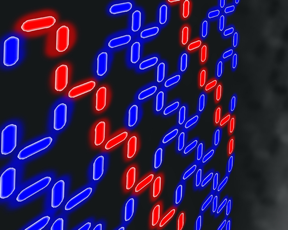 Extremely small arrays of magnets, known as tetris spin ice (shown here), can order themselves by increasing their disorder.
CREDIT
Credit: University of Illinois at Urbana-Champaign
Extremely small arrays of magnets, known as tetris spin ice (shown here), can order themselves by increasing their disorder.
CREDIT
Credit: University of Illinois at Urbana-Champaign
Abstract: Extremely small arrays of magnets with strange and unusual properties can order themselves by increasing entropy, or the tendency of physical systems to disorder, a behavior that appears to contradict standard thermodynamics ? but doesn?t.
Los Alamos, NM | Posted on April 8th, 2022
?Paradoxically, the system orders because it wants to be more disordered,? said Cristiano Nisoli, a physicist at Los Alamos and coauthor of a paper about the research in Nature Physics. ?Our research demonstrates entropy-driven order in a structured system of magnets at equilibrium.?
The system examined in this work, known as tetris spin ice, was studied as part of a long-standing collaboration between Nisoli and Peter Schiffer at Yale University, with theoretical analysis and simulations led at Los Alamos and experimental work led at Yale. The research team includes scientists from a number of universities and academic institutions.
Nanomagnet arrays, like tetris spin ice, show promise as circuits of logic gates in neuromorphic computing, a leading-edge computing architecture that closely mimics how the brain works. They also have possible applications in a number of high-frequency devices using ?magnonics? that exploit the dynamics of magnetism on the nanoscale.
Entropy is the measure of the state of disorder, randomness or uncertainty in a physical system. A liquid, for instance, has high entropy because at warm temperatures ? high energy ? its molecules are free to move around in a random, disordered way.
But when liquids are cooled to form solids, the molecules calm down and order themselves through interactions to optimize their energy. They can arrange themselves in a crystal lattice in only a limited number of configurations. This lowers their entropy: they are highly ordered.
Some systems, however, are not so simple. Parts of the system settle in an orderly way, but others don?t. These ?frustrated? systems retain disorder.
Tetris spin ice, which is composed of 2D arrays of very small magnets that interact but are frustrated, is a strange mix of the two cases. The magnetic pole orientations frustrated in such way that the system retains some order while remaining disordered. At low temperature it decomposes into alternating ordered and disordered stripes.
The apparent paradox of increasing entropy with increasing order is resolved by the entropic interaction between the alternating layers. By mutual ordering of the ordered stripes, the system increases the disorder in the other stripes. Thus, order happens without any decrease in energy, but via an increase in entropy.
?No law of thermodynamics is truly broken,? Nisoli said. ?The concept that systems order by reducing entropy applies to most systems, but, as we show, not to all. Our system is exotic and behaves counterintuitively, with an increase of entropy, a measure of disorder, being the driver of visible order.?
The research team comprised members from Lawrence Berkeley National Laboratory, Los Alamos, Seagate Technology, University of Illinois at Urbana-Champaign, University of Liverpool, University of Minnesota, Wayne State University and Yale.
Funding: Laboratory Directed Research and Development at Los Alamos National Laboratory and U.S. Department of Energy Office of Basic Energy Sciences, and National Science Foundation.
####
For more information, please click here
Contacts:Charles PolingDOE/Los Alamos National Laboratory
Cell: 505-257-8006
Copyright © DOE/Los Alamos National Laboratory
If you have a comment, please Contact us.
Issuers of news releases, not 7th Wave, Inc. or Nanotechnology Now, are solely responsible for the accuracy of the content.
Bookmark:


 Engineering piezoelectricity and strain sensitivity in CdS to promote piezocatalytic hydrogen evolution May 13th, 2022
Small microring array enables large complex-valued matrix multiplication May 13th, 2022
?Nanomagnetic? computing can provide low-energy AI, researchers show May 6th, 2022
Laboratories
Could quantum technology be New Mexico?s next economic boon? Quantum New Mexico Coalition aims to establish state as national hub April 1st, 2022
Entanglement unlocks scaling for quantum machine learning: New No-Free-Lunch theorem for quantum neural networks gives hope for quantum speedup February 25th, 2022
Govt.-Legislation/Regulation/Funding/Policy
On-Chip Photodetection: Two-dimensional material heterojunctions hetero-integration May 13th, 2022
The future of desalination? A fast, efficient, selective membrane for purifying saltwater May 13th, 2022
Possible Futures
New nanomechanical oscillators with record-low loss May 13th, 2022
Study finds nanomedicine targeting lymph nodes key to triple negative breast cancer treatment: In mice, nanomedicine can remodel the immune microenvironment in lymph node and tumor tissue for long-term remission and lung tumor elimination in this form of metastasized breast cance May 13th, 2022
Discoveries
New nanomechanical oscillators with record-low loss May 13th, 2022
Study finds nanomedicine targeting lymph nodes key to triple negative breast cancer treatment: In mice, nanomedicine can remodel the immune microenvironment in lymph node and tumor tissue for long-term remission and lung tumor elimination in this form of metastasized breast cance May 13th, 2022
Announcements
New nanomechanical oscillators with record-low loss May 13th, 2022
Study finds nanomedicine targeting lymph nodes key to triple negative breast cancer treatment: In mice, nanomedicine can remodel the immune microenvironment in lymph node and tumor tissue for long-term remission and lung tumor elimination in this form of metastasized breast cance May 13th, 2022
Interviews/Book Reviews/Essays/Reports/Podcasts/Journals/White papers/Posters
On-Chip Photodetection: Two-dimensional material heterojunctions hetero-integration May 13th, 2022
Engineering piezoelectricity and strain sensitivity in CdS to promote piezocatalytic hydrogen evolution May 13th, 2022
Research partnerships
Rice ?metalens? could disrupt vacuum UV market: Solid-state nanophotonic technology could potentially replace cabinets of equipment May 6th, 2022
Nanoclusters self-organize into centimeter-scale hierarchical assemblies April 22nd, 2022
