
| Date | 9th, Apr 2022 |
|---|
Home > Press > USTC found a pathway to high-quality ZnSe quantum wires
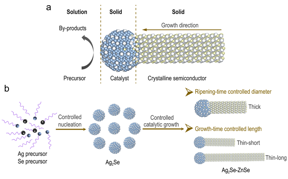 (a) The solution-solid-solid growth mechanism. (b) Two-step catalyzed growth for independent radial and axial size control of ZnSe QWs.
CREDIT
?Science China Press
(a) The solution-solid-solid growth mechanism. (b) Two-step catalyzed growth for independent radial and axial size control of ZnSe QWs.
CREDIT
?Science China Press
Abstract: One-dimensional semiconductor nanowires with strong quantum confinement effect, i.e. quantum wires (QWs), are of great interest for applications in advanced optoelectronics and photochemical conversions. Beyond the state-of-the-art Cd-containing ones, ZnSe QWs, as a representative heavy-metal-free semiconductor, have shown the utmost potential for next-generation environmental-friendly applications.
Beijing, China | Posted on April 8th, 2022
Unfortunately, ZnSe nanowires produced yet are largely limited to the strong quantum confinement regime with near-violet-light absorption or to the bulk regime with undiscernible exciton features. Simultaneous, on-demand, and high-precision manipulations on their radial and axial sizes ? that allows strong quantum confinement in the blue-light region ? has so far been challenging, which substantially impedes their further applications.
In a new article published in the National Science Review, a research team led by professor YU Shuhong at University of Science and Technology of China (USTC) has reported the on-demand synthesis of high-quality, blue-light-active ZnSe QWs by developing a flexible synthetic approach ? a two-step catalytic growth strategy that enables independent, high-precision, and wide-range controls over the diameter and length of ZnSe QWs. In this way, they bridge the gap between prior magic-sized ZnSe QWs and bulk-like ZnSe nanowires.
The researchers found that a new epitaxial orientation between the cubic-phase catalyst tips and wurtzite ZnSe QWs kinetically favors the formation of ultrathin, stacking-fault free QWs. The strong quantum confinement, high-degree size control, and the absence of mixed phases together lead to their well-defined, ultranarrow excitonic absorption in the blue-light region with full width at half maximum (FWHM) of sub-13 nm. After surface thiol passivation, they further eliminated the surface electron traps in these ZnSe QWs, resulting in long-lived charge carriers and high-efficiency solar-to-H2 conversion.
The two-step catalyzed growth strategy is believed to be general for a variety of colloidal nanowires. The access to those high-quality nanowires would thus offer a versatile material library for heavy-metal free applications in solar fuels and optoelectronics in the future.
####
For more information, please click here
Contacts:Bei YanScience China Press
Office: 86-10-64015905Expert Contact
Shu-Hong YuUniversity of Science and Technology of China
Copyright © Science China Press
If you have a comment, please Contact us.
Issuers of news releases, not 7th Wave, Inc. or Nanotechnology Now, are solely responsible for the accuracy of the content.
Bookmark:


 Engineering piezoelectricity and strain sensitivity in CdS to promote piezocatalytic hydrogen evolution May 13th, 2022
Small microring array enables large complex-valued matrix multiplication May 13th, 2022
Engineering piezoelectricity and strain sensitivity in CdS to promote piezocatalytic hydrogen evolution May 13th, 2022
Small microring array enables large complex-valued matrix multiplication May 13th, 2022
Going gentle on mechanical quantum systems: New experimental work establishes how quantum properties of mechanical quantum systems can be measured without destroying the quantum state May 13th, 2022
Small microring array enables large complex-valued matrix multiplication May 13th, 2022
Lightening up the nanoscale long-wavelength optoelectronics May 13th, 2022
Small microring array enables large complex-valued matrix multiplication May 13th, 2022
Going gentle on mechanical quantum systems: New experimental work establishes how quantum properties of mechanical quantum systems can be measured without destroying the quantum state May 13th, 2022
Small microring array enables large complex-valued matrix multiplication May 13th, 2022
Engineering piezoelectricity and strain sensitivity in CdS to promote piezocatalytic hydrogen evolution May 13th, 2022
Small microring array enables large complex-valued matrix multiplication May 13th, 2022
Lightening up the nanoscale long-wavelength optoelectronics May 13th, 2022
Development of high-durability single-atomic catalyst using industrial humidifier: Identification of the operating mechanism of cobalt-based single-atomic catalyst and development of a mass production process. Utilization for catalyst development in various fields including fuel May 13th, 2022
Development of high-durability single-atomic catalyst using industrial humidifier: Identification of the operating mechanism of cobalt-based single-atomic catalyst and development of a mass production process. Utilization for catalyst development in various fields including fuel May 13th, 2022
Faster, more efficient nanodevice to filter proton and alkaline metal ions: Monash University researchers have developed a faster, more efficient nanodevice to filter proton and alkaline metal ions which will help design next-generation membranes for clean energy technology, conv April 8th, 2022
Lightening up the nanoscale long-wavelength optoelectronics May 13th, 2022
Small microring array enables large complex-valued matrix multiplication May 13th, 2022
Graphene crystals grow better under copper cover April 1st, 2022
?Workhorse? of photovoltaics combined with perovskite in tandem for the first time February 25th, 2022
