
The realization of UV-C laser diodes based on AlGaN has been challenging, according to the Cornell team. Wide-bandgap semiconductors exhibit low carrier mobilities, large dopant activation energies, and asymmetries between electron and hole transport. The team’s approach surmounted these challenges by using an AlGaN semiconductor material system to develop a high-quality DUV emitter.
“It is known that this is a material that is suitable, but it was a materials synthesis problem,” researcher Len van Deurzen said. “The challenge is making the materials pure enough that they're actually going to be useful and sustain the requirements of a laser.”
The team used plasma-assisted molecular beam epitaxy, a crystal growth technique, to grow a high-quality crystal of aluminum nitride (AlN). An AlGaN double heterostructure was grown by molecular beam epitaxy on the single-crystal AlN.
“We need multiple aluminum gallium nitride layers stacked on top of each other and one important parameter is the interface quality between those layers,” van Deurzen said. “We can grow very sharp interfaces without the impurities and dislocations that form with other growth techniques.”
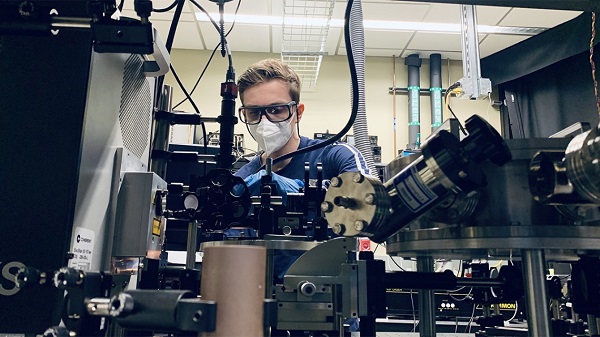
The researchers demonstrated multimode lasing by optically pumping the device. The double heterostructure Fabry-Pérot laser bars exhibited multimode emission with peak gain at 284 nm and low modal linewidths on the order of 0.1 nm at room temperature. According to the researchers, this linewidth is an order of magnitude more precise than similar devices that have used UV lasing by molecular beam epitaxy.
To achieve electrically injected, DUV AlGaN-based laser diodes with large on-time or continuous-wave mode capabilities, it is important to have electronic design optimization to maximize optical gain, as well as waveguide design and growth optimization to keep the intrinsic optical losses low. As a result, the applied growth technique and its chemical and heterostructural design characteristics could be used to further develop and improve electrically injected AlGaN laser diodes.
The next step in the research, professor Debdeep Jena said, will be to use the same materials platform to develop a laser that is driven by an electrical current from a battery, which is a more practical energy source for commercially available light-emitting devices.
The research was published in AIP Advances (www.doi.org/10.1063/5.0085365).
