
| Date | 15th, Apr 2022 |
|---|
Home > Press > First hybrid quantum bit based on topological insulators: Scientists at Forschungszentrum J?lich take an important step on the path towards topological quantum computers
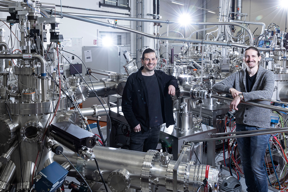 Dr. Peter Sch?ffelgen (left) and Tobias Schmitt (right) in front of the NanoCluster at Forschungszentrum J?lich where core components of the hybrid qubit were fabricated in an ultra-high vacuum.
CREDIT
Forschungszentrum J?lich / Sascha Kreklau
Dr. Peter Sch?ffelgen (left) and Tobias Schmitt (right) in front of the NanoCluster at Forschungszentrum J?lich where core components of the hybrid qubit were fabricated in an ultra-high vacuum.
CREDIT
Forschungszentrum J?lich / Sascha Kreklau
Abstract: With their superior properties, topological qubits could help achieve a breakthrough in the development of a quantum computer designed for universal applications. So far, no one has yet succeeded in unambiguously demonstrating a quantum bit, or qubit for short, of this kind in a lab. However, scientists from Forschungszentrum J?lich have now gone some way to making this a reality. For the first time, they succeeded in integrating a topological insulator into a conventional superconducting qubit. Just in time for "World Quantum Day" on 14 April, their novel hybrid qubit made it to the cover of the latest issue of the renowned journal Nano Letters.
J?lich, Germany | Posted on April 15th, 2022
Quantum computers are regarded as the computers of the future. Using quantum effects, they promise to deliver solutions for highly complex problems that cannot be processed by conventional computers in a realistic time frame. However, the widespread use of such computers is still a long way off. Current quantum computers generally contain only a small number of qubits. The main problem is that they are highly prone to error. The bigger the system, the more difficult it is to fully isolate it from its environment.
Many hopes are therefore pinned on a new type of quantum bit ? the topological qubit. This approach is being pursued by several research groups as well as companies such as Microsoft. This type of qubit exhibits the special feature that it is topologically protected; the particular geometric structure of the superconductors as well as their special electronic material properties ensure that quantum information is retained. Topological qubits are therefore considered to be particularly robust and largely immune to external sources of decoherence. They also appear to enable fast switching times comparable to those achieved by the conventional superconducting qubits used by Google and IBM in current quantum processors.
However, it is not yet clear whether we will ever succeed in actually producing topological qubits. This is because a suitable material basis is still lacking to experimentally generate the special quasiparticles required for this without any doubt. These quasiparticles are also known as Majorana states. Until now, they could only be unambiguously demonstrated in theory, but not in experiments. Hybrid qubits, as they have now been constructed for the first time by the research group led by Dr. Peter Sch?ffelgen at the Peter Gr?nberg Institute (PGI-9) of Forschungszentrum J?lich, are now opening up new possibilities in this area. They already contain topological materials at crucial points. Therefore, this novel type of hybrid qubit provides researchers with a new experimental platform to test the behaviour of topological materials in highly sensitive quantum circuits.
####
For more information, please click here
Contacts:Tobias SchloesserForschungszentrum Juelich
Office: +49-246-161-4771Expert Contacts
Tobias SchmittForschungszentrum J?lich, Peter Gr?nberg Institute, Semiconductor Nanoelectronics (PGI-9)
Office: +49 2461 61-85417Dr. Peter Sch?ffelgenForschungszentrum J?lich, Peter Gr?nberg Institut, Semiconductor Nanoelectronics (PGI-9)
Office: +49 2461 61-85250Prof. Dr. Detlev Gr?tzmacherForschungszentrum J?lich, Head of the Peter Gr?nberg Instituts, Semiconductor Nanoelectronics (PGI-9)
Office: +49 2461 61-2340
Copyright © Forschungszentrum Juelich
If you have a comment, please Contact us.
Issuers of news releases, not 7th Wave, Inc. or Nanotechnology Now, are solely responsible for the accuracy of the content.
Bookmark:


 Engineering piezoelectricity and strain sensitivity in CdS to promote piezocatalytic hydrogen evolution May 13th, 2022
Small microring array enables large complex-valued matrix multiplication May 13th, 2022
Engineering piezoelectricity and strain sensitivity in CdS to promote piezocatalytic hydrogen evolution May 13th, 2022
Small microring array enables large complex-valued matrix multiplication May 13th, 2022
Going gentle on mechanical quantum systems: New experimental work establishes how quantum properties of mechanical quantum systems can be measured without destroying the quantum state May 13th, 2022
Small microring array enables large complex-valued matrix multiplication May 13th, 2022
New error mitigation approach helps quantum computers level up: New error mitigation approach helps quantum computers level up, ASCR: Quantum computers are prone to errors that limit their usefulness in scientific research May 6th, 2022
New hardware integrates mechanical devices into quantum tech April 22nd, 2022
Going gentle on mechanical quantum systems: New experimental work establishes how quantum properties of mechanical quantum systems can be measured without destroying the quantum state May 13th, 2022
Small microring array enables large complex-valued matrix multiplication May 13th, 2022
Engineering piezoelectricity and strain sensitivity in CdS to promote piezocatalytic hydrogen evolution May 13th, 2022
Small microring array enables large complex-valued matrix multiplication May 13th, 2022
Lightening up the nanoscale long-wavelength optoelectronics May 13th, 2022
Development of high-durability single-atomic catalyst using industrial humidifier: Identification of the operating mechanism of cobalt-based single-atomic catalyst and development of a mass production process. Utilization for catalyst development in various fields including fuel May 13th, 2022
