
| Date | 19th, Apr 2022 |
|---|
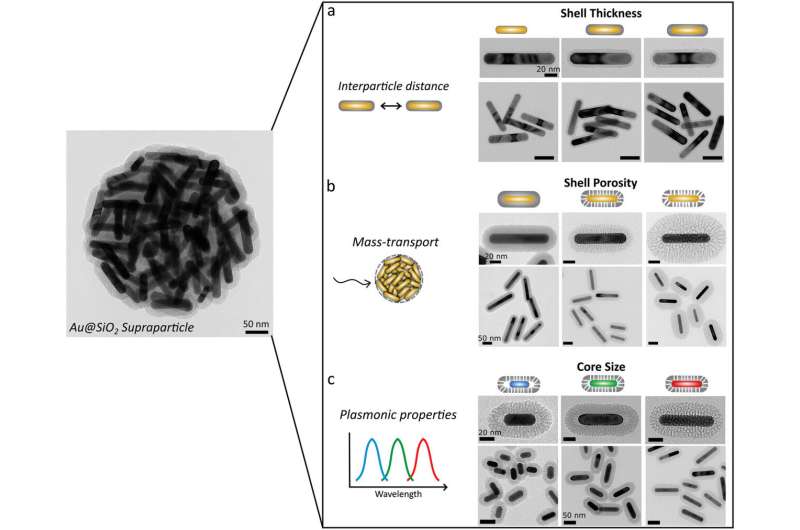 Silica-coated AuNR supraparticles as a tunable platform for sensing: the interparticle distance, mass- and heat-transport and plasmonic properties can all be tuned via the properties of the individual Au@SiO2 NR building blocks. Credit: Advanced Functional Materials (2022). DOI: 10.1002/adfm.202200148
Utrecht researchers have developed a new type of sensor, about 500 times smaller than the width of a human hair, with an unprecedented ability to detect extremely small amounts of molecules. These sensors can be used to detect and identify trace amounts of substances such as chemical pollutants or molecules important in medicine. The sensors make use of Raman scattering, a phenomenon that gives such unique signals for different molecules that it is often referred to as "molecular fingerprinting." In their publication in Advanced Functional Materials, the researchers present the preparation and use of these tiny sensors.
Lead researcher Prof. Alfons van Blaaderen explains that their "design relies on the assembly of gold nanorods, which enhance the Raman scattering of molecules placed close to their tips tens of thousand times, into a larger spherical cluster in which the Raman signals are even further enhanced. A crucial step in the preparation was to first wrap each gold nanorod in its own protective porous coating. By controlling the thickness and porosity of this coating, we were able to control how closely the nanorods could be packed together, and how easy or difficult it is for molecules to enter into the sensor."
Small water droplets
Bringing the coated rods together in a nano-sensor was a key goal for lead authors Jessi van der Hoeven and Harith Gurunarayanan. Van der Hoeven explains that they "wanted to controllably form a spherical cluster out of these rods, where so-called 'hot spots' for the Raman scattering would overlap and enhance the Raman signals even further. To do so, we put the rods in small water droplets. By slowly evaporating the water, the nanorods were forced to pack together into a spherical assembly."
