
| Date | 23rd, Apr 2022 |
|---|
Home > Press > Water processing: light helps degrade hormones: KIT researchers use polymer membranes coated with titanium dioxide for photocatalytic cleaning � results are reported in Nature Nanotechnology
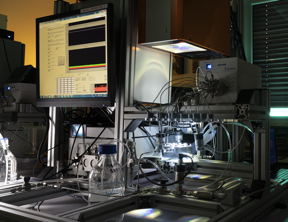 Photocatalytic membrane filtration system with a sun simulator. The membranes are coated with titanium dioxide. (Photo: Markus Breig, KIT)
CREDIT
Markus Breig, KIT
Photocatalytic membrane filtration system with a sun simulator. The membranes are coated with titanium dioxide. (Photo: Markus Breig, KIT)
CREDIT
Markus Breig, KIT
Abstract: Wherever people are living, hormones used in e.g. contraceptives or agriculture enter the wastewater. Steroid hormones, such as sex hormones and corticosteroids, may accumulate in the environment and adversely affect humans and animals, as they impair behavioral development and fertility. Sex hormones, for instance, may cause male fish to develop female sexual characteristics. It is therefore important to remove hormones, together with other micropollutants, from the wastewater before they enter the natural water cycle again, from which drinking water is extracted. �Supplying people with clean drinking water presently is one of the most important challenges worldwide,� says Professor Andrea Iris Sch�fer, Head of KIT�s Institute for Advanced Membrane Technology (IAMT). �Micropollutants represent a big threat for our future, as they impair our fertility and brain function.�
Karlsruhe, Germany | Posted on April 22nd, 2022
Inspired by Solar Cell Technology
For years, Sch�fer has studied water processing by nanofiltration. For this purpose, she uses polymer membranes with nanometer-sized pores. However, nanofiltration requires high pressure and, hence, much energy. Moreover, micropollutants may accumulate in the polymer membrane materials and gradually enter the filtered water. Even if the pollutants are separated completely, a flow of concentrated pollutants may develop and require further treatment.
Inspired by solar cell technology, the field of work of Professor Bryce S. Richards from KIT, Sch�fer had the idea to coat polymer membranes with titanium dioxide and to design photocatalytic membranes. Photocatalytically active titanium dioxide nanoparticles are applied to microfiltration membranes, whose pores are somewhat larger than in nanofiltration. Irradiation with light then triggers a chemical reaction, as a result of which steroid hormones are degraded on the membranes. Together with her team at IAMT and colleagues from the Leibniz Institute of Surface Engineering (IOM), Leipzig, Sch�fer has now realized her idea and presented the new technology in Nature Nanotechnology.
Catalyst for Water
�We have developed a catalyst for water,� Sch�fer summarizes her work. Using the photocatalytic polymer membranes, steroid hormones were removed in the continuous flow mode down to the analytical detection limit of 4 ng/l. In fact, the concentrations measured were very close to 1 ng/l, the limit given in the new Drinking Water Guideline of the WHO. The researchers are now optimizing their technology by reducing the time needed and energy consumed. Moreover, their focus lies on using natural light. In particular, their research is aimed at degrading other pollutants by photocatalysis, such as industrial chemicals like perfluoro-alkylated and polyfluorinated substances (PFAS) or pesticides, such as glyphosate. Another goal is to upscale the technology. (or)
####
For more information, please click here
Contacts:Monika LandgrafKarlsruher Institute of Technology (KIT)
Office: +49 721 608-41150Expert Contact
Regina LinkKarlsruher Institute of Technology
Office: +49 721 608-41158
Copyright © Karlsruhe Institute of Technology
If you have a comment, please Contact us.
Issuers of news releases, not 7th Wave, Inc. or Nanotechnology Now, are solely responsible for the accuracy of the content.
Bookmark:


Chemistry
News and information
 Engineering piezoelectricity and strain sensitivity in CdS to promote piezocatalytic hydrogen evolution May 13th, 2022
New nanomechanical oscillators with record-low loss May 13th, 2022
Small microring array enables large complex-valued matrix multiplication May 13th, 2022
Possible Futures
Engineering piezoelectricity and strain sensitivity in CdS to promote piezocatalytic hydrogen evolution May 13th, 2022
New nanomechanical oscillators with record-low loss May 13th, 2022
Small microring array enables large complex-valued matrix multiplication May 13th, 2022
Discoveries
New nanomechanical oscillators with record-low loss May 13th, 2022
Small microring array enables large complex-valued matrix multiplication May 13th, 2022
Announcements
Engineering piezoelectricity and strain sensitivity in CdS to promote piezocatalytic hydrogen evolution May 13th, 2022
New nanomechanical oscillators with record-low loss May 13th, 2022
Small microring array enables large complex-valued matrix multiplication May 13th, 2022
Interviews/Book Reviews/Essays/Reports/Podcasts/Journals/White papers/Posters
Lightening up the nanoscale long-wavelength optoelectronics May 13th, 2022
On-Chip Photodetection: Two-dimensional material heterojunctions hetero-integration May 13th, 2022
Engineering piezoelectricity and strain sensitivity in CdS to promote piezocatalytic hydrogen evolution May 13th, 2022
Environment
University of Strathclyde and National University of Singapore to co-ordinate satellite quantum communications May 13th, 2022
Lightening up the nanoscale long-wavelength optoelectronics May 13th, 2022
New approach can predict pollution from cooking emissions April 15th, 2022
Water
The future of desalination? A fast, efficient, selective membrane for purifying saltwater May 13th, 2022
The deformation of the hydrogel is used to measure the negative pressure of water April 22nd, 2022
Photocatalysts with built-in electric field helps to remove pollutants from water April 15th, 2022
