
| Date | 7th, May 2022 |
|---|
Home > Press > New error mitigation approach helps quantum computers level up: New error mitigation approach helps quantum computers level up, ASCR: Quantum computers are prone to errors that limit their usefulness in scientific research
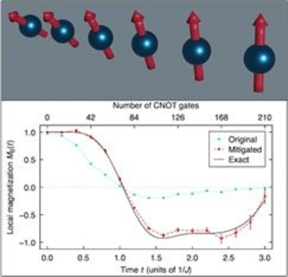 image: Researchers demonstrated a new quantum error mitigation approach by simulating the evolution of a chain of six spins (top). The mitigated results are much closer to the exact results than the original measured data from the quantum computer (bottom). view more
Credit: Image courtesy of Bert de Jong, Lawrence Berkeley National Laboratory
image: Researchers demonstrated a new quantum error mitigation approach by simulating the evolution of a chain of six spins (top). The mitigated results are much closer to the exact results than the original measured data from the quantum computer (bottom). view more
Credit: Image courtesy of Bert de Jong, Lawrence Berkeley National Laboratory
Abstract: The ScienceQuantum computers have been improving rapidly over the past several years, but they still exhibit error rates far higher than conventional computers. This limits their usefulness. To move quantum computing forward, researchers must develop methods to mitigate errors. The better the error mitigation, the more operations can be performed on quantum computers. This will allow researchers to run calculations on a quantum computer that they can�t do without error mitigation. Researchers have now developed a novel error mitigation approach � called noise estimation circuits � that moves forward on achieving this goal. When combined with three other error mitigation techniques, noise elimination circuits obtained reliable results for dynamic simulations of materials.
Washington, DC | Posted on May 6th, 2022
The ImpactAdvances in quantum computing could lead to breakthroughs in a huge range of areas. These could include clean energy production, cleaner industrial processes, drug development, and artificial intelligence">artificial intelligence. However, quantum computers are noisy. In quantum computers, noise means interference from magnetic fields, changes in temperature, and other sources. This noise leads to the accumulation of errors in complex quantum simulations that require many operations. The novel error mitigation approach will allow researchers to run longer, more realistic simulations and still obtain reliable results. This will broaden the potential impact of upcoming quantum computers on scientific discovery.
SummaryQuantum computers have the potential to solve complex problems much faster than classical computers, but currently they are too error-prone to be consistently useful. While error correction would be the ideal solution, it is not yet feasible on current quantum computers due to the number of qubits needed. The next best thing is error mitigation � methods and software to minimize errors in the science outcomes of quantum simulations.
Researchers at Lawrence Berkeley National Laboratory developed a new approach to quantum error mitigation that could help make quantum computing�s theoretical potential a reality: noise estimation circuits. A circuit is a series of operations or a program executed on a quantum computer to calculate the answer of a scientific problem. The team used a modified version of the circuit to estimate errors and correct the output measured for the real scientific simulation circuit they wanted to run. While the noise estimation circuit approach corrects some errors, it does not correct them all. By combining the new approach with three other error mitigation techniques, the researchers were able to obtain reliable results on an IBM Q quantum system.
FundingThe study was supported by the Department of Energy (DOE) Office of Science through the Advanced Scientific Computing Research program�s Quantum Algorithms Team and Accelerated Research for Quantum Computing Programs, and by the DOE Office of Science High Energy Physics program through the Quantum Information Science Enabled Discovery program. The Oak Ridge Leadership Computing Facility provided the researchers with access to the IBM computer used for this study.
####
For more information, please click here
Contacts:Michael ChurchDOE/US Department of Energy
Office: 2028416299
Copyright © DOE/US Department of Energy
If you have a comment, please Contact us.
Issuers of news releases, not 7th Wave, Inc. or Nanotechnology Now, are solely responsible for the accuracy of the content.
Bookmark:


News and information
 Engineering piezoelectricity and strain sensitivity in CdS to promote piezocatalytic hydrogen evolution May 13th, 2022
New nanomechanical oscillators with record-low loss May 13th, 2022
Small microring array enables large complex-valued matrix multiplication May 13th, 2022
Possible Futures
Engineering piezoelectricity and strain sensitivity in CdS to promote piezocatalytic hydrogen evolution May 13th, 2022
New nanomechanical oscillators with record-low loss May 13th, 2022
Small microring array enables large complex-valued matrix multiplication May 13th, 2022
Quantum Computing
New hardware integrates mechanical devices into quantum tech April 22nd, 2022
Discoveries
New nanomechanical oscillators with record-low loss May 13th, 2022
Small microring array enables large complex-valued matrix multiplication May 13th, 2022
Announcements
Engineering piezoelectricity and strain sensitivity in CdS to promote piezocatalytic hydrogen evolution May 13th, 2022
New nanomechanical oscillators with record-low loss May 13th, 2022
Small microring array enables large complex-valued matrix multiplication May 13th, 2022
Interviews/Book Reviews/Essays/Reports/Podcasts/Journals/White papers/Posters
Lightening up the nanoscale long-wavelength optoelectronics May 13th, 2022
On-Chip Photodetection: Two-dimensional material heterojunctions hetero-integration May 13th, 2022
Engineering piezoelectricity and strain sensitivity in CdS to promote piezocatalytic hydrogen evolution May 13th, 2022
