
In recent years, lasers have been developed that are able to generate pulses lasting a few femtoseconds to generate ultrafast bursts of electrical currents. This is done by illuminating tiny graphene-based wires connecting two gold metals. The ultrashort laser pulse sets in motion, or excites, the electrons in graphene and sends them in a particular direction, therefore generating a net electrical current.
Laser pulses are able to generate electricity far faster than any traditional method and can do so in the absence of applied voltage. The direction and magnitude of the current can be controlled by varying the shape of the laser pulse, or changing its phase, in other words.
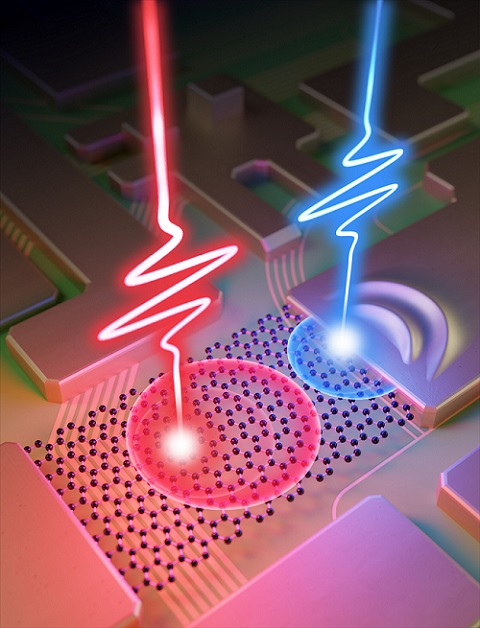
Because the graphene is connected to gold, both real and virtual charge carriers are absorbed by the metal to produce a net current.
The team found that by changing the laser pulse’s shape, it could generate currents where only the real or virtual charge carriers play a role. This finding, the ability to independently control two types of currents, drastically augments the design elements of lightwave electronics.
Using this augmented control landscape, the team experimentally demonstrated, for the first time, logic gates that operated on the femtosecond timescale.
In the experiment, the input signals are the shape or phase of two synchronized laser pulses, each one chosen to only generate a burst of real or virtual charge carriers. Depending on the laser phases used, these two contributions to the currents can either add up or cancel. The net electrical signal can be assigned logical information 0 or 1, yielding an ultrafast logic gate.
“It will probably be a very long time before this technique can be used in a computer chip, but at least we now know that lightwave electronics is practically possible,” said Tobias Boolakee, who led the experimental efforts as a Ph.D. student at FAU.
The study represents the culmination of more than 15 years of research by Ignacio Franco, an associate professor of chemistry and physics at Rochester.
The work was published in Nature (www.doi.org/10.1038/s41586-022-04565-9).
