
Unlike conventional QPI systems, where phase recovery is performed on a computer using an intensity measurement or a hologram, a diffractive QPI network directly processes the optical waves generated by the object itself to retrieve the phase information of the specimen as the light propagates through the diffractive network. The entire phase recovery and quantitative phase imaging processes are completed at the speed of light without the need for an external power source, save for the light source.
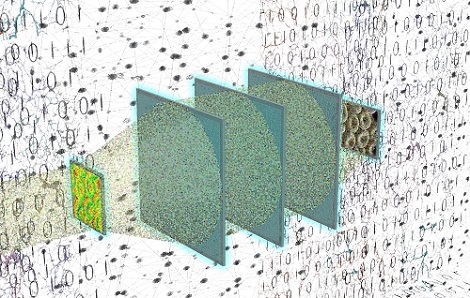
According to the researchers, the results constitute the first all-optical phase retrieval and phase-to-intensity transformation achieved through diffraction. The diffractive QPI networks trained using deep learning cannot only generalize to unseen, new phase objects that statistically resemble the training images, but also generalize to entirely new types of objects with different spatial features.
Additionally, the diffractive QPI networks are designed in such a way that the quantification of the input phase is invariant to possible changes in the illumination light intensity or the detection efficiency of the image sensor. The team also showed that the diffractive QPI networks could be optimized to maintain their quantitative phase image quality even under mechanical misalignments of its diffractive layers.
The diffractive QPI networks developed by the researchers may pave the way to various new applications in microscopy and sensing, due to their computational speed, lower power consumption, and memory usage.
The research was published in Advanced Optical Materials (www.doi.org/10.1002/adom.202200281).
