
The network includes a ground station, drones, lasers, and fiber optics. The entangled single-photon sources are produced by focusing a laser on special nonlinear crystals and then processing the resulting “down-conversion” beam of photons. The optical alignment system uses mirrors that tilt to steer the photons directly where they need to go. The single photons travel one-by-one from the source drone to another to communicate securely.
“The combination of quantum communication and unmanned aerial systems, or UAS, in this project represents an important advance in the Air Force’s efforts to create fieldable quantum systems for the warfighter,” said A. Matthew Smith, a senior research physicist at the Air Force Research Laboratory Information Directorate. “Additionally, the potential of secure communication from a portable quantum communication UAS in contested environments represents important future capabilities for the Air Force.”
The work stems from a $1.5 million Phase II Small Business Technology Transfer federal grant awarded to Qubitekk. Miller, Qubbitek, and L3Harris are collaborating with the U.S. Air Force to combine expertise from academia, including the University of Illinois Urbana-Champaign; government; and industry with the potential to scale the project for larger applications and with larger aerial platforms, as well as other ground and maritime platforms.
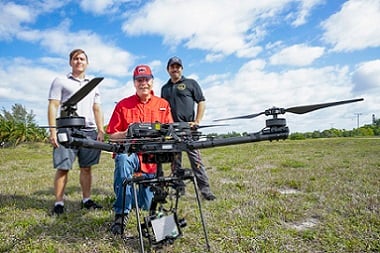
Eventually, Miller plans to incorporate quantum memory in the drones so that they can conduct error correction and relay and store information.
“We are just scratching the surface of something that is going to amplify into a lot of different applications,” Miller said. “This technology is not only going to be on drones or robots. Eventually, we will have this secure communication technology on buildings and satellites that will open up a free space optical link between them.”
