
SERS can be used to increase the diagnostic signals of biomolecules on a metal surface by more than 1 million times. It has been used in chemical and environmental analysis to detect biomarkers for various diseases. High production costs and limited batch-to-batch reproducibility, however, have so far hindered widespread application in food safety diagnostics.
The researchers hope that the newly developed sensors could be used to uncover food pesticides before consumption.
“Reports show that up to half of all fruits sold in the EU contain pesticide residues that in larger quantities have been linked to human health problems,” said Georgios Sotiriou, principal researcher at the institute's Department of Microbiology, Tumor and Cell Biology and the study’s corresponding author. “However, current techniques for detecting pesticides on single products before consumption are restricted in practice by the high cost and cumbersome manufacturing of its sensors. To overcome this, we developed inexpensive and reproducible nanosensors that could be used to monitor traces of fruit pesticides at, for example, the store.”
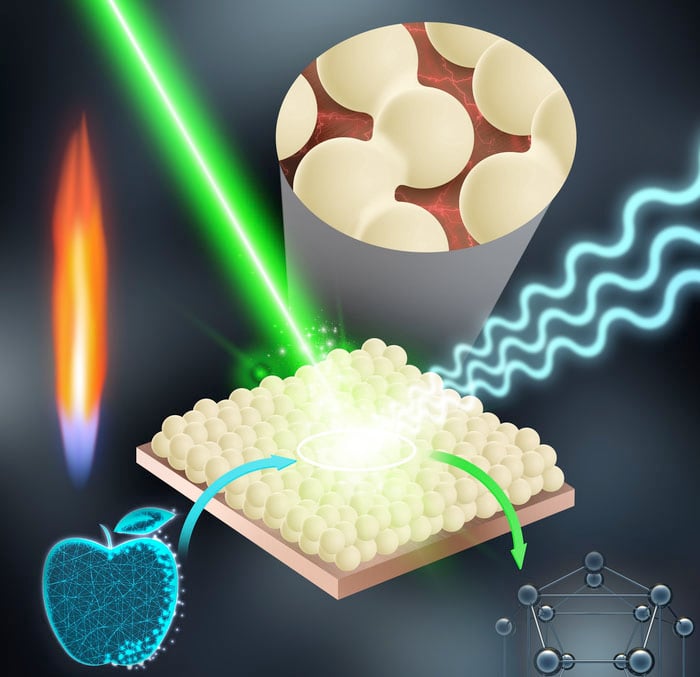
The researchers’ SERS nanosensor uses flame spray — a well-established and cost-effective technique for depositing metallic coating — to deliver small droplets of silver nanoparticles onto a glass surface. “The flame spray can be used to quickly produce uniform SERS films across large areas, removing one of the key barriers to scalability,” said Haipeng Li, a postdoctoral researcher in Sotiriou’s lab, as well as the study’s first author.
The researchers fine-tuned the distance between the individual silver nanoparticles to enhance their sensitivity. To test the sensors’ substance-detecting ability, the team applied a thin layer of tracer dye on top of the sensors and used a spectrometer to uncover their molecular fingerprints. The sensors reliably and uniformly detected the molecular signals. Additionally, tests after 2.5 months showed that their performance remained intact, underscoring their shelf life potential and feasibility for large-scale production, according to the researchers.
Following the proof-of-concept demonstration, the researchers will explore whether the nanosensors can be applied to other areas. The researchers identified one such application as biomarker discovery for specific diseases at the point-of-care in resource-limited settings.
The research was published in Advanced Science (www.doi.org/10.1002/advs.202201133).
