
| Date | 15th, Jun 2022 |
|---|
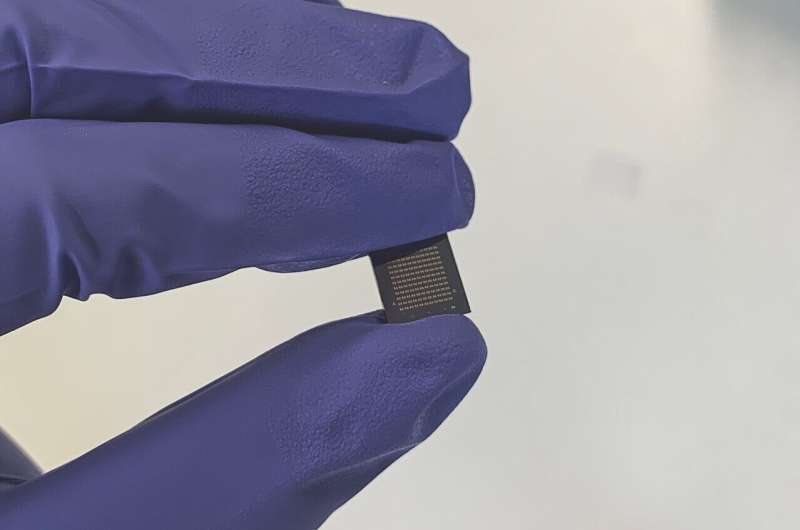 Credit: June Sang Lee, University of Oxford
In a paper published today in Science Advances, researchers at the University of Oxford have developed a method using the polarization of light to maximize information storage density and computing performance using nanowires.
Light has an exploitable property—different wavelengths of light do not interact with each other—a characteristic used by fiberoptics to carry parallel streams of data. Similarly, different polarizations of light do not interact with each other either. Each polarization can be used as an independent information channel, enabling more information to be stored in multiple channels, hugely enhancing information density.
First author and DPhil student June Sang Lee, Department of Materials, University of Oxford said: "We all know that the advantage of photonics over electronics is that light is faster and more functional over large bandwidths. So, our aim was to fully harness such advantages of photonics combining with tunable material to realize faster and denser information processing."
