
| Date | 25th, Jun 2022 |
|---|
Home > Press > Boron nitride nanotube fibers get real: Rice lab creates first heat-tolerant, stable fibers from wet-spinning process
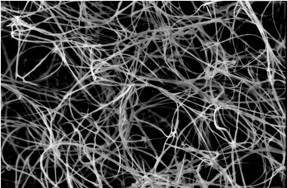 A tangle of unprocessed boron nitride nanotubes seen through a scanning electron microscope. Rice University scientists introduced a method to combine them into fibers using the custom wet-spinning process they developed to make carbon nanotube fibers. (Credit: Pasquali Research Group/Rice University)
Abstract: Boron nitride nanotubes used to be hard to process, according to Rice University researchers. Not anymore.
Houston, TX | Posted on June 24th, 2022
A Rice team led by professors Matteo Pasquali and Angel Mart? has simplified handling of the highly valuable nanotubes to make them more suitable for large-scale applications, including aerospace, electronics and energy-efficient materials.
The researchers reported in Nature Communications that boron nitride nanotubes, aka BNNTs, assemble themselves into liquid crystals under the right conditions, primarily concentrations above 170 parts per million by weight in chlorosulfonic acid.
These liquid crystals consist of aligned BNNTs that are far easier to process than the tangled nanotubes that usually form in solution. The lab proceeded to form fibers and films from the liquid crystalline solutions.
?BNNT fibers are attractive for the manufacture of a variety of products, with applications that range from wearables to aerospace vehicles,? said Mart?, whose lab designed solutions and helped characterize the fibers produced in Pasquali?s lab.
Boron nitride nanotubes are like carbon nanotubes, but with alternating boron and nitrogen atoms instead of carbon in their hexagonal lattices. Both types of nanotubes are strong, but unlike electrically conductive carbon nanotubes, BNNTs are good electrical insulators and are thermally and chemically stable in air up to 900 degrees Celsius (1,652 degrees Fahrenheit).
To form liquid crystals, the researchers needed to be sure their nanotubes were free of contaminants. Unfortunately, those contaminants were mostly bits of boron nitride that threatened to gum up the works.
?Early BNNT samples contained lots of non-nanotube boron nitride structures,? said graduate student and lead author Cedric Ginestra. ?They were either chemically bound to the BNNTs or just physically adhered in a way that prevented BNNTs from dispersing in acid and aligning at higher concentrations.
?It is difficult to separate these boron nitride allotropes from BNNTs, and hard to even measure their concentration,? he said. ?All the different types of boron nitride appear identical by basically every quantitative technique that we?ve tried so far.?
Working with their supplier to optimize their BNNT purification process for the formation of liquid crystalline solutions and using a purification process developed in the Pasquali lab helped them obtain better batches of BNNTs, he said. Once suitable material was produced, the Pasquali group was primed to quickly adapt its wet-spinning techniques for carbon nanotube fibers to make the first boron nitride threads with the process.
?There are reports of others taking solid puffs of BNNTs and stretching and twisting them to make a yarn, but that?s very different from our process,? Ginestra said. ?Our goal was to make a very highly aligned fiber because the properties are better along the length of the nanotubes.?
Liquid crystals are the ideal precursor for fibers because the nanotubes within are already aligned, he said. BNNT alignment in the liquid crystals was identified microscopically by their birefringence, a phenomenon by which crystals split light, prism-like, even if they appear to be clear.
The films also demonstrated how BNNT solution processing can adopt methods developed for carbon nanotubes, Ginestra said. Such transparent thin films could be useful in next-generation electronics. ?The BNNT film and fiber properties will improve as the material and our understanding of the liquid crystalline solution improves,? he said.
Mart? noted BNNT films would be useful as filters for ultraviolet light, antifouling coatings and for corrosion protection.
Co-authors of the paper are Rice graduate students Cecilia Mart?nez-Jim?nez and Oliver Dewey, alumni Ashleigh Smith McWilliams, Robert Headrick and Dmitry Kosynkin and postdoctoral researcher Jesus Acapulco; graduate student Asia Matatyaho Ya?akobi and professor emeritus Yeshayahu Talmon of the Technion-Israel Institute of Technology and the Russell Berrie Nanotechnology Institute, Haifa, Israel; Lyndsey Scammell and Michael Smith of BNNT LLC, Newport News, Virginia; former Rice postdoctoral researcher Daniel Marincel, now an assistant professor at the Rose-Hulman Institute of Technology, Terre Haute, Indiana; senior researcher Cheol Park of the NASA Langley Research Center, Hampton, Virginia; and associated research fellow Sang-Hyon Chu of the National Institute of Aerospace, Hampton, Virginia.
Mart? is a professor of chemistry, bioengineering and materials science and nanoengineering. Pasquali is the A.J. Hartsook Professor of Chemical and Biomolecular Engineering, a professor of chemistry and of materials science and nanoengineering and director of the Carbon Hub.
The research was supported by the Air Force Office of Scientific Research (FA9550-18-1-0014, FA9550-19-1-7045), the Welch Foundation (C-1668), the National Council of Science and Technology (CONACyT) Mexico (710115), a NASA Space Technology Research Fellowship (NNX14AL71H), the National Science Foundation (1807737, 2108838), the Department of Energy (DE-AR0001015), the United States-Israel Binational Science Foundation (2016161) and an Office of Naval Research Small Business Innovation Research grant (N68335-19-C-0560).
####
About Rice UniversityLocated on a 300-acre forested campus in Houston, Rice University is consistently ranked among the nation?s top 20 universities by U.S. News & World Report. Rice has highly respected schools of Architecture, Business, Continuing Studies, Engineering, Humanities, Music, Natural Sciences and Social Sciences and is home to the Baker Institute for Public Policy. With 4,240 undergraduates and 3,972 graduate students, Rice?s undergraduate student-to-faculty ratio is just under 6-to-1. Its residential college system builds close-knit communities and lifelong friendships, just one reason why Rice is ranked No. 1 for lots of race/class interaction and No. 1 for quality of life by the Princeton Review. Rice is also rated as a best value among private universities by Kiplinger?s Personal Finance.
Follow Rice News and Media Relations via Twitter @RiceUNews.
For more information, please click here
Contacts:Jeff Falk713-348-6775
Mike Williams713-348-6728
If you have a comment, please Contact us.
Issuers of news releases, not 7th Wave, Inc. or Nanotechnology Now, are solely responsible for the accuracy of the content.
Bookmark:


 Biology?s hardest working pigments and ?MOFs? might just save the climate: A range of processes that currently depend on fossil fuels but are really hard to electrify will depend on the development of genuinely clean fuels, and for that to happen, much more efficient catalysts wi July 22nd, 2022
First electric nanomotor made from DNA material: Synthetic rotary motors at the nanoscale perform mechanical work July 22nd, 2022
UNC Charlotte-led team invents new anticoagulant platform, offering hope for advances for heart surgery, dialysis, other procedures July 15th, 2022
Rensselaer researchers learn to control electron spin at room temperature to make devices more efficient and faster: Electron spin, rather than charge, holds the key July 15th, 2022
Biology?s hardest working pigments and ?MOFs? might just save the climate: A range of processes that currently depend on fossil fuels but are really hard to electrify will depend on the development of genuinely clean fuels, and for that to happen, much more efficient catalysts wi July 22nd, 2022
First electric nanomotor made from DNA material: Synthetic rotary motors at the nanoscale perform mechanical work July 22nd, 2022
The best semiconductor of them all? Researchers have found a material that can perform much better than silicon. The next step is finding practical and economic ways to make it July 22nd, 2022
Quantum computer works with more than zero and one: Quantum digits unlock more computational power with fewer quantum particles July 22nd, 2022
Quantum network nodes with warm atoms June 24th, 2022
Artificial neurons go quantum with photonic circuits: Quantum memristor as missing link between artificial intelligence and quantum computing March 25th, 2022
Buckyballs on gold are less exotic than graphene July 22nd, 2022
Nanotubes: a promising solution for advanced rubber cables with 60% less conductive filler June 1st, 2022
HKU physicists found signatures of highly entangled quantum matter July 22nd, 2022
The best semiconductor of them all? Researchers have found a material that can perform much better than silicon. The next step is finding practical and economic ways to make it July 22nd, 2022
Quantum computer works with more than zero and one: Quantum digits unlock more computational power with fewer quantum particles July 22nd, 2022
Generating power where seawater and river water meet July 22nd, 2022
Buckyballs on gold are less exotic than graphene July 22nd, 2022
Biology?s hardest working pigments and ?MOFs? might just save the climate: A range of processes that currently depend on fossil fuels but are really hard to electrify will depend on the development of genuinely clean fuels, and for that to happen, much more efficient catalysts wi July 22nd, 2022
Strain-sensing smart skin ready to deploy: Nanotube-embedded coating detects threats from wear and tear in large structures July 15th, 2022
Bumps could smooth quantum investigations: Rice University models show unique properties of 2D materials stressed by contoured substrates June 10th, 2022
Strain-sensing smart skin ready to deploy: Nanotube-embedded coating detects threats from wear and tear in large structures July 15th, 2022
University of Strathclyde and National University of Singapore to co-ordinate satellite quantum communications May 13th, 2022
Nanotubes: a promising solution for advanced rubber cables with 60% less conductive filler June 1st, 2022
OCSiAl receives the green light for Luxembourg graphene nanotube facility project to power the next generation of electric vehicles in Europe March 4th, 2022
UNC Charlotte-led team invents new anticoagulant platform, offering hope for advances for heart surgery, dialysis, other procedures July 15th, 2022
Luisier wins SNSF Advanced Grant to develop simulation tools for nanoscale devices July 8th, 2022
Crystal phase engineering offers glimpse of future potential, researchers say July 15th, 2022
Undergrads begin summer quantum research with support from Moore Foundation, Chicago region universities, natio
