
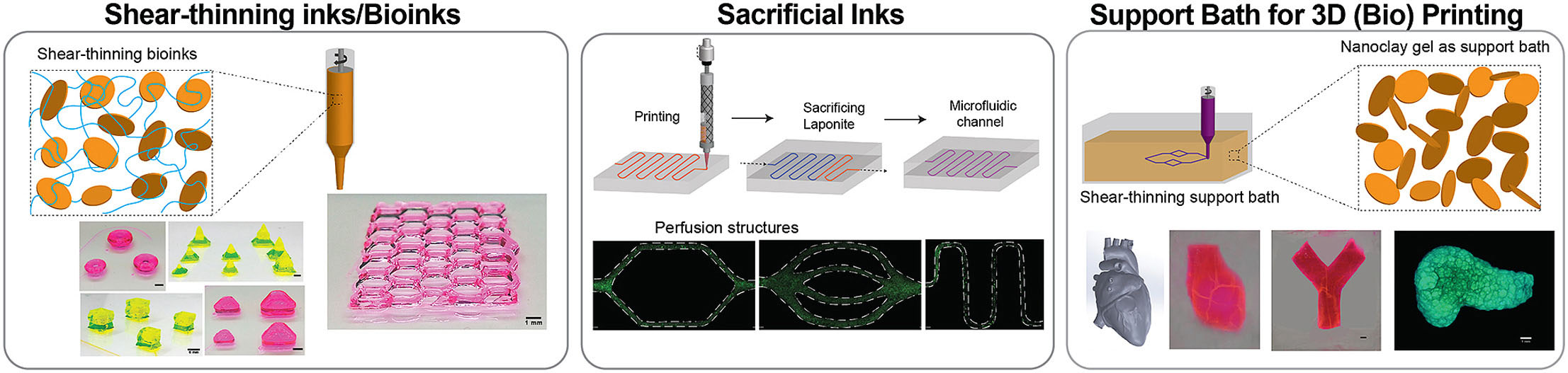
 Dr. Akhilesh K. Gaharwar, assistant professor in the Department of Biomedical Engineering, introduced colloidal solutions of 2D nanosilicates as a platform technology to print complex structures via 3D bioprinting. (Image: Texas A&M Engineering) (click on image to enlarge)
The results of the team’s research were published in the journal Bioprinting ("2D Nanosilicate for additive manufacturing: Rheological modifier, sacrificial ink and support bath").
Some major challenges in extrusion-based 3D printing are the inability to print tall and complex structures, as soft materials flow under gravity and cannot form self-supporting structures. To overcome these challenges, researchers used colloidal nanosilicates and demonstrated them as a platform technology for bioprinting using three different approaches.
In the first approach, Satyam Rajput, a biomedical engineering graduate student in the Gaharwar Laboratory and the lead author of the paper, designed a shear-thinning ink composed of nanosilicates and water-soluble polymers such as agarose, alginate, kappa-carrageenan, gelatin, gelatin methacryloyl, polyethylene glycol, and N-isopropyl acrylamide. The printable ink formulation showed good shape fidelity.
In the second approach, the team demonstrated the use of nanosilicates as a sacrificial ink, an instrument designed to fail and be removed, to design microfluidic devices for in vitro disease modeling. These perfusable devices can be used for various applications to emulate and study vascular physiology and fluid mechanics, disease models, tissue organization and function, therapeutic tissue engineering, and 3D-cell culture models and screen drugs.
In the third approach, the researchers utilized a colloidal nanosilicate gel as a support bath for 3D printing by nullifying the surface tension and gravitational forces. A range of complex structures such as a bifurcated vessel, femur, meniscus, DNA double helix, heart and trileaflet valve were printed inside the support bath.
“The versatility of nanosilicates could be widely adopted in the fields of additive manufacturing, tissue engineering, drug delivery and medical devices,” Gaharwar said.
Source: By Alleynah Veatch Cofas, Texas A&M University
Share this:
Dr. Akhilesh K. Gaharwar, assistant professor in the Department of Biomedical Engineering, introduced colloidal solutions of 2D nanosilicates as a platform technology to print complex structures via 3D bioprinting. (Image: Texas A&M Engineering) (click on image to enlarge)
The results of the team’s research were published in the journal Bioprinting ("2D Nanosilicate for additive manufacturing: Rheological modifier, sacrificial ink and support bath").
Some major challenges in extrusion-based 3D printing are the inability to print tall and complex structures, as soft materials flow under gravity and cannot form self-supporting structures. To overcome these challenges, researchers used colloidal nanosilicates and demonstrated them as a platform technology for bioprinting using three different approaches.
In the first approach, Satyam Rajput, a biomedical engineering graduate student in the Gaharwar Laboratory and the lead author of the paper, designed a shear-thinning ink composed of nanosilicates and water-soluble polymers such as agarose, alginate, kappa-carrageenan, gelatin, gelatin methacryloyl, polyethylene glycol, and N-isopropyl acrylamide. The printable ink formulation showed good shape fidelity.
In the second approach, the team demonstrated the use of nanosilicates as a sacrificial ink, an instrument designed to fail and be removed, to design microfluidic devices for in vitro disease modeling. These perfusable devices can be used for various applications to emulate and study vascular physiology and fluid mechanics, disease models, tissue organization and function, therapeutic tissue engineering, and 3D-cell culture models and screen drugs.
In the third approach, the researchers utilized a colloidal nanosilicate gel as a support bath for 3D printing by nullifying the surface tension and gravitational forces. A range of complex structures such as a bifurcated vessel, femur, meniscus, DNA double helix, heart and trileaflet valve were printed inside the support bath.
“The versatility of nanosilicates could be widely adopted in the fields of additive manufacturing, tissue engineering, drug delivery and medical devices,” Gaharwar said.
Source: By Alleynah Veatch Cofas, Texas A&M University
Share this:
Nanowerk Newsletter
Get our daily Nanotechnology News to your inbox!
