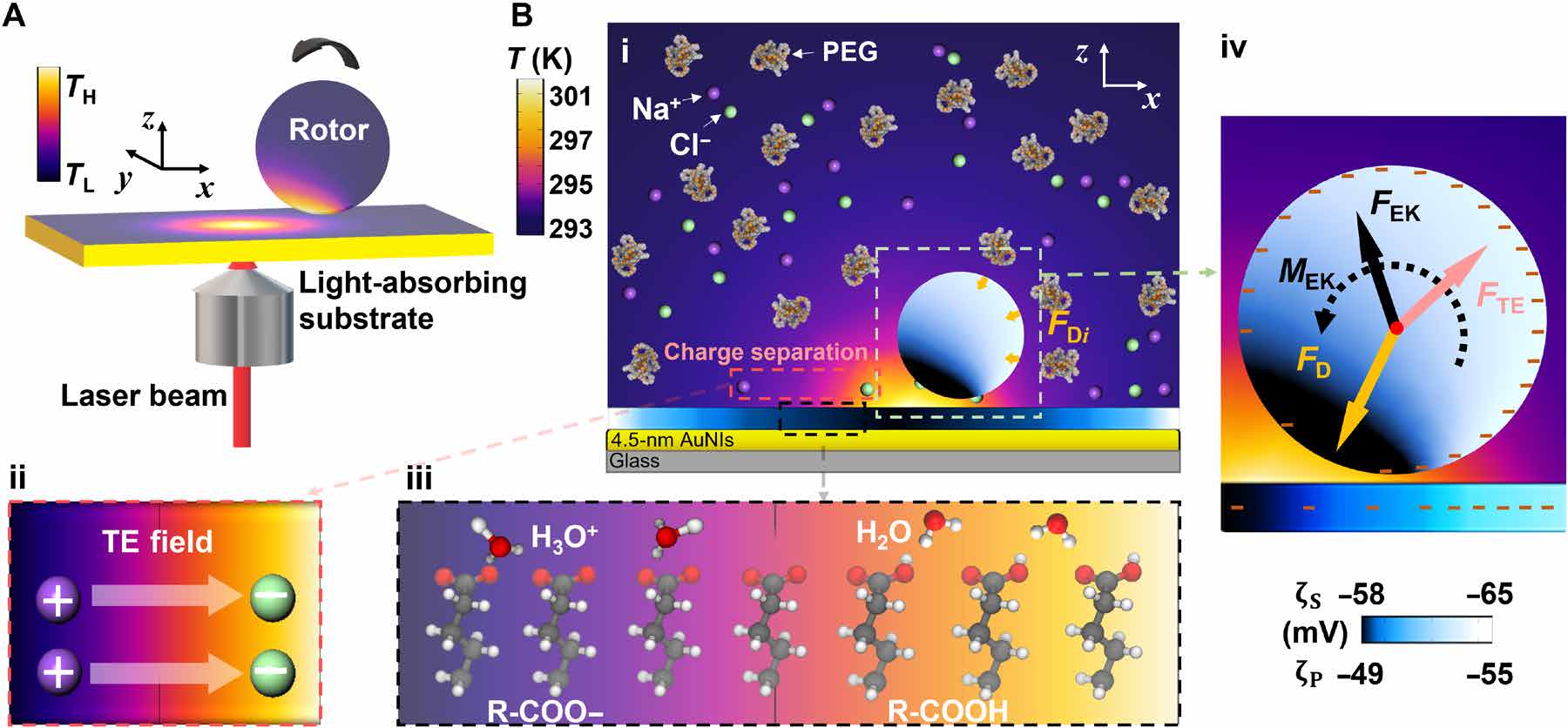
Working mechanism of light-driven out-of-plane rotation of micro/nanoscale rotors. (A) A simplified schematic illustrating the experimental setup and operation for OTER of micro/nanoparticles. (B) Working mechanism of OTER: (i) In the nonuniform temperature field, Na
+ and Cl
? ions and PEG molecules diffuse to the cold region. Yellow arrows indicate discrete depletion forces (F
Di) acting on the rotor, which lead to a total depletion force (F
D) in (iv). (ii) An opto-thermoelectric (TE) field is created by the separation Na
+ and Cl
? ions owing to their different thermodiffusion coefficients. Gray arrows indicate the direction of the TE field. (iii) The temperature field also affects the dissociation of carboxylic function groups, thus the surface charges on the substrate. (iv) Optothermal forces and torque on the rotor: In the steady state, the gradient distribution of PEG molecules generates an attractive depletion force (F
D) on the particle. A repulsive force (F
TE) is generated from the TE field. A thermo-electrokinetic force (F
EK) is from the 11-mercaptoundecanoic acid–coated plasmonic substrate with nonuniform thermo-responsive surface charge (from ?65 to ?58 mV). The surface charge of most particles also varies with the temperature due to their ionized acid groups on the surface. For instance, the local surface charge of a carboxylic functionalized polystyrene (PS) particle ranges from ?55 to ?49 mV. The “?” symbols indicate the temperature-dependent distributions of negative charges on the surface of the particle and substrate. The light-irradiated regimes with the higher temperature feature the lower charge density. A net torque, M
EK, can be generated on the particle at the certain position where a balance is reached among F
D, F
TE, and F
EK. The optical power is 78.4 µW. The red dot marks the centroid of the particle. (Reprinted with permission by American Association for the Advancement of Science under CC BY-NC license) (click on image to enlarge)
"Current optical rotation techniques require laser beams with designed intensity profile and polarization or objects with sophisticated shapes or optical birefringence," Ding explains. "These requirements make it challenging to use simple optical setups for light-driven rotation of many highly symmetric or isotropic objects, including biological cells."
Instead of light-matter interactions – the mechanism of traditional optical tweezers and rotation techniques – the out-of-plane rotation developed by the Zheng group relies on the coordination and modulation of three thermal forces by illuminating a light-absorbing substrate with an arbitrary low-power laser beam. Specifically, opto–thermoelectric force and depletion force fix the object in space, meanwhile the thermo-electrokinetic interaction between the object and substrate powers the rotation.
This universal approach to the rotation of objects of various materials (biological, polymeric, dielectric, and composite colloids) and of various sizes (from subwavelength scale to micrometer scale) in a liquid environment, including spherically symmetric and isotropic particles, uses a single, arbitrary low-power (down to 9.4 µW) laser beam. This low-power optics allows the rotation of nano- and microscale objects along an axis perpendicular to the optical axis, i.e., out-of-plane rotation, which is not achievable with conventional optical tweezers.
The researchers are confident that their OTER technique will find a wide range of applications in imaging, sensing, and biomedicine. For instance, as Ding explains, the capability to completely map a biological sample is crucial because most are asymmetric and the biomolecules on their surface are non-uniformly distributed. OTER could meet this challenge by introducing a simple laser beam to the optical microscope system to rotate the sample on demand, enabling new studies such as vesicle trafficking by offering 3D total internal reflection fluorescence microscopy (TIRF) characterizations.

