
| Date | 23rd, Jul 2022 |
|---|
Home > Press > Buckyballs on gold are less exotic than graphene
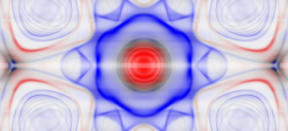 Using density functional theory and measurement data from spin-resolved photoemission, the team investigated the origin of the repeating Au(111) bands and resolved them as deep surface resonances. These resonances lead to an onion-like Fermi surface of Au(111).
CREDIT
HZB
Using density functional theory and measurement data from spin-resolved photoemission, the team investigated the origin of the repeating Au(111) bands and resolved them as deep surface resonances. These resonances lead to an onion-like Fermi surface of Au(111).
CREDIT
HZB
Abstract: Graphene consists of carbon atoms that crosslink in a plane to form a flat honeycomb structure. In addition to surprisingly high mechanical stability, the material has exciting electronic properties: The electrons behave like massless particles, which can be clearly demonstrated in spectrometric experiments. Measurements reveal a linear dependence of energy on momentum, namely the so-called Dirac cones - two lines that cross without a band gap - i.e. an energy difference between electrons in the conduction band and those in the valence bands.
Berlin, Germany | Posted on July 22nd, 2022
Variants in graphene architectureArtificial variants of graphene architecture are a hot topic in materials research right now. Instead of carbon atoms, quantum dots of silicon have been placed, ultracold atoms have been trapped in the honeycomb lattice with strong laser fields, or carbon monoxide molecules have been pushed into place on a copper surface piece by piece with a scanning tunneling microscope, where they could impart the characteristic graphene properties to the electrons of the copper.
Artificial graphene with buckyballs?A recent study suggested that it is infinitely easier to make artificial graphene using C60 molecules called buckyballs. Only a uniform layer of these needs to be vapor-deposited onto gold for the gold electrons to take on the special graphene properties. Measurements of photoemission spectra appeared to show a kind of Dirac cone.
Analysis of band structures at BESSY II"That would be really quite amazing," says Dr. Andrei Varykhalov, of HZB, who heads a photoemission and scanning tunneling microscopy group. "Because the C60 molecule is absolutely nonpolar, it was hard for us to imagine how such molecules would exert a strong influence on the electrons in the gold." So Varykhalov and his team launched a series of measurements to test this hypothesis.
In tricky and detailed analyses, the Berlin team was able to study C60 layers on gold over a much larger energy range and for different measurement parameters. They used angle-resolved ARPES spectroscopy at BESSY II, which enables particularly precise measurements, and also analysed electron spin for some measurements.
Normal behavior"We see a parabolic relationship between momentum and energy in our measured data, so it's a very normal behavior. These signals come from the electrons deep in the substrate (gold or copper) and not the layer, which could be affected by the buckyballs," explains Dr. Maxim Krivenkov, lead author of the study. The team was also able to explain the linear measurement curves from the previous study. "These measurement curves merely mimic the Dirac cones; they are an artifact, so to speak, of a deflection of the photoelectrons as they leave the gold and pass through the C60 layer," Varykhalov explains. Therefore, the buckyball layer on gold cannot be considered an artificial graphene.
####
For more information, please click here
Contacts:Media Contact
Antonia RoetgerHelmholtz-Zentrum Berlin f�r Materialien und Energie
Office: 0049-308-062-43733
Expert Contact
Dr. Maxim KrivenkovHelmholtz-Zentrum Berlin
Copyright © Helmholtz-Zentrum Berlin f�r Materialien und Energie
If you have a comment, please Contact us.
Issuers of news releases, not 7th Wave, Inc. or Nanotechnology Now, are solely responsible for the accuracy of the content.
Bookmark:


News and information
 Scientists unravel �Hall effect� mystery in search for next generation memory storage devices August 19th, 2022
Researchers design new inks for 3D-printable wearable bioelectronics: Potential uses include printing electronic tattoos for medical tracking applications August 19th, 2022
2 Dimensional Materials
Controlled synthesis of crystal flakes paves path for advanced future electronics June 17th, 2022
Solving the puzzle of 2D disorder: An interdisciplinary team developed a new method to characterize disorder in 2D materials June 17th, 2022
UBCO researchers change the game when it comes to activity tracking: Flexible, highly sensitive motion device created by extrusion printing June 17th, 2022
Graphene/ Graphite
A novel graphene based NiSe2 nanocrystalline array for efficient hydrogen evolution reaction July 15th, 2022
Possible Futures
New chip ramps up AI computing efficiency August 19th, 2022
Rice team eyes cells for sophisticated data storage: National Science Foundation backs effort to turn living cells into equivalent of computer RAM August 19th, 2022
Chip Technology
New chip ramps up AI computing efficiency August 19th, 2022
Scientists unravel �Hall effect� mystery in search for next generation memory storage devices August 19th, 2022
Researchers design new inks for 3D-printable wearable bioelectronics: Potential uses include printing electronic tattoos for medical tracking applications August 19th, 2022
Nanotubes/Buckyballs/Fullerenes/Nanorods
Strain-sensing smart skin ready to deploy: Nanotube-embedded coating detects threats from wear and tear in large structures July 15th, 2022
Boron nitride nanotube fibers get real: Rice lab creates first heat-tolerant, stable fibers from wet-spinning process June 24th, 2022
Nanotubes: a promising solution for advanced rubber cables with 60% less conductive filler June 1st, 2022
CEA and Startup C12 Join Forces to Develop Next-Generation Quantum Computers with Multi-Qubit Chips at Wafer Scale March 25th, 2022
Discoveries
Scientists unravel �Hall effect� mystery in search for next generation memory storage devices August 19th, 2022
Researchers design new inks for 3D-printable wearable bioelectronics: Potential uses include printing electronic tattoos for medical tracking applications August 19th, 2022
Visualizing nanoscale structures in real time: Open-source software enables researchers to see materials in 3D while they're still on the electron microscope August 19th, 2022
Announcements
Scientists unravel �Hall effect� mystery in search for next generation memory storage devices August 19th, 2022
Researchers design new inks for 3D-printable wearable bioelectronics: Potential uses include printing electronic tattoos for medical tracking applications August 19th, 2022
Visualizing nanoscale structures in real time: Open-source software enables researchers to see materials in 3D while they're still on the electron microscope August 19th, 2022
Interviews/Book Reviews/Essays/Reports/Podcasts/Journals/White papers/Posters
Scientists unravel �Hall effect� mystery in search for next generation memory storage devices August 19th, 2022
Researchers design new inks for 3D-printable wearable bioelectronics: Potential uses include printing electronic tattoos for medical tracking applications August 19th, 2022
Visualizing nanoscale structures in real time: Open-source software enables researchers to see materials in 3D while they're still on the electron microscope August 19th, 2022
