
| Date | 23rd, Jul 2022 |
|---|
Home > Press > At the water�s edge: Self-assembling 2D materials at a liquid�liquid interface: Scientists find a simple way to produce heterolayer coordination nanosheets, expanding the diversity of 2D materials
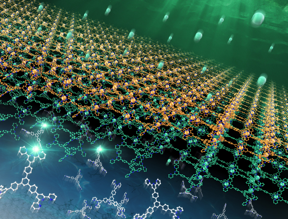 This image depicts the formation of the second layer in a heterolayer coordination nanosheet. Cobalt ions pass through the preexisting first layer (composed of iron coordination centers and terpyridine ligands), which has formed at the liquid�liquid interface between water and dichloromethane. They then assemble into coordinated layers by combining with terpyridine ligands.
CREDIT
Hiroshi Nishihara from Tokyo University of Science
This image depicts the formation of the second layer in a heterolayer coordination nanosheet. Cobalt ions pass through the preexisting first layer (composed of iron coordination centers and terpyridine ligands), which has formed at the liquid�liquid interface between water and dichloromethane. They then assemble into coordinated layers by combining with terpyridine ligands.
CREDIT
Hiroshi Nishihara from Tokyo University of Science
Abstract: The past few decades have witnessed a great amount of research in the field of two-dimensional (2D) materials. As the name implies, these thin film-like materials are composed of layers that are only a few atoms thick. Many of the chemical and physical properties of 2D materials can be fine-tuned, leading to promising applications in many fields, including optoelectronics, catalysis, renewable energy, and more.
Tokyo, Japan | Posted on July 22nd, 2022
Coordination nanosheets are one particularly interesting type of 2D material. The �coordination� refers to the effect of metallic ions in these molecules, which act as coordination centers. These centers can spontaneously create organized molecular dispositions that span multiple layers in 2D materials. This has attracted the attention of materials scientists due to their favorable properties. In fact, we have only begun to scratch the surface regarding what heterolayer coordination nanosheets � coordination nanosheets whose layers have different atomic composition � can offer.
In a recent study published first on June 13, 2022, and featured on the front cover of Chemistry�A European Journal, a team of scientists from Tokyo University of Science (TUS) and The University of Tokyo in Japan reported a remarkably simple way to synthesize heterolayer coordination nanosheets. Composed of the organic ligand, terpyridine, coordinating iron and cobalt, these nanosheets assemble themselves at the interface between two immiscible liquids in a peculiar way. The study, led by Prof. Hiroshi Nishihara from TUS, also included contributions from Mr. Joe Komeda, Dr. Kenji Takada, Dr. Hiroaki Maeda, and Dr. Naoya Fukui from TUS.
To synthesize the heterolayer coordination nanosheets, the team first created the liquid�liquid interface to enable their assembly. They dissolved tris(terpyridine) ligand in dichloromethane (CH2Cl2), an organic liquid that does not mix with water. They then poured a solution of water and ferrous tetrafluoroborate, an iron-containing chemical, on top of the CH2Cl2. After 24 hours, the first layer of the coordination nanosheet, bis(terpyridine)iron (or �Fe-tpy�), formed at the interface between both liquids.
Following this, they removed the iron-containing water and replaced it with cobalt-containing water. In the next few days, a bis(terpyridine)cobalt (or �Co-tpy�) layer formed right below the iron-containing one at the liquid�liquid interface.
The team made detailed observations of the heterolayer using various advanced techniques, such as scanning electron microscopy, X-ray photoelectron spectroscopy, atomic force microscopy, and scanning transmission electron microscopy. They found that the Co-tpy layer formed neatly below the Fe-tpy layer at the liquid�liquid interface. Moreover, they could control the thickness of the second layer depending on how long they left the synthesis process run its course.
Interestingly, the team also found that the ordering of the layers could be swapped by simply changing the order of the synthesis steps. In other words, if they first added a cobalt-containing solution and then replaced it with an iron-containing solution, the synthesized heterolayer would have cobalt coordination centers on the top layer and iron coordination centers on the bottom layer. �Our findings indicate that metal ions can go through the first layer from the aqueous phase to the CH2Cl2 phase to react with terpyridine ligands right at the boundary between the nanosheet and the CH2Cl2 phase,� explains Prof. Nishihara. �This is the first ever clarification of the growth direction of coordination nanosheets at a liquid/liquid interface.�
Additionally, the team investigated the reduction�oxidation properties of their coordination nanosheets as well as their electrical rectification characteristics. They found that the heterolayers behaved much like a diode in a way that is consistent with the electronic energy levels of Co-tpy and Fe-tpy. These insights, coupled with the easy synthesis procedure developed by the team, could help in the design of heterolayer nanosheets made of other materials and tailored for specific electronics applications. �Our synthetic method could be applicable to other coordination polymers synthesized at liquid�liquid interfaces,� highlights Prof. Nishihara. �Therefore, the results of this study will expand the structural and functional diversity of molecular 2D materials.�
With eyes set on the future, the team will keep investigating chemical phenomena occurring at liquid�liquid interfaces, elucidating the mechanisms of mass transport and chemical reactions. Their findings can help expand the design of 2D materials and, hopefully, lead to better performance of optoelectronic devices, such as solar cells.
####
About Tokyo University of ScienceTokyo University of Science (TUS) is a well-known and respected university, and the largest science-specialized private research university in Japan, with four campuses in central Tokyo and its suburbs and in Hokkaido. Established in 1881, the university has continually contributed to Japan's development in science through inculcating the love for science in researchers, technicians, and educators.
With a mission of �Creating science and technology for the harmonious development of nature, human beings, and society", TUS has undertaken a wide range of research from basic to applied science. TUS has embraced a multidisciplinary approach to research and undertaken intensive study in some of today's most vital fields. TUS is a meritocracy where the best in science is recognized and nurtured. It is the only private university in Japan that has produced a Nobel Prize winner and the only private university in Asia to produce Nobel Prize winners within the natural sciences field.
Website: https://www.tus.ac.jp/en/mediarelations/
About Professor Hiroshi Nishihara from Tokyo University of Science
Dr. Hiroshi Nishihara is a Professor of Chemistry at Tokyo University of Science in Japan. He is a distinguished professor, researcher, and pioneer in the field of electrochemistry and the synthesis of conductive metal complex polymers. His research is focused on the creation of new electro- and photo-functional materials comprising both transition metals and π-conjugated chains, as well as the invention of unidirectional electron transfer systems using molecular layer interfaces. He has published more than 467 papers with over 14911 citations to his credit.
Funding information
This study was financially supported by JST-CREST JPMJCR15F2, JSPS KAKENHI (grant no. JP19H05460), and the White Rock Foundation.
For more information, please click here
Contacts:Hiroshi MatsudaTokyo University of Science
Copyright © Tokyo University of Science
If you have a comment, please Contact us.
Issuers of news releases, not 7th Wave, Inc. or Nanotechnology Now, are solely responsible for the accuracy of the content.
Bookmark:


News and information
 Scientists unravel �Hall effect� mystery in search for next generation memory storage devices August 19th, 2022
Researchers design new inks for 3D-printable wearable bioelectronics: Potential uses include printing electronic tattoos for medical tracking applications August 19th, 2022
2 Dimensional Materials
Buckyballs on gold are less exotic than graphene July 22nd, 2022
Chemistry
First electric nanomotor made from DNA material: Synthetic rotary motors at the nanoscale perform mechanical work July 22nd, 2022
A novel graphene based NiSe2 nanocrystalline array for efficient hydrogen evolution reaction July 15th, 2022
Possible Futures
New chip ramps up AI computing efficiency August 19th, 2022
Rice team eyes cells for sophisticated data storage: National Science Foundation backs effort to turn living cells into equivalent of computer RAM August 19th, 2022
Chip Technology
New chip ramps up AI computing efficiency August 19th, 2022
Scientists unravel �Hall effect� mystery in search for next generation memory storage devices August 19th, 2022
Researchers design new inks for 3D-printable wearable bioelectronics: Potential uses include printing electronic tattoos for medical tracking applications August 19th, 2022
Optical computing/Photonic computing
Deep-ultraviolet nonlinear optical crystals: Concept development and materials discovery July 8th, 2022
Photoinduced large polaron transport and dynamics in organic-inorganic hybrid lead halide perovskite with terahertz probes July 8th, 2022
Photonic synapses with low power consumption and high sensitivity are expected to integrate sensing-memory-preprocessing capabilities July 1st, 2022
Materials/Metamaterials
Strain-sensing smart skin ready to deploy: Nanotube-embedded coating detects threats from wear and tear in large structures July 15th, 2022
New protocol for assessing the safety of nanomaterials July 1st, 2022
Nanotubes: a promising solution for advanced rubber cables with 60% less conductive filler June 1st, 2022
A one-stop shop for quantum sensing materials May 27th, 2022
Interviews/Book Reviews/Essays/Reports/Podcasts/Journals/White papers/Posters
Scientists unravel �Hall effect� mystery in search for next generation memory storage devices August 19th, 2022
Researchers design new inks for 3D-printable wearable bioelectronics: Potential uses include printing electronic tattoos for medical tracking applications August 19th, 2022
Visualizing nanoscale structures in real time: Open-source software enables researchers to see materials in 3D while they're still on the electron microscope August 19th, 2022
Energy
Generating power where seawater and river water meet July 22nd, 2022
A novel graphene based NiSe2 nanocrystalline array for efficient hydrogen evolution reaction July 15th, 2022
Solar/Photovoltaic
Photoinduced large polaron transport and dynamics in organic-inorganic hybrid lead halide perovskite with terahertz probes July 8th, 2022
Key in increasing efficiency of next-generation solar cell, found in �light absorption capacity�! July 1st, 2022
Solving the solar energy storage problem with rechargeable batteries that can convert and store energy at once June 24th, 2022
