
Ultrafast quantum computing that relies on lasers to manipulate cold atoms trapped with optical tweezers is expected to support a quantum computer architecture that breaks through the limitations of the superconducting and trapped-ion types currently in development, the researchers said.
Cold-atom quantum computers are based on laser cooling and trapping techniques, which yielded Nobel Prizes in 1997 and 2018. These techniques, together with additional breakthroughs, have enabled scientists to develop the ability to arrange arrays of cold atoms in arbitrary shapes with optical tweezers, and to observe each one individually.
Because atoms are natural quantum systems, they are favored as qubits. In addition, because these atoms are well isolated from the surrounding environment and independent of each other, the coherence time of a qubit can reach several seconds. A two-qubit gate, which is considered an essential basic arithmetic element for quantum computing, is performed by exciting one electron of the atom into a giant electronic orbital, called a Rydberg orbital.
The cold-atom platform has emerged as a promising candidate for quantum computer hardware. The platform can be easily scaled up while maintaining high coherence compared to the superconducting and trapped-ion types that are currently being developed.
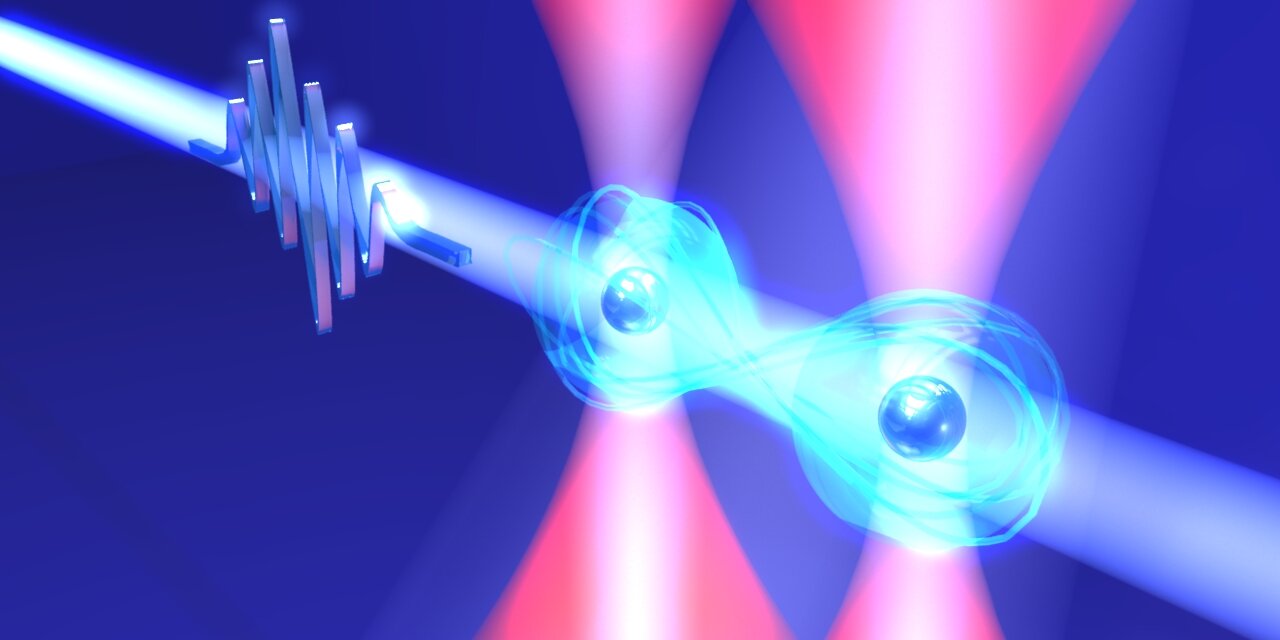
In the current research, the implemented two-qubit gate is called a “controlled-Z gate,” which is an operation that flips the quantum superposition of a first qubit from 0 + 1 to 0 − 1 depending on the state (0 or 1) of a second qubit. The accuracy, or fidelity, of the quantum gate is degraded by noise from the external environment and the operating laser, which makes the development of quantum computers difficult.
Since the timescale of noise is generally slower than 1 μs, if a quantum gate that is sufficiently faster than this interval can be realized, it will be possible to avoid the degradation of calculation accuracy due to noise and avoid a bottleneck that has so far inhibited realizing a practical quantum computer.
The team used rubidium atoms, in the gas phase, cooled to almost absolute zero, and trapped in optical tweezers separated by a distance of roughly 1 μm, to realize what it said is the fastest two-qubit gate between two single atoms to be demonstrated.
After it arranged the atoms, the team irradiated them with ultrashort laser pulses that emitted light for 1/100 billionth of a second. The researchers observed that two electrons trapped respectively in the smallest orbitals of two adjacent atoms were knocked into Rydberg orbitals. The interaction between these giant atoms then led to a periodic, back-and-forth exchange of the orbital shape and electron energy occurring with a period of 6.5 ns, which was more than two orders of magnitude faster than noise.
The research was published in Nature Photonics (www.doi.org/10.1038/s41566-022-01047-2).
