
| Date | 26th, Aug 2022 |
|---|
Home > Press > An alternative to MINFLUX that enables nanometre resolution in a confocal microscope
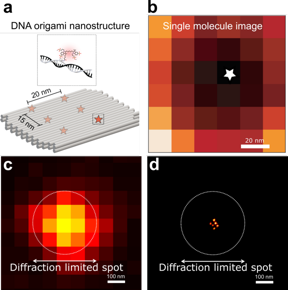 a. Schematic of the DNA origami used to place six fluorophores in a rectangular arrangement. b. Image of a single molecule obtained with RASTMIN. c. Diffraction limited image of the DNA origami. d. Super resolved image of the DNA origami using RASTMIN.
CREDIT
by Luciano A. Masullo, Alan M. Szalai, Luc�a F. Lopez, Mauricio Pilo-Pais, Guillermo P. Acuna, and Fernando D. Stefani
a. Schematic of the DNA origami used to place six fluorophores in a rectangular arrangement. b. Image of a single molecule obtained with RASTMIN. c. Diffraction limited image of the DNA origami. d. Super resolved image of the DNA origami using RASTMIN.
CREDIT
by Luciano A. Masullo, Alan M. Szalai, Luc�a F. Lopez, Mauricio Pilo-Pais, Guillermo P. Acuna, and Fernando D. Stefani
Abstract: Fluorescence microscopy is a major workhorse in life sciences, biophysics, and physical chemistry, as it allows visualization with great specificity and sensitivity. In particular, the detection of single fluorescent molecules has been used to provide information beyond ensemble averages with applications in different fields of research. For example, super-resolution methods based on the localization of single emitters have been used in the last 15 years to study biological systems with unprecedented spatial resolution in the 10-50 nm range, and even enabling the discovery of supramolecular cellular structures. On the other hand, single-molecule tracking has enabled to study individual trajectories of relevant targets that would be otherwise hidden in the average behaviour of an ensemble of unsynchronized molecules.
Changchun, China | Posted on August 26th, 2022
Most commonly, the position of a single fluorescent molecule is obtained from a fit to its image recorded in a scientific camera. However, this kind of approaches can barely surpass the 10-nm resolution barrier because of the photostability of the fluorescent dyes. In this way, the closest environment around a target (with typical size of 1-5 nm) cannot be interrogated. Alternatively, other approaches infer the molecular position from the signal registered upon excitation with a sequence of spatially shifted patterns of light. These methods, particularly when using a minimum of light intensity, have been demonstrated to be more efficient to obtain the molecular coordinates. In particular, the so-called MINFLUX technique has been proved to achieve 1-2 nm localization precision with moderate number of photons. However, the high technical complexity of MINFLUX and other related techniques has hampered its widespread application.
In a new paper published in Light: Science & Applications, a team of scientists, led by Professor Fernando Stefani from Centro de Investigaciones en Bionanociencias (CIBION), Consejo Nacional de Investigaciones Cient�ficas y T�cnicas (CONICET, Argentina), in cooperation with the group of Prof. Guillermo Acuna at the University of Fribourg (Switzerland), have developed RASTMIN, a method that delivers equivalent resolution to MINFLUX, but can be implemented in standard confocal microscopes. In RASTMIN, only two main modifications to a confocal microscope need to be implemented. On the one hand, a doughnut-shaped focus has to be generated. On the other hand, the sample needs to be actively stabilized relative to the optical system. Apart from these two conditions, that are also needed in MINFLUX, no further modifications are required. For example, RASTMIN uses scanning and data acquisition routines available in any standard confocal microscope, and hence the control software already installed in any confocal setup can still be used to perform RASTMIN.
In the paper, the authors demonstrate the performance of RASTMIN by obtaining super-resolved images of fluorophores in a tailored DNA nanostructures (a DNA origami) achieving a localization precision of 1-2 nm. They also combine RASTMIN with fluorescence lifetime imaging.
The authors anticipate that RASTMIN will pave the route to new discoveries in life sciences:
�The structure and function of biological matter is shaped through the assembly and interaction of biomolecules at the nanoscale. In some cases, changing the spatial arrangement of certain proteins in the nanometer scale, or even changing the conformational state of a single protein can lead to a biological response of an entire cell. So far, fluorescence imaging with nanometer-scale resolution has been limited to a reduced number of expert groups. With RASTMIN, because it can be easily implemented in existing laser-scanning microscopes, we foresee that many more groups will now access to this new regime of spatial resolution, increasing the number of biological questions addressed and discoveries.� said Professor Stefani.
�Of course, fully exploiting the resolution power of RASTMIN will raise new challenges. For example, it will require the implementation of labeling strategies that do not artificially increase the size of the target molecules. This is a general issue for molecular-scale resolution techniques, and many labs around the world are currently devoting efforts to develop labeling strategies that minimize this problem. We expect that the introduction of RASTMIN will represent a breakthrough since it will make nm-scale nanoscopy accessible to a significantly broader community, encouraging scientists from different fields to develop tools to keep improving and easing this type of techniques.�
####
For more information, please click here
Contacts:Yaobiao LiLight Publishing Center, Changchun Institute of Optics, Fine Mechanics And Physics, CAS
Office: 86-431-861-76851
Expert Contact
Fernando D. StefaniUniversidad de Buenos Aires, Argentina
Copyright © Light Publishing Center, Changchun Institute of Optics, Fine Mechanics And Physics, CAS
If you have a comment, please Contact us.
Issuers of news releases, not 7th Wave, Inc. or Nanotechnology Now, are solely responsible for the accuracy of the content.
Bookmark:


Imaging
News and information
 Solvent study solves solar cell durability puzzle: Rice-led project could make perovskite cells ready for prime time September 23rd, 2022
Heat-resistant nanophotonic material could help turn heat into electricity: The key to beating the heat is degrading the materials in advance September 23rd, 2022
Chicago Quantum Exchange welcomes six new partners highlighting quantum technology solutions, from Chicago and beyond September 23rd, 2022
�Twisty� photons could turbocharge next-gen quantum communication: Team�s on-chip technology uses orbital angular momentum to encode more information into a single photon September 23rd, 2022
Possible Futures
Chicago Quantum Exchange welcomes six new partners highlighting quantum technology solutions, from Chicago and beyond September 23rd, 2022
�Twisty� photons could turbocharge next-gen quantum communication: Team�s on-chip technology uses orbital angular momentum to encode more information into a single photon September 23rd, 2022
Wrapping of nanosize copper cubes can help convert carbon dioxide into other chemicals September 23rd, 2022
Upgrading your computer to quantum September 23rd, 2022
Discoveries
�Twisty� photons could turbocharge next-gen quantum communication: Team�s on-chip technology uses orbital angular momentum to encode more information into a single photon September 23rd, 2022
Upgrading your computer to quantum September 23rd, 2022
Key element for a scalable quantum computer: Physicists from Forschungszentrum J�lich and RWTH Aachen University demonstrate electron transport on a quantum chip September 23rd, 2022
Announcements
Heat-resistant nanophotonic material could help turn heat into electricity: The key to beating the heat is degrading the materials in advance September 23rd, 2022
Chicago Quantum Exchange welcomes six new partners highlighting quantum technology solutions, from Chicago and beyond September 23rd, 2022
�Twisty� photons could turbocharge next-gen quantum communication: Team�s on-chip technology uses orbital angular momentum to encode more information into a single photon September 23rd, 2022
Wrapping of nanosize copper cubes can help convert carbon dioxide into other chemicals September 23rd, 2022
Interviews/Book Reviews/Essays/Reports/Podcasts/Journals/White papers/Posters
Modulating MoSe2 functional plane via doping-defect engineering strategy to develop conductive and electrocatalytic mediators in Li-S batteries September 23rd, 2022
Solvent study solves solar cell durability puzzle: Rice-led project could make perovskite cells ready for prime time September 23rd, 2022
Key element for a scalable quantum computer: Physicists from Forschungszentrum J�lich and RWTH Aachen University demonstrate electron transport on a quantum chip September 23rd, 2022
Tools
Atomic level deposition to extend Moore�s law and beyond July 15th, 2022
New technology helps reveal inner workings of human genome June 24th, 2022
Snapshot measurement of single nanostructure�s circular dichroism March 25th, 2022
