
| Date | 23rd, Sep 2022 |
|---|
Home > Press > Key element for a scalable quantum computer: Physicists from Forschungszentrum J�lich and RWTH Aachen University demonstrate electron transport on a quantum chip
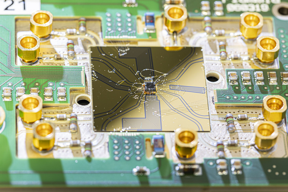 Semiconductor quantum chip with quantum bus of the JARA cooperation of Forschungszentrum J�lich and RWTH Aachen University
CREDIT
Forschungszentrum J�lich / Sascha Kreklau
Semiconductor quantum chip with quantum bus of the JARA cooperation of Forschungszentrum J�lich and RWTH Aachen University
CREDIT
Forschungszentrum J�lich / Sascha Kreklau
Abstract: Millions of quantum bits are required for quantum computers to prove useful in practical applications. The scalability is one of the greatest challenges in the development of future devices. One problem is that the qubits have to be very close to each other on the chip in order to couple them together. Researchers at Forschungszentrum J�lich and RWTH Aachen University have now come a significant step closer to solving the problem. They succeeded in transferring electrons, the carriers of quantum information, over several micrometres on a quantum chip. Their "quantum bus" could be the key component to master the leap to millions of qubits.
Juelich, Germany | Posted on September 23rd, 2022
Quantum computers have the potential to vastly exceed the capabilities of conventional computers for certain tasks. But there is still a long way to go before they can help to solve real-world problems. Many applications require quantum processors with millions of quantum bits. Today�s prototypes merely come up with a few of these compute units.
"Currently, each individual qubit is connected via several signal lines to control units about the size of a cupboard. That still works for a few qubits. But it no longer makes sense if you want to put millions of qubits on the chip. Because that' s necessary for quantum error correction," says Dr. Lars Schreiber from the JARA Institute for Quantum Information at Forschungszentrum J�lich and RWTH Aachen University.
At some point, the number of signal lines becomes a bottleneck. The lines take up too much space compared to the size of the tiny qubits. And a quantum chip cannot have millions of inputs and outputs - a modern classical chip only contains about 2000 of these. Together with colleagues at Forschungszentrum J�lich and RWTH Aachen University, Schreiber has been conducting research for several years to find a solution to this problem.
Their overall goal is to integrate parts of the control electronics directly on the chip. The approach is based on so-called semiconductor spin qubits made of silicon and germanium. This type of qubit is comparatively tiny. The manufacturing processes largely match those of conventional silicon processors. This is considered to be advantageous when it comes to realising very many qubits. But first, some fundamental barriers have to be overcome.
"The natural entanglement that is caused by the proximity of the particles alone is limited to a very small range, about 100 nanometres. To couple the qubits, they currently have to be placed very close to each other. There is simply no space for additional control electronics that we would like to install there," says Schreiber.
To set the qubits apart, the JARA Institute for Quantum Information (IQI) came up with the idea of a quantum shuttle. This special component should help to exchange quantum information between the qubits over greater distances. The researchers have been working on the "quantum bus" for five years and have already filed more than 10 patents. The research began as part of the European QuantERA consortium Si-QuBus and is now being continued in the national project QUASAR of the Federal Ministry of Education and Research (BMBF) together with industrial partners.
"About 10 micrometres have to be bridged from one qubit to the next. According to theory, millions of qubits can be realized with such an architecture. We recently predicted this in collaboration with circuit engineers from the Central Institute for Engineering, Electronics and Analytics at Forschungszentrum J�lich," explains IQI Institute Director Prof. Hendrik Bluhm. Researchers at TU Delft and Intel have also come to this same conclusion.
An important step has now been achieved by Lars Schreiber and his team. They succeeded in transporting an electron 5000 times over a distance of 560 nanometres without any significant errors. This corresponds to a distance of 2.8 millimetres. The results were published in the scientific journal npj Quantum Information.
�Surfing� electrons
One essential improvement: the electrons are driven by means of four simple control signals, which � in contrast to previous approaches � do not become more complex over longer distances. This is important because otherwise extensive control electronics would be required, which would take up too much space � or could not be integrated on the chip at all.
This achievement is based on a new way of transporting electrons. "Until now, people have tried to steer the electrons specifically around individual disturbances on their path. Or they created a series of so-called quantum dots and let the electrons hop from one of these dots to another. Both approaches require precise signal adjustment, which results in too complex control electronics," explains Lars Schreiber. "In contrast, we generate a potential wave on which the electrons simply surf over various sources of interference. A few control signals are sufficient for such a uniform wave; four sinusoidal pulses is all it takes."
As a next step, the physicists now want to show that the qubit information encoded in the electron spin is not lost during transportation. Theoretical calculations have already shown that this is possible in silicon in certain speed ranges. The quantum bus thus paves the way to a scalable quantum computer architecture that can also serve as a basis for several million qubits.
####
For more information, please click here
Contacts:Tobias SchloesserForschungszentrum Juelich
Office: +49-246-161-4771
Expert Contacts
Prof. Hendrik BluhmForschungszentrum J�lich, JARA-Institute Quantum Information (PGI-11)
Dr. Lars SchreiberForschungszentrum J�lich, JARA-Institute Quantum Information (PGI-11)
Copyright © Forschungszentrum Juelich
If you have a comment, please Contact us.
Issuers of news releases, not 7th Wave, Inc. or Nanotechnology Now, are solely responsible for the accuracy of the content.
Bookmark:


News and information
 �Kagome� metallic crystal adds new spin to electronics October 28th, 2022
Improving the efficiency of nanogenerators that harvest static electricity October 28th, 2022
New era of two-dimensional ferroelectrics: Reviewing layered van-der-Waals ferroelectrics for future nanoelectronics October 28th, 2022
Advanced Materials and NanoSystems: Theory and Experiment-Part 1 & 2 October 28th, 2022
Quantum Physics
Lattice distortion of perovskite quantum dots induces coherent quantum beating September 9th, 2022
Bound by light: Glass nanoparticles show unexpected coupling when levitated with laser light August 26th, 2022
Master equation to boost quantum technologies: FQXi-funded analysis will help physicists exert exquisitely precise real-time feedback control over quantum systems August 26th, 2022
Possible Futures
New era of two-dimensional ferroelectrics: Reviewing layered van-der-Waals ferroelectrics for future nanoelectronics October 28th, 2022
Advanced Materials and NanoSystems: Theory and Experiment-Part 1 & 2 October 28th, 2022
Chip Technology
�Kagome� metallic crystal adds new spin to electronics October 28th, 2022
New era of two-dimensional ferroelectrics: Reviewing layered van-der-Waals ferroelectrics for future nanoelectronics October 28th, 2022
Quantum Computing
New measurements quantifying qudits provide glimpse of quantum future October 14th, 2022
Nanoelectronics
Reduced power consumption in semiconductor devices September 23rd, 2022
Atomic level deposition to extend Moore�s law and beyond July 15th, 2022
Controlled synthesis of crystal flakes paves path for advanced future electronics June 17th, 2022
Discoveries
Scientists have proposed a new material for perovskite solar cells: It is cheaper its analogues, easier to manufacture and to modify October 28th, 2022
�Kagome� metallic crystal adds new spin to electronics October 28th, 2022
Improving the efficiency of nanogenerators that harvest static electricity October 28th, 2022
Announcements
Scientists have proposed a new material for perovskite solar cells: It is cheaper its analogues, easier to manufacture and to modify October 28th, 2022
�Kagome� metallic crystal adds new spin to electronics October 28th, 2022
Improving the efficiency of nanogenerators that harvest static electricity October 28th, 2022
New era of two-dimensional ferroelectrics: Reviewing layered van-der-Waals ferroelectrics for future nanoelectronics October 28th, 2022
Interviews/Book Reviews/Essays/Reports/Podcasts/Journals/White papers/Posters
Scientists have proposed a new material for perovskite solar cells: It is cheaper its analogues, easier to manufacture and to modify October 28th, 2022
Improving the efficiency of nanogenerators that harvest static electricity October 28th, 2022
New era of two-dimensional ferroelectrics: Reviewing layered van-der-Waals ferroelectrics for future nanoelectronics October 28th, 2022
Advanced Materials and NanoSystems: Theory and Experiment-Part 1 & 2 October 28th, 2022
Quantum nanoscience
Upgrading your computer to quantum September 23rd, 2022
Lattice distortion of perovskite quantum dots induces coherent quantum beating September 9th, 2022
Master equation to boost quantum technologies: FQXi-funded analysis will help physicists exert exquisitely precise real-time feedback control over quantum systems August 26th, 2022
