
| Date | 30th, Sep 2022 |
|---|
Home > Press > Ultrasmall VN/Co heterostructure with optimized N active sites anchored in N-doped graphitic nanocarbons for boosting hydrogen evolution
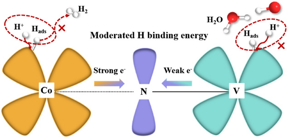 VN, as an early-transition-metal nitride, owns inherent shortage of 3d electron, displaying week electron adsorption ability, thus restraining the continuous formation of Hads. As a late transition metal, Co atom takes the more 3d electron than V atom for granted, which could restrict the release of Hads due to the strong interplay between Co atom and Hads. In consequence, once electron intercoupling of VN and Co proceeds, the electron-rich d-orbitals of Co atoms and the electron-deficient d-orbitals of V atoms will simultaneously transfer electrons to the p-orbitals of bridging N atoms, hence leading to an improved delocalization of electrons among Co, V and N in VN/Co@GNC. When the electron density on Co and V atoms balance, the interactions between N atoms and Hads could be optimized in view of the Sabatier mechanism, which would be conducive to enhancing the adsorption and dissociation of water molecules for upgraded hydrogen production. Art by Chen�s group.
CREDIT
Beijing Zhongke Journal Publising Co. Ltd.
VN, as an early-transition-metal nitride, owns inherent shortage of 3d electron, displaying week electron adsorption ability, thus restraining the continuous formation of Hads. As a late transition metal, Co atom takes the more 3d electron than V atom for granted, which could restrict the release of Hads due to the strong interplay between Co atom and Hads. In consequence, once electron intercoupling of VN and Co proceeds, the electron-rich d-orbitals of Co atoms and the electron-deficient d-orbitals of V atoms will simultaneously transfer electrons to the p-orbitals of bridging N atoms, hence leading to an improved delocalization of electrons among Co, V and N in VN/Co@GNC. When the electron density on Co and V atoms balance, the interactions between N atoms and Hads could be optimized in view of the Sabatier mechanism, which would be conducive to enhancing the adsorption and dissociation of water molecules for upgraded hydrogen production. Art by Chen�s group.
CREDIT
Beijing Zhongke Journal Publising Co. Ltd.
Abstract: This study is led by Dr. Chen (State Key Laboratory of Inorganic Synthesis and Preparative Chemistry, College of Chemistry, Jilin University). Two big problems of growing to deplete of traditional energy and acute environmental pollution have actuated an ongoing demand relating to the exploitation of sustainable green energy that endorses a global carbon-neutral strategy. Hydrogen fuel, which presents high energy density and non-pollution, has been foreseen as ideal green energy. In current industrial hydrogen production ways, electricity-driven water splitting is one of the most promising sustainable hydrogen production technologies, in which electric power can be converted from solar or wind. The hydrogen evolution reaction (HER) is one important half-rection of water splitting, and its art-of-state electrocatalysts highly depend on Pt and Pt-based noble metal materials with the near-zero onset potential and tiptop HER activity. However, the obvious shortcomings of precious metal electrocatalysts lie in the rare reserves and high prices, which largely restrict commercial applications. Therefore, the top priority is developing noble-metal-free substitutes with cost-effective and comparable catalytic performance for HER.
Beijing, China | Posted on September 30th, 2022
In the last decades, numerous efficient non-noble metal catalysts have been exploited for HER, including oxides, carbides, chalcogenides, phosphides, and nitrides. In transition metal nitrides, vanadium nitride (VN), recently attracting much attention for its good electrical conductivity, chemical stability, and corrosion resistance, which could be applied in the realm of fuel cells, batteries, and supercapacitors. Noticeably, VN is also recognized as a characteristic interstitial compound with an electronic structure semblable to Pt, which is considered an ideal electrocatalyst for the HER. In terms of synthesis methods of VN-related electrocatalysts, most of the procedures involved in high-temperature calcination, inescapably lead to particle agglomeration and thus greatly decrease the number of active sites, which results in unsatisfied HER activity. It is well known that constructing an ultrafine structure can increase the number of active sites exposed on the surface of electrocatalysts, which was deemed as an effective pathway to upgrade the activity of the catalyst. The key thought of this method is mainly to form ultrasmall nanoparticles by reducing the particle size, consequently endowing the catalyst with more catalytically active sites. Furthermore, although VN, as a representative early-transition-metal nitride, has tremendous potential to catalyze the HER, its insufficient d-band density still makes it somewhat difficult to generate adsorbed hydrogen (Hads), leading to the undesirable catalytic HER activity of pure VN. Cobalt (Co), a typical late transition metal featuring with fairly substantial reserves and enriched 3d electrons, can be employed to cover the shortage in deficient 3d electrons of the band center of VN, thereby contributing to the electrochemical reactivity. Additionally, it is well documented that N-doped carbon-based materials as skeletons for enhancing the electronic conductivity and dispersity of catalytic materials, favoring the electron transfer and full contact between electrolyte and active substance. Given the above speculations, the elaborated engineering of the N-doped carbon-supported ultrasmall VN/Co hybrid is taken into consideration for improved HER activity in alkaline conditions.
Herein, they reported heterogeneous VN/Co nanoparticles with the ultrasmall structure embedded in N-doped graphitized nanocarbon by a simple calcination protocol. Impressively, the resultant delivered the current density of 10 mA/cm2 at the small overpotential of 155 mV and retained the catalytic durability for at least 565 h (∼23 days) in 1 M KOH solution. This intriguing work highlighted novel tactics of d-electron complementation for engineering metal nitrides as efficient electrocatalysts toward HER. The findings of this work provide a new idea and strategy for the development of industrial super-stable catalysts.
####
For more information, please click here
Contacts:Media Contact
LIngshu QianBeijing Zhongke Journal Publising Co. Ltd.
Expert Contact
Hui ChenState Key Laboratory of Inorganic Synthesis and Preparative Chemistry, College of Chemistry, Jilin University
Copyright © Beijing Zhongke Journal Publising Co. Ltd.
If you have a comment, please Contact us.
Issuers of news releases, not 7th Wave, Inc. or Nanotechnology Now, are solely responsible for the accuracy of the content.
Bookmark:


News and information
 �Kagome� metallic crystal adds new spin to electronics October 28th, 2022
Improving the efficiency of nanogenerators that harvest static electricity October 28th, 2022
New era of two-dimensional ferroelectrics: Reviewing layered van-der-Waals ferroelectrics for future nanoelectronics October 28th, 2022
Advanced Materials and NanoSystems: Theory and Experiment-Part 1 & 2 October 28th, 2022
Possible Futures
New era of two-dimensional ferroelectrics: Reviewing layered van-der-Waals ferroelectrics for future nanoelectronics October 28th, 2022
Advanced Materials and NanoSystems: Theory and Experiment-Part 1 & 2 October 28th, 2022
Discoveries
Scientists have proposed a new material for perovskite solar cells: It is cheaper its analogues, easier to manufacture and to modify October 28th, 2022
�Kagome� metallic crystal adds new spin to electronics October 28th, 2022
Improving the efficiency of nanogenerators that harvest static electricity October 28th, 2022
Announcements
Scientists have proposed a new material for perovskite solar cells: It is cheaper its analogues, easier to manufacture and to modify October 28th, 2022
�Kagome� metallic crystal adds new spin to electronics October 28th, 2022
Improving the efficiency of nanogenerators that harvest static electricity October 28th, 2022
New era of two-dimensional ferroelectrics: Reviewing layered van-der-Waals ferroelectrics for future nanoelectronics October 28th, 2022
Interviews/Book Reviews/Essays/Reports/Podcasts/Journals/White papers/Posters
Scientists have proposed a new material for perovskite solar cells: It is cheaper its analogues, easier to manufacture and to modify October 28th, 2022
Improving the efficiency of nanogenerators that harvest static electricity October 28th, 2022
New era of two-dimensional ferroelectrics: Reviewing layered van-der-Waals ferroelectrics for future nanoelectronics October 28th, 2022
Advanced Materials and NanoSystems: Theory and Experiment-Part 1 & 2 October 28th, 2022
Environment
Scientists have proposed a new material for perovskite solar cells: It is cheaper its analogues, easier to manufacture and to modify October 28th, 2022
Energy
Scientists have proposed a new material for perovskite solar cells: It is cheaper its analogues, easier to manufacture and to modify October 28th, 2022
Improving the efficiency of nanogenerators that harvest static electricity October 28th, 2022
Current and Future Developments in Nanomaterials and Carbon Nanotubes: Applications of Nanomaterials in Energy Storage and Electronics October 28th, 2022
