
| Date | 14th, Oct 2022 |
|---|
Home > Press > Physicists from the University of Warsaw and the Military University of Technology have developed a new photonic system with electrically tuned topological features
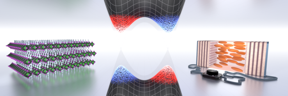 Electrically tuned Berry curvature and strong light-matter coupling in the liquid crystal cavity with perovskite at room temperature� (visualisation: Mateusz Krol, source: Faculty of Physics, University of Warsaw)
CREDIT
Mateusz Krol, source: Faculty of Physics, University of Warsaw
Electrically tuned Berry curvature and strong light-matter coupling in the liquid crystal cavity with perovskite at room temperature� (visualisation: Mateusz Krol, source: Faculty of Physics, University of Warsaw)
CREDIT
Mateusz Krol, source: Faculty of Physics, University of Warsaw
Abstract: Scientists from the Faculty of Physics at the University of Warsaw in cooperation with the Military University of Technology, the Italian CNR Nanotec, the British University of Southampton and the University of Iceland obtained a new photonic system with electrically tuned topological features, constructed of perovskites and liquid crystals. You can read about the discovery, that can be used in the creation of efficient and unconventional light sources, in the latest "Science Advances".
Warsaw, Poland | Posted on October 14th, 2022
Perovskites are materials that have a chance to revolutionize energy. These are durable and easy-to-produce materials, the special property of which is a high solar light absorption coefficient and therefore are used to build new, more efficient photovoltaic cells. In recent years, the emission properties of these materials, so far underestimated, have been used.
� We noticed that two-dimensional perovskites are very stable at room temperature, have high exciton binding energy and high quantum efficiency � describes PhD student Karolina Lempicka-Mirek from the Faculty of Physics at the University of Warsaw, the first author of the publication - These special properties can be used in the construction of efficient and unconventional light sources. This is important for applications in new photonic systems. - In particular, it is planned to use perovskites for information processing with high energy efficiency � adds Barbara Pietka, researcher from University of Warsaw.
Scientists managed to create a system in which excitons in a two-dimensional perovskite were strongly coupled with photons trapped in a birefringent photonic structure: a two-dimensional optical cavity filled with a liquid crystal. � In such a regime, new quasiparticles are created: excitonic polaritons, which are known primarily for the possibility of phase transition to non-equilibrium Bose-Einstein condensate, the formation of superfluid states at room temperature and strong light emission similar to laser light � explains Barbara Pietka.
� Our system turned out to be an ideal platform for creating photonic energy bands with non-zero Berry curvature and studying optical spin-orbit effects mimicking those previously observed in semiconductor physics at cryogenic temperatures � explains Mateusz Krol PhD student from the Faculty of Physics at the University of Warsaw. � In this case, we recreated the Rashba-Dresselhaus spin-orbit coupling in the strong light-matter coupling regime at room temperature.
� The generation of a polariton band with a non-zero Berry curvature was possible thanks to designing a special twist of the liquid crystal molecules at the surface of the mirrors � explains the co-author of the study, Wiktor Piecek from the Military University of Technology, where the tested optical cavities were fabricated.
� Berry curvature describes quantitatively the topological properties of energy bands in materials such as 3D topological insulators, Weil semi-metals and Dirac materials � explains Helgi Sigurdsson from the University of Iceland. � It plays primarily a key role in anomalous transport and the quantum Hall effect. In recent years, many ground-breaking experiments have been carried out in the design and study of geometric and topological energy bands in ultracold atomic gasses and photonics.
� The photonic structure developed in this work, using the spin-orbit coupling and the properties of polaritons, opens the way to study the topological states of light fluids at room temperature � explains Jacek Szczytko from the Faculty of Physics at the University of Warsaw. � Moreover, it can be used in optical neuromorphic networks, where precise control over nonlinear properties of photons is necessary � adds Barbara Pietka.
An international team of scientists conducted research supported, among others, by the National Science Center (grants 2017/27/B/ST3/00271, 2018/31/N/ST3/03046), NAWA Canaletto grant PPN/BIT/2021/1/00124/U/00001, European Union FET-Open program Horizon 2020, grant "TopoLight" (964770).
####
About University of Warsaw, Faculty of PhysicsPhysics and astronomy at the University of Warsaw appeared in 1816 as part of the then Faculty of Philosophy. In 1825, the Astronomical Observatory was established. Currently, the Faculty of Physics at the University of Warsaw consists of the following institutes: Experimental Physics, Theoretical Physics, Geophysics, the Department of Mathematical Methods and the Astronomical Observatory. The research covers almost all areas of modern physics, on scales from quantum to cosmological. The Faculty's research and teaching staff consist of over 200 academic teachers, 81 of whom are professors. About 1,000 students and over 170 doctoral students study at the Faculty of Physics at the University of Warsaw.
For more information, please click here
Contacts:Media Contact
Agata MeissnerUniversity of Warsaw, Faculty of Physics
Office: 225-532-573Expert Contact
Barbara PietkaFaculty of Physics University of Warsaw
Office: +48 55 32 764
Copyright © University of Warsaw, Faculty of Physics
If you have a comment, please Contact us.
Issuers of news releases, not 7th Wave, Inc. or Nanotechnology Now, are solely responsible for the accuracy of the content.
Bookmark:


News and information
 �Kagome� metallic crystal adds new spin to electronics October 28th, 2022
Improving the efficiency of nanogenerators that harvest static electricity October 28th, 2022
New era of two-dimensional ferroelectrics: Reviewing layered van-der-Waals ferroelectrics for future nanoelectronics October 28th, 2022
Advanced Materials and NanoSystems: Theory and Experiment-Part 1 & 2 October 28th, 2022
Display technology/LEDs/SS Lighting/OLEDs
Liquid crystal templated chiral nanomaterials October 14th, 2022
Research improves upon conventional LED displays: With new technology, LEDs can be more cost-efficient and last longer September 9th, 2022
�Life-like� lasers can self-organise, adapt their structure, and cooperate July 15th, 2022
Possible Futures
New era of two-dimensional ferroelectrics: Reviewing layered van-der-Waals ferroelectrics for future nanoelectronics October 28th, 2022
Advanced Materials and NanoSystems: Theory and Experiment-Part 1 & 2 October 28th, 2022
Chip Technology
�Kagome� metallic crystal adds new spin to electronics October 28th, 2022
New era of two-dimensional ferroelectrics: Reviewing layered van-der-Waals ferroelectrics for future nanoelectronics October 28th, 2022
Optical computing/Photonic computing
Current and Future Developments in Nanomaterials and Carbon Nanotubes: Applications of Nanomaterials in Energy Storage and Electronics October 28th, 2022
New measurements quantifying qudits provide glimpse of quantum future October 14th, 2022
Discoveries
Scientists have proposed a new material for perovskite solar cells: It is cheaper its analogues, easier to manufacture and to modify October 28th, 2022
�Kagome� metallic crystal adds new spin to electronics October 28th, 2022
Improving the efficiency of nanogenerators that harvest static electricity October 28th, 2022
Announcements
Scientists have proposed a new material for perovskite solar cells: It is cheaper its analogues, easier to manufacture and to modify October 28th, 2022
�Kagome� metallic crystal adds new spin to electronics October 28th, 2022
Improving the efficiency of nanogenerators that harvest static electricity October 28th, 2022
New era of two-dimensional ferroelectrics: Reviewing layered van-der-Waals ferroelectrics for future nanoelectronics October 28th, 2022
Interviews/Book Reviews/Essays/Reports/Podcasts/Journals/White papers/Posters
Scientists have proposed a new material for perovskite solar cells: It is cheaper its analogues, easier to manufacture and to modify October 28th, 2022
Improving the efficiency of nanogenerators that harvest static electricity October 28th, 2022
New era of two-dimensional ferroelectrics: Reviewing layered van-der-Waals ferroelectrics for future nanoelectronics October 28th, 2022
Advanced Materials and NanoSystems: Theory and Experiment-Part 1 & 2 October 28th, 2022
Photonics/Optics/Lasers
New measurements quantifying qudits provide glimpse of quantum future October 14th, 2022
�Twisty� photons could turbocharge next-gen quantum communication: Team�s on-chip technology uses orbital angular momentum to encode more information into a single photon September 23rd, 2022
