
| Date | 14th, Oct 2022 |
|---|
Home > Press > Liquid crystal templated chiral nanomaterials
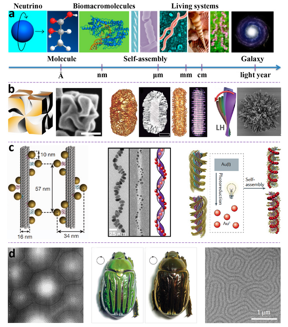 image: a, Chirality at various hierarchical scales. b, Chiral nanomaterials with intrinsic chirality prepared by enantioselective synthesis. c, Chiral nanomaterials based on different soft templates (left-to-right): DNA-, peptide-, and chiral gelator-directed self-assembly of achiral nanoparticles. d, Chiral liquid crystalline nanoarchitecture observed in beetles and biomimetic system. (Left) Atomic force microscopy image of the beetle exoskeleton. (Middle) Beetle exoskeletons under left- and right-handed circularly polarized light. (Right) Scanning electron microscope image showing the self-assembly of platinum nanoparticles around the fingerprint of a cholesteric liquid-crystalline template. view more
Credit: by Xuan Zhang, Yiyi Xu, Cristian Valenzuela, Xin Fang Zhang, Ling Wang, Wei Feng, and Quan Li
image: a, Chirality at various hierarchical scales. b, Chiral nanomaterials with intrinsic chirality prepared by enantioselective synthesis. c, Chiral nanomaterials based on different soft templates (left-to-right): DNA-, peptide-, and chiral gelator-directed self-assembly of achiral nanoparticles. d, Chiral liquid crystalline nanoarchitecture observed in beetles and biomimetic system. (Left) Atomic force microscopy image of the beetle exoskeleton. (Middle) Beetle exoskeletons under left- and right-handed circularly polarized light. (Right) Scanning electron microscope image showing the self-assembly of platinum nanoparticles around the fingerprint of a cholesteric liquid-crystalline template. view more
Credit: by Xuan Zhang, Yiyi Xu, Cristian Valenzuela, Xin Fang Zhang, Ling Wang, Wei Feng, and Quan Li
Abstract: Chirality is omnipresent in living organisms and nature. Chiral architectures can be found at a variety of hierarchical levels, ranging from atomic, molecular to supramolecular, macroscopic, and galactic scales. However, chirality at a molecular scale is inherently weak, and extending the chirality from molecules to nanomaterials could bring many new opportunities for the design and synthesis of emerging chiral functional nanomaterials with a remarkable improvement in chiroptical properties. Chiral nanomaterials can be realized from directed self-assembly of nanoscale achiral functional building blocks using various chiral soft templates such as DNA, peptide and protein, liquid crystal (LC), chiral polymer, and organogelators. Among the different chiral soft templates, liquid-crystalline soft templates are highly attractive due to their inherent long-range ordered molecular assemblies that couple liquid fluidity with crystal ordering from molecular to macroscopic hierarchical levels. Recently, many researchers have devoted themselves to the design and synthesis of advanced chiral functional nanomaterials using liquid crystalline soft templates. Benefiting from chiral self-assembly feature of diverse chiral liquid-crystalline phases, it is possible to transfer their chirality and periodicity into functional nanomaterials with unique and unprecedented functionalities.
Changchun, China | Posted on October 14th, 2022
In an invited review paper published on Featured Issue of Advanced Liquid Crystal Photonics in Light Science & Application, Professor Ling Wang and Wei Feng from School of Materials Science and Engineering, Tianjin University, China, Professor Quan Li from Institute of Advanced Materials and School of Chemistry and Chemical Engineering, Southeast University, China, and their co-workers have presented a comprehensive review of the state-of-the-art advances of liquid crystal-templated chiral nanomaterials and their promising applications. First, the critical chiroptical properties of chiral nanomaterials are introduced. Then, an overview of chiral functional nanomaterials is showcased, which includes chiral plasmonic nanomaterials based on thermotropic and lyotropic liquid crystal templates, as well as chiral luminescent nanomaterials based on different nanoscale building blocks, such as emerging inorganic quantum dots, perovskite nanocrystals, and upconversion nanoparticles. Finally, this review concludes with a perspective on the emerging applications, challenges, and future opportunities of such fascinating chiral nanomaterials. This review can not only deepen our understanding of the fundamentals of soft matter chirality, but also shine light on the development of advanced chiral functional nanomaterials toward their versatile applications in optics, biology, catalysis, electronics, and beyond.
�Compared to emerging DNA-based soft templates, chiral liquid-crystalline templates are faster, less expensive, and more adaptable to guide the self-assembly of nanoscale building blocks into arbitrary and high-order chiral nanomaterials over a larger range of scales, thanks to their inherent long-range ordered molecular arrangements that combine the liquid fluidity with crystal ordering from atomic-molecular to macroscopic levels. Different thermotropic and lyotropic liquid crystal templates have been applied for fabricating chiral plasmonic nanomaterials with enhanced circular dichroism (CD), amplified dissymmetry factor, and dynamic chiroptical responses, which are of paramount significance for many potential applications, such as negative-refractive-index materials, ultrasensitive biosensing, enantioselective analysis, and beyond. A variety of emerging nanoscale functional building blocks, such as inorganic quantum dots, perovskite nanocrystals, and upconversion nanoparticles, have been employed for the design and synthesis of novel chiral luminescent nanomaterials exhibiting significantly enhanced circularly polarized luminescence, which could find important applications in many emerging fields, such as biological science, 3D display, information encryption, chiral spintronics, and enantioselective photochemistry.� Ling Wang and Quan Li stressed.
�Despite the great achievements, the development of chiral functional nanomaterials based on bottom-up soft template strategy remains in its early stages, and there are still many challenges to be addressed for motivating breakthrough research in this significant field. The first one is to develop chiral functional nanomaterials with high optical asymmetry g-factors (gabs for absorption and glum for luminescence), as the reported values are still far from the theoretical value of �2. The second one is to endow the chiral functional nanomaterials with tunable chiroptical activity to diverse target wavelengths ranging from the ultraviolet, visible, near-infrared to terahertz regions. Importantly, more attentions in the future research should be paid to bridge the research gap from the proof-of-concept on a laboratory scale to the large-scale synthesis of chiral functional nanomaterials and their integration into multi-material hierarchical architectures and even more complex advanced functional devices.� they added.
�The unique combination of liquid crystalline nanoscience with nanoscale chirality and emerging bottom-up self-assembly will pour vitality into the development of programmable and reconfigurable chiral functional nanomaterials with unlimited possibilities. Future endeavors of scientists and engineers from multidisciplinary research backgrounds will certainly bring new twists into fundamental breakthrough and technological applications of emerging soft-matter chirality and truly advanced chiral functional nanomaterials which embrace biology, optics, electronics, spintronics, physics, chemistry, materials science, device engineering, and other interdisciplinary areas.� they forecast.
####
For more information, please click here
Contacts:Media Contact
Yaobiao LiLight Publishing Center, Changchun Institute of Optics, Fine Mechanics And Physics, CAS
Office: 86-431-861-76851Expert Contact
Ling WangTianjin University, China
Copyright © Light Publishing Center, Changchun Institute of Optics, Fine Mechanics And Physics, CAS
If you have a comment, please Contact us.
Issuers of news releases, not 7th Wave, Inc. or Nanotechnology Now, are solely responsible for the accuracy of the content.
Bookmark:


Chemistry
 Wrapping of nanosize copper cubes can help convert carbon dioxide into other chemicals September 23rd, 2022
New catalyst offers a more affordable way to produce hydrogen from seawater September 9th, 2022
News and information
�Kagome� metallic crystal adds new spin to electronics October 28th, 2022
Improving the efficiency of nanogenerators that harvest static electricity October 28th, 2022
New era of two-dimensional ferroelectrics: Reviewing layered van-der-Waals ferroelectrics for future nanoelectronics October 28th, 2022
Advanced Materials and NanoSystems: Theory and Experiment-Part 1 & 2 October 28th, 2022
Display technology/LEDs/SS Lighting/OLEDs
Physicists from the University of Warsaw and the Military University of Technology have developed a new photonic system with electrically tuned topological features October 14th, 2022
Possible Futures
New era of two-dimensional ferroelectrics: Reviewing layered van-der-Waals ferroelectrics for future nanoelectronics October 28th, 2022
Advanced Materials and NanoSystems: Theory and Experiment-Part 1 & 2 October 28th, 2022
Spintronics
�Kagome� metallic crystal adds new spin to electronics October 28th, 2022
Synthesis of air-stable room-temperature van der Waals magnetic thin flakes September 30th, 2022
New road towards spin-polarised currents September 9th, 2022
Self Assembly
Nanoclusters self-organize into centimeter-scale hierarchical assemblies April 22nd, 2022
Atom by atom: building precise smaller nanoparticles with templates March 4th, 2022
Nanostructures get complex with electron equivalents: Nanoparticles of two different sizes break away from symmetrical designs January 14th, 2022
Discoveries
Scientists have proposed a new material for perovskite solar cells: It is cheaper its analogues, easier to manufacture and to modify October 28th, 2022
�Kagome� metallic crystal adds new spin to electronics October 28th, 2022
Improving the efficiency of nanogenerators that harvest static electricity October 28th, 2022
Materials/Metamaterials
Advanced Materials and NanoSystems: Theory and Experiment-Part 1 & 2 October 28th, 2022
Announcements
Scientists have proposed a new material for perovskite solar cells: It is cheaper its analogues, easier to manufacture and to modify October 28th, 2022
�Kagome� metallic crystal adds new spin to electronics October 28th, 2022
Improving the efficiency of nanogenerators that harvest static electricity October 28th, 2022
New era of two-dimensional ferroelectrics: Reviewing layered van-der-Waals ferroelectrics for future nanoelectronics October 28th, 2022
Interviews/Book Reviews/Essays/Reports/Podcasts/Journals/White papers/Posters
Scientists have proposed a new material for perovskite solar cells: It is cheaper its analogues, easier to manufacture and to modify October 28th, 2022
Improving the efficiency of nanogenerators that harvest static electricity October 28th, 2022
New era of two-dimensional ferroelectrics: Reviewing layered van-der-Waals ferroelectrics for future nanoelectronics October 28th, 2022
Advanced Materials and NanoSystems: Theory and Experiment-Part 1 & 2 October 28th, 2022
